

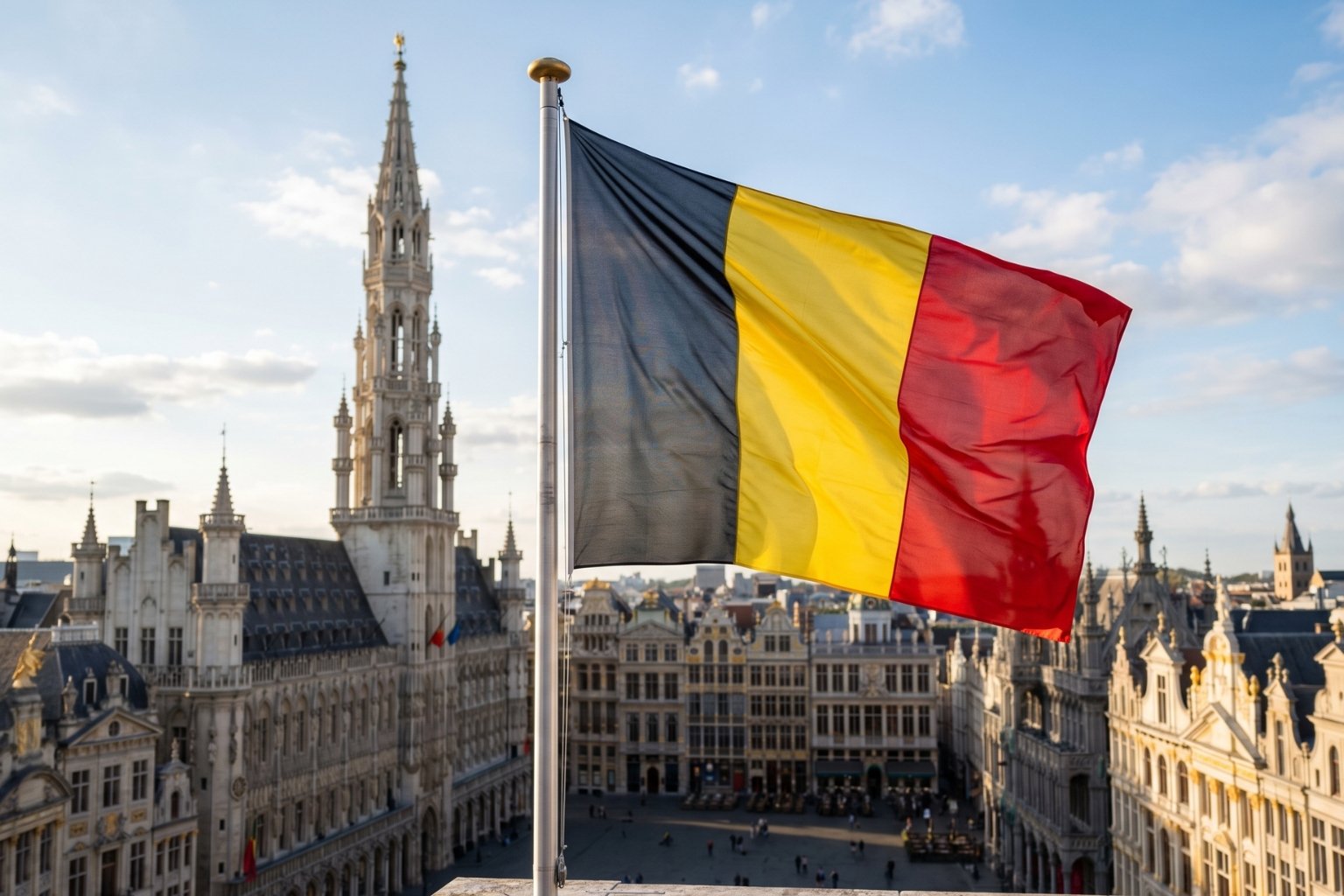

On the morning of August 26, 1830, a French tricolor was flying over the barricades of Brussels. A journalist named Édouard Ducpétiaux walked up, took it down, and replaced it with something else entirely. That gesture, impulsive and deliberate at once, gave Belgium its flag. What he raised that day was not invented from scratch. It was pulled from seven centuries of heraldry, revolution, and shared memory.
What Does the Belgian Flag Look Like?
The Belgian flag is a vertical tricolor of three equal stripes: black at the hoist, yellow at the center, and red at the fly. It is one of the narrower national flags in the world, with an official ratio of 13:15, a proportion so unusual it is rarely replicated and almost never questioned.
For everyday civil use, a more practical 2:3 ratio is standard. Above the Royal Palace in Brussels, the flag is actually displayed in a 4:3 format, adjusted specifically for the angle of view from the street below. These variations are not oversights. They reflect a country that has always been more pragmatic than rigidly symbolic.
No emblem, no coat of arms, no inscription breaks the three bands. The design is deliberately clean, and that restraint is part of what makes it striking.
The Colors and Their Meaning
Black
Black is the oldest color in Belgium’s visual identity. It comes directly from the shield of the Duchy of Brabant, a medieval state whose emblem showed a golden lion on a black background. It also echoes the heraldry of Flanders and Namur, two of the territory’s most powerful historical regions.
Officially, black carries the meaning of strength. Informally, and particularly after the devastation of two World Wars fought on Belgian soil, it has taken on layers of collective mourning that no official decree could quite capture.
Yellow
Yellow is the color of the lion itself, the golden figure that dominated Brabant’s coat of arms for centuries. It speaks to prosperity, light, and centrality, and it is no coincidence that Brabant, the region whose capital is Brussels, was long the economic and political heart of the Low Countries.
In the flag’s official symbolism, yellow stands for wisdom. In practice, it is the color most immediately associated with Belgian identity, the one that shows up on football kits, on city banners, and on the back of the famous Red Devils, whose name borrows, somewhat confusingly, from a different stripe.
Red
Red comes from the claws and tongue of the Brabant lion, what heraldists call armé et lampassé de gueules, armed and tongued in red. It also runs through the heraldry of Hainaut, Limburg, and Luxembourg, regions that form the southern and eastern parts of the country.
The official meaning is courage. The revolutionary connotation is harder to miss. In 1830, red on a barricade meant something specific, and the Belgians who chose these colors knew exactly what they were referencing.
The Heraldic Roots: The Duchy of Brabant
To understand the Belgian flag, you need to go back well before Belgium existed as a state. The Duchy of Brabant was a medieval territory that covered much of what is now central Belgium and part of the southern Netherlands. It was a serious political and economic power in the Holy Roman Empire, and its heraldic identity was correspondingly strong.
A golden lion on a black shield is documented in Brabant’s coat of arms as early as 1234. But the colors were already circulating before that. A rampant lion appeared in the seal of the Count of Flanders in 1162, and its gold-and-black coloring is recorded from 1171. These were not decorative choices. In medieval heraldry, colors carried legal and dynastic weight.
By 1787, those three colors, black, yellow, and red, were already being worn as cockades by citizens of Brussels when they rose against their Austrian rulers. The flag was not invented in 1830. It was recognized.
From Revolution to Flag: The Story of 1830
The Brabant Revolution of 1789
The story that most sources skip begins forty years before Belgian independence. In 1789, the same year as the French Revolution, the people of the Austrian Netherlands launched their own uprising. At the Battle of Turnhout on October 27, 1789, Belgian patriots defeated the Austrian Imperial Army and briefly established the United Belgian States.
That short-lived entity never officially adopted a flag. But the black, yellow, and red cockades were everywhere. The colors had already passed from heraldry into political identity. When 1830 came, people knew what they meant.
August 1830 and the Decision That Changed the Stripes
The Belgian Revolution began in late August 1830, triggered partly by a performance at the Brussels opera and rapidly escalating into street fighting. In those first chaotic days, a French tricolor flew above the revolutionary barricades, a natural reflex given the French inspiration for the uprising.
It was Édouard Ducpétiaux, journalist at the Courrier des Pays-Bas, who replaced it the following day with a red, yellow, and black flag, the colors arranged horizontally. The sequence was different from what we know today. The design was improvised. But the choice of colors was not.
The Constitution and Official Adoption
On September 30, 1830, the provisional government officially adopted the national flag, still in its horizontal arrangement. The Constitution of February 7, 1831 enshrined the colors in law through what is now Article 193: “The Belgian Nation adopts red, yellow and black colours, and as arms of the kingdom the Lion of Belgium with the motto: Union is Strength.”
The vertical arrangement, along with the convention of placing the black stripe at the hoist side, was finalized in 1831. The Constitution was not amended. The legal text simply refers to the colors, not their orientation.
Vertical vs. Horizontal: Why the Orientation Matters
This is the detail most accounts mention but none explain. The switch from horizontal to vertical stripes was not a matter of aesthetics. It was a political act of distinction.
Belgium had just broken free from the Kingdom of the Netherlands, whose flag was a horizontal tricolor of red, white, and blue. Flying a horizontal flag of any kind risked visual association with the former ruler. A vertical arrangement sent a different message entirely, one aligned with the French Revolutionary model and clearly legible as a new, independent, democratic state.
It also aligned Belgium with a broader European moment. The early 19th century was a period in which new nations across the continent were reaching for tricolor flags as markers of popular sovereignty. Belgium was not following a trend. It was participating in a shared political grammar.
Belgium, Germany, and the Tricolor Family
The comparison comes up constantly and causes genuine confusion. Both the Belgian flag and the German flag use black, yellow or gold, and red. They share a heraldic ancestry rooted in medieval central European heraldry. But they look nothing alike and come from entirely different histories.
The German flag is horizontal. The Belgian flag is vertical. Germany’s colors derive from the uniforms of the Lützow Free Corps during the Napoleonic Wars and the revolutionary movements of 1848. Belgium’s come from the Duchy of Brabant and a specific revolutionary moment in Brussels.
The shared palette is a coincidence of medieval heraldry, not a family resemblance. Knowing the difference is the kind of thing that makes a dinner conversation in either country considerably more interesting.
The Flag Today: A Symbol of a Complex Nation
Belgium is a country that does not make unity easy. It is divided into three linguistic communities (Dutch-speaking Flanders, French-speaking Wallonia, and German-speaking Eastern Belgium), three regions, and a federal state with a political architecture so intricate it has set world records for the longest periods without a government.
In that context, the black, yellow, and red flag carries a particular weight. It is one of the very few symbols that belongs equally to all Belgians, not because everyone agrees on what it means, but because its roots run deeper than any current political dispute. The Duchy of Brabant predates the language divide. The Revolution of 1830 was fought by people who spoke French and Dutch in the same streets.
The flag flies above the Royal Palace in Brussels when the monarch is present. It appears at European Union summits beside the twelve gold stars. It drapes across the shoulders of athletes in Liège and Ghent and Bruges. And at major football tournaments, the Red Devils wear it in a form that is more red than black or yellow, which is its own kind of Belgian compromise.
What the flag encodes, finally, is not simplicity. It is layered history, a medieval lion, a journalist’s gesture, a constitutional clause, and a country that has always been more complicated and more interesting than it looks on a map. Three stripes, seven centuries, one nation still in the process of becoming itself.
