

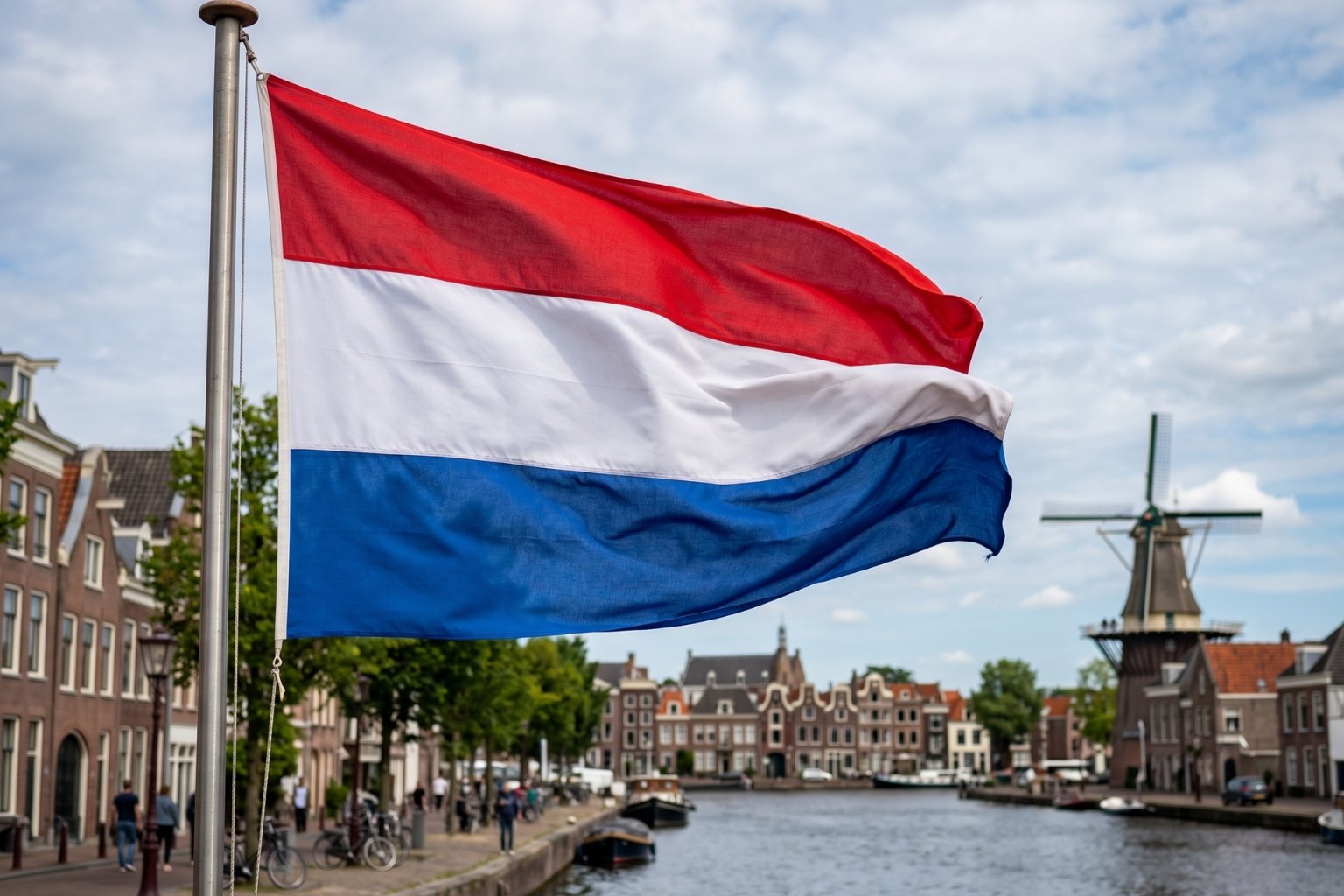

The Netherlands is the most orange country on earth. Fans paint their faces before matches, streets turn the color of tangerines on King’s Day, and the national football team is recognizable from a mile away. Yet the Dutch flag is red, white, and blue. Not a trace of orange. That contradiction is not a historical accident. It is one of the most compelling stories any national symbol has ever told.
What the Netherlands Flag Looks Like
The Dutch flag is a horizontal tricolor made of three equal bands. From top to bottom: bright vermilion red, pure white, cobalt blue. The official proportions are 2:3 (height to width). Its current form was formalized by royal decree from Queen Wilhelmina on February 19, 1937, though its origins stretch back more than three and a half centuries.
The colors carry precise names in Dutch law: red is defined as helder rood, white as wit, and blue as kobaltblauw. That level of precision was not pedantry in a country whose maritime tradition made identifying flags at sea a matter of life and trade.
The Colors of the Netherlands Flag and What They Mean
Red
The red band at the top symbolizes courage, strength, and bravery. But this is not an abstract red. It points directly to the sixteenth-century wars of Dutch independence, when the provinces of the Low Countries rose against Spanish Habsburg rule. The soldiers who carried the first versions of this flag wore this color into battle, and the red still holds that memory of armed resistance.
It is also worth noting that red was not the original choice. It used to be orange. The reason it changed is the beating heart of this flag’s history.
White
The central white band represents peace, honesty, and unity. In European heraldic tradition, white (or silver) signals purity and integrity. For the Dutch Republic of the seventeenth century, the world’s first modern commercial republic, it also carried the civic values of a Protestant merchant class that had broken with Rome and with Madrid: transparency, a word kept, a contract honored.
Blue
The cobalt blue band at the bottom speaks of loyalty, justice, and vigilance. It is impossible to look at this color without thinking of the sea. The Netherlands built its entire identity on water. The VOC, the Dutch East India Company, was the largest commercial enterprise in the world in the seventeenth century. The blue of the flag carries that founding relationship with the ocean, the trade routes, and a people who literally pushed back the sea to create their own land.
The Origin of the Netherlands Flag: William of Orange and the Prinsenvlag
The story of the Dutch flag begins in 1568, when the northern provinces of the Low Countries rose against Philip II of Spain. Leading the rebellion was William of Orange, known as William the Silent (Willem de Zwijger). His title referred not to a fruit or a color but to the Principality of Orange in what is now southern France, which he had inherited.
For his armies, William adopted the colors of his livery: orange, white, and blue. This horizontal tricolor, known as the Prinsenvlag (the Prince’s Flag), became the banner of the revolt. The first documented military use dates to the Siege of Leiden in 1574, where Dutch officers wore orange-white-blue brassards on their arms. From 1577 onward, it served as the official flag of the Dutch fleet at sea.
The Prinsenvlag was never formally adopted by law. It existed, it was used, it was recognized, but no legislation ever codified it. That legal ambiguity would carry serious consequences.
Why Is the Dutch Flag Red and Not Orange?
It is the question anyone should ask when watching a Netherlands football match. The answer is practical, political, and geopolitical all at once.
The Orange Dye Did Not Hold at Sea
The first explanation is material. The orange dyes available in the sixteenth and seventeenth centuries were not colorfast. Exposed to sunlight and saltwater, they gradually faded toward red. On the flags flying from merchant and naval vessels, orange and red became indistinguishable. Paintings from the period show a slow transition: from 1597 onward, red appears in place of orange on certain ships, and by 1630 it has become dominant.
The Ban on Orange: The Death of Willem II and Republican Politics
The second reason is political. In 1650, Willem II of Orange died without a designated successor. Dutch republicans, long kept in check by the influence of the House of Orange, seized the moment. In 1652, the Prinsenvlag was officially banned. The Statenvlag (States’ Flag), in red, white, and blue, replaced it as the symbol of the Republic freed from princely tutelage.
This was a deliberate act. Red did not drift in by accident. Removing orange from the flag meant removing the House of Orange from the nation’s symbolic field.
The Anglo-Dutch Treaty of 1654
The third reason is diplomatic. In 1654, a defense treaty between the Netherlands and England contained a remarkable clause: no member of the House of Orange could ever hold the position of stadtholder, the head of the Dutch state. The treaty formally buried the political legitimacy of the Orange family. Red settled permanently in place of orange, and the break was complete before it was even officially decreed.
The Shadow of World War II
One final layer cemented the orange flag’s fall from grace. In the 1930s, the NSB (Nationaal-Socialistische Beweging), the Dutch pro-Nazi movement, adopted the Prinsenvlag as its emblem. During the German occupation, the orange-white-blue flag became associated with collaboration. That association reinforced, in Dutch collective memory, the red-white-blue Statenvlag as the only legitimate flag of the nation. Today, the Prinsenvlag still appears occasionally among far-right groups in the Netherlands, which is precisely why most Dutch people want nothing to do with it.
The Netherlands Flag Through the Centuries
| Period | Key Event |
|---|---|
| 1568 | Start of the Dutch Revolt against Spain |
| 1572 | First documented Dutch flag |
| 1574 | Military use of the Prinsenvlag at the Siege of Leiden |
| 1577 | Prinsenvlag adopted as the official naval flag |
| 1597 | First appearances of red replacing orange on ships |
| 1630-1660 | Gradual orange-to-red transition; the Statenvlag takes hold |
| 1652 | Official ban on the Prinsenvlag |
| 1796 | Brief republican variant featuring an allegorical figure |
| 1937 | Royal decree by Queen Wilhelmina formalizing red, white, and blue |
The Netherlands Flag’s Influence on Flags Around the World
This is one of the most underappreciated Dutch contributions to world history: the Dutch tricolor directly influenced several flags that still fly today.
New York City and the city of Albany in New York State both carry flags derived from the orange-white-blue Prinsenvlag, a direct legacy of the colony of New Amsterdam, founded by the Dutch West India Company in the seventeenth century. The Dutch were there before the British, and the flags of those cities still show it.
Russia adopted a white-blue-red tricolor after Peter the Great, deeply impressed by Dutch maritime power during his 1697 visit to the Netherlands, decided his empire needed a proper naval flag. The colors are the same. The order of the bands is different.
The former South African flag (1928-1994) incorporated a miniaturized version of the Prinsenvlag at its center, reflecting the Dutch settlers who arrived at the Cape as early as 1652.
Luxembourg shares the same red, white, and blue colors, though its blue is noticeably lighter. The two flags look almost identical and are regularly confused, but their histories are entirely separate.
Orange Without the Flag: Why the Dutch Never Let Go of Their Color
The paradox does not resolve itself. It gets celebrated.
Orange may have been stripped from the flag in 1652, but it never left the Dutch soul. Koningsdag (King’s Day, celebrated on April 27) turns Dutch cities into a sea of warm color every year. Amsterdam, Rotterdam, Utrecht: streets fill with orange clothing, orange decorations, and orange-tinted beer. It is not nostalgia. It is pure identity.
The national football team, known simply as Oranje, is one of the most recognizable in the world precisely because of a color no other nation has claimed with such conviction. In 1974, Johan Cruyff and his teammates in their blazing orange shirts played a brand of football so complete and so beautiful that it marked the history of the sport as much as the history of style.
Orange is also the color of the royal family, the House of Orange-Nassau, which still reigns over the Netherlands today. The fact that this color is absent from the official flag while remaining omnipresent in national life says something essential about how the Dutch hold history and identity together: without rigid nostalgia, with a certain lightness, and remarkable coherence beneath the apparent contradiction.
The flag is red, white, and blue. The Dutch are, irreversibly, orange.
