

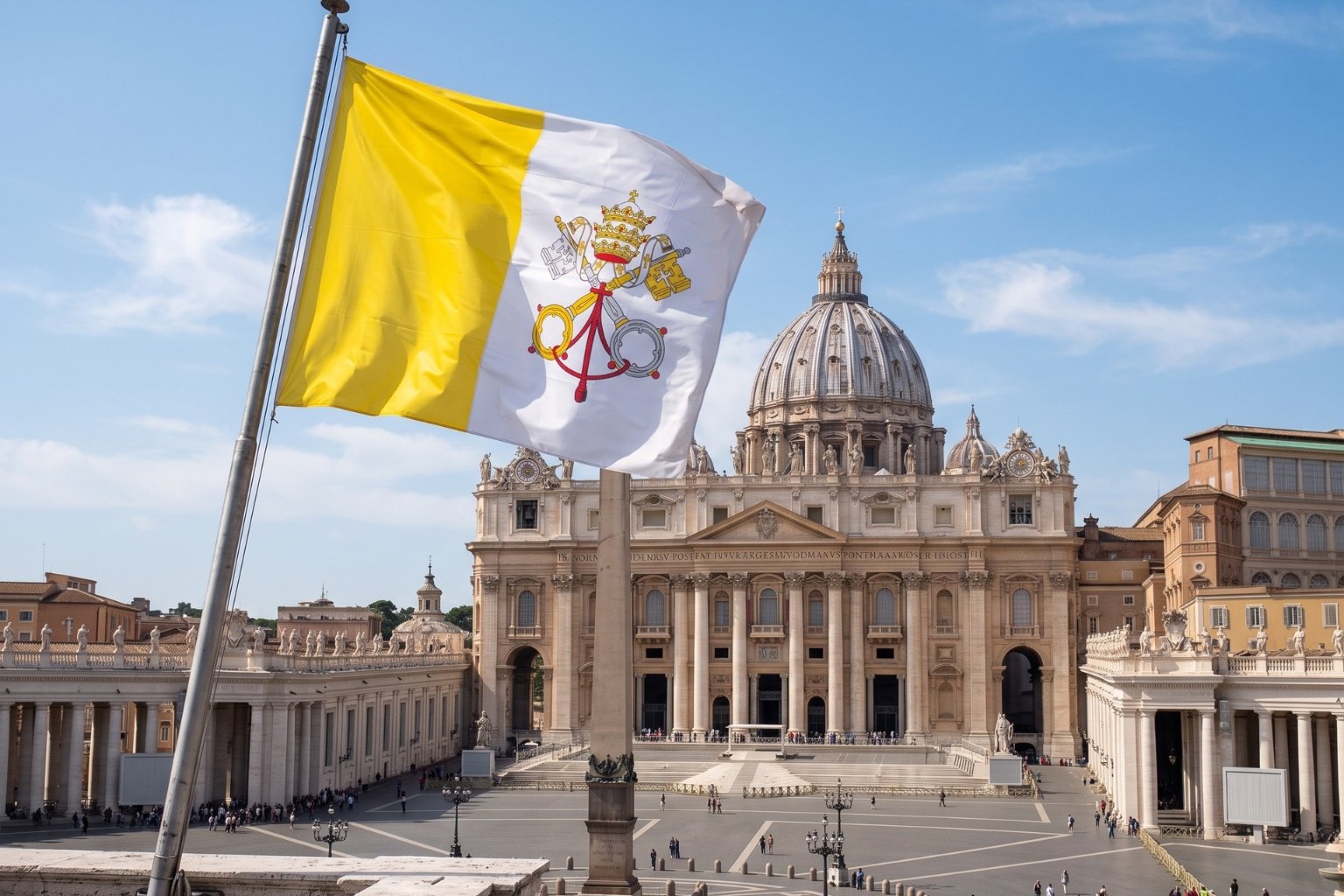

Every flag tells you something about power. The Vatican flag tells you about two kinds at once. Split down the middle in gold and white, crowned with a coat of arms that has outlived empires, it flies over the smallest country on earth and one of the most recognized institutions in the world. Here is what the Vatican flag’s colors, symbols, and long history actually mean.
What the Vatican Flag Looks Like
The Vatican flag is a vertical bicolor, split evenly between gold on the side closest to the pole and white on the outer half. Unlike almost every other national flag, it is perfectly square. Only Switzerland shares that shape.
Centered on the white half sits the coat of arms of the Holy See, two crossed keys beneath a triple crowned tiara. It looks simple from a distance. Up close, every element on it carries centuries of meaning.
The Meaning Behind the Colors
Gold and Silver, Not Just Yellow and White
What reads as yellow and white on the flag is technically gold and silver, the heraldic terms for those colors. Gold traditionally stands for spiritual power, the pope’s authority over the Church. Silver, shown as white, represents earthly or temporal authority, his historical role as a sovereign ruler.
The pairing is not decorative. It mirrors the two keys on the coat of arms, one gold and one silver, each tied to a different kind of power the pope has held since the Middle Ages.
The Coat of Arms, Explained
The crossed keys on the flag reference a line from the Gospel of Matthew, where Jesus tells Saint Peter he is giving him the keys to the kingdom of heaven. One key opens the everyday, earthly world. The other opens something beyond it. They cross because both are needed to connect the two.
A red cord binds the keys together, symbolizing how spiritual and worldly authority are joined rather than separate. Above them sits the papal tiara, the triple crown popes wore at their coronation from the twelfth century until Pope Paul VI set the tradition aside in 1963. It remains on the flag as a mark of sovereignty even though no pope has worn one in decades.
The History of the Vatican Flag
The flag did not arrive fully formed. It is the product of a slow, occasionally political shift away from an older set of colors entirely.
| Period | Colors Used | What Changed |
|---|---|---|
| Before 1808 | Red and yellow | Traditional colors of Rome and the Papal Senate |
| 1808 | Yellow and white introduced | Pope Pius VII broke from red after Napoleon’s occupation |
| 1815 to 1870 | Yellow and white, merchant flag | Colors made official for the Papal States’ ships and troops |
| 1929 | Modern flag adopted | The Lateran Treaty establishes Vatican City as a sovereign state |
Rome’s Original Colors Were Red and Yellow
For most of its history, the Papal States flew a flag in red and yellow, drawn from the coat of arms of the Holy See and shared with the old Roman Senate. Those colors marked papal territory across central Italy for centuries.
1808, Napoleon, and the Break From Red
Everything changed in 1808, when French troops under General Miollis occupied Rome and folded papal forces into Napoleon’s army. Pope Pius VII, unwilling to see his soldiers wear the same colors as the annexing power, ordered his guard to swap red for white. The move was as much a protest as a design choice, a way to visually separate his loyal troops from the French. That single decision, recorded in a papal order dated March 1808, is the direct ancestor of the flag flown today.
From Merchant Flag to Official Symbol (1815 to 1870)
Once the Papal States regained independence in 1815, the yellow and white pairing spread from the guard’s cockade to actual flags, first for the merchant fleet, then for infantry and state use. By 1862 the design had settled into the vertical stripes recognizable today, though it still represented a territory rather than a fully independent nation.
The Lateran Treaty and the Flag We Know Today (1929)
Papal rule over central Italy ended in 1870 when the Papal States were absorbed into a unified Italy. The flag as an official symbol went with it, until the Lateran Treaty of 1929 created Vatican City as an independent state. Pope Pius XI adopted the old 1825 merchant flag as the new nation’s official banner, and it has flown unchanged since June 1929.
Where You’ll Actually See This Flag
The Vatican flag shows up in more places than Vatican City itself. It flies over Saint Peter’s Square during papal audiences and Sunday blessings. Catholic churches worldwide often display it beside their national flag near the altar or entrance. Papal nunciatures, the Vatican’s embassies abroad, also fly it, since these buildings hold the same extraterritorial status as Vatican soil itself.
If you happen to be in Rome when the pope addresses the crowd from his apartment window, look up. You will usually spot the flag hanging just below the sill.
Three Things Most People Don’t Know
It shares its shape with only one other country. The Vatican and Switzerland are the only two nations with perfectly square flags, a coincidence with no historical link between them.
A Vatican flag has been to the moon. Apollo 11 carried one aboard in 1969. It later returned to Earth and now sits in the Vatican Museums, displayed alongside a small sample of lunar rock.
An incorrect version circulated online for years. Between 2006 and 2022, a widely used digital image showed the tiara’s lining in red instead of white, an error that started on Wikimedia Commons and spread across the internet before anyone corrected it.
Quick Answers
What do the colors of the Vatican flag mean
Gold represents the pope’s spiritual authority, while white, standing in for silver, represents his historical role as a temporal ruler.
Why is the Vatican flag square
No confirmed historical reason has ever been documented. It has simply stayed square since its earliest versions, and Switzerland is the only other country to share the format.
When was the Vatican flag officially adopted
Pope Pius XI adopted the current design on June 7, 1929, shortly after signing the Lateran Treaty that created Vatican City as an independent state.
