

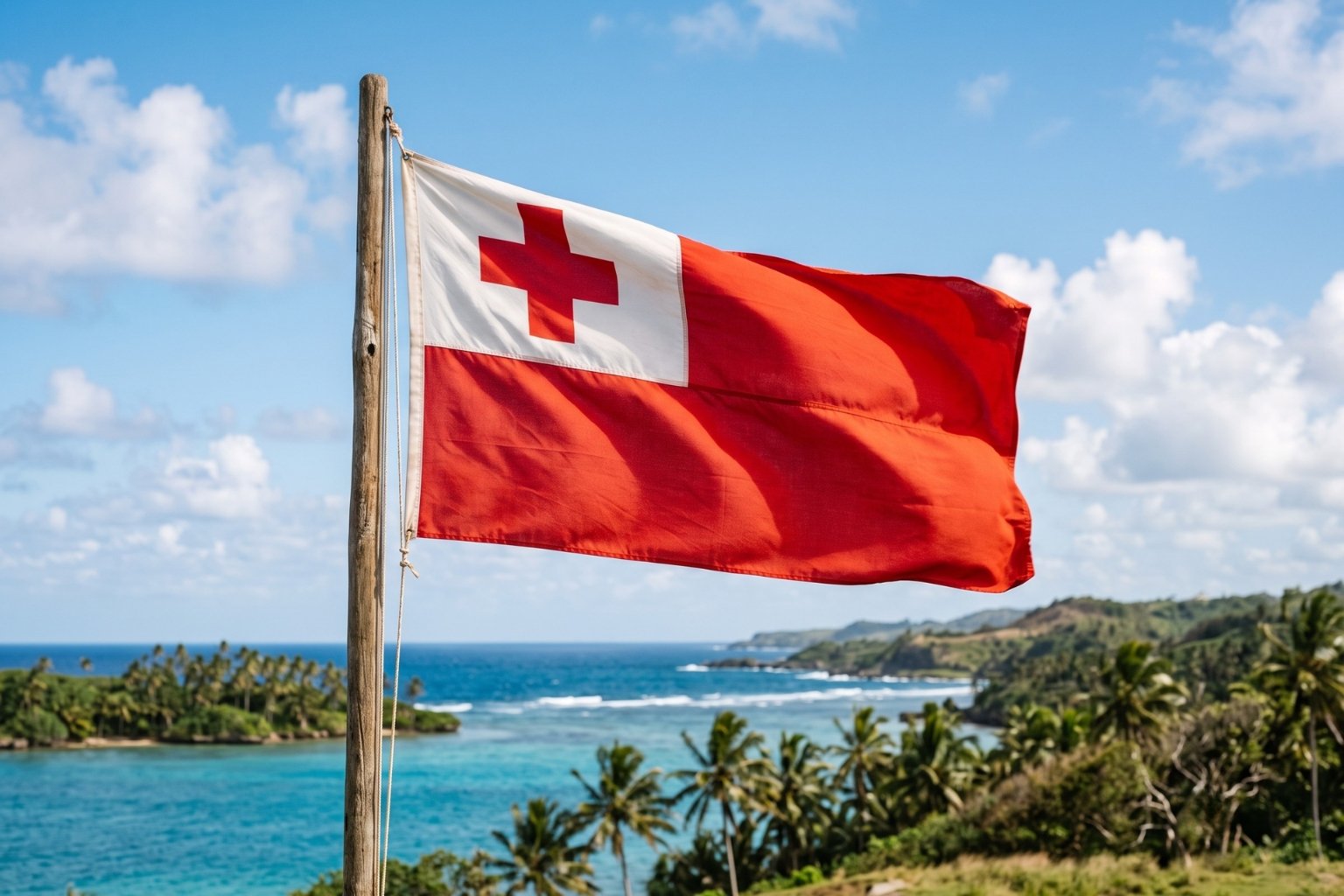

A field of deep red split by a stark white square, a red cross sitting inside it, no other color, no ornament. That is the Tonga flag, one of the oldest unchanged national flags in the Pacific and one of the very few in the world that its own constitution forbids from ever being redesigned. Behind that simplicity sits a very specific nineteenth century turning point, a king who tied his young nation’s identity to Christianity, and a design so protected that changing even a shade of color would mean rewriting the country’s founding law.
What the Tonga Flag Looks Like
Before the history, the shape. The Tonga flag is a red field with a white canton in the upper corner near the staff, and inside that white square sits a red Greek cross, meaning its arms are equal in length and shortened rather than stretched to the edges.
The proportions are fixed at a ratio of 1 to 2, so the flag is exactly twice as long as it is tall. There is no third color anywhere on it, a rare choice among Pacific nations, most of which folded in blue or yellow once European flag conventions reached the region.
What the Colors and the Cross Actually Mean
Red and white were not decorative choices here, they were selected with a message in mind, and each element carries more than the single line most sites give it.
Red stands for the blood of Christ shed at the crucifixion, an image that reflects how central Christianity became to Tongan identity after missionaries arrived in the early nineteenth century. In the wider Polynesian tradition, red also carried an older association with courage and sacrifice for one’s land, so the color layered a new religious meaning onto an existing cultural one rather than replacing it.
White stands for purity, and practically speaking, it also does the job of keeping the cross legible from a distance against a solid red field.
The cross is shortened rather than stretched to the edges of the canton, and Tongan tradition holds that an earlier version of the flag carried a cross closer in shape to the emerging Red Cross emblem, prompting a redesign so the two symbols would not be confused. That detail is passed down more as national lore than as documented fact, but it explains the current cross’s distinct, compact shape.
The History Behind the Design
The flag did not appear all at once. It took shape over roughly three decades, following the political and religious transformation of Tonga itself.
Before 1875
The first flag associated with the Tongan monarchy dates to the 1840s, decades before the current design. It used a white field marked with red or blue crosses in each corner and the initials A and M at the center, standing for the king’s name at the time. It worked well as a personal royal emblem, but it did not yet function as a symbol for the whole nation.
King George Tupou I and Shirley Baker
That changed under King George Tupou I, the ruler who unified Tonga’s chiefdoms into a single kingdom. He relied on an English adviser, Shirley Waldemar Baker, to help design a flag that could represent the country on equal footing with the Western powers trading and exploring the Pacific at the time. The design was first raised in 1866, nearly a decade before it became official.
The Constitution of 1875
On November 4, 1875, Tonga adopted its constitution, and the flag was written directly into that founding document. This is the detail most worth remembering, the flag was not simply approved, it was legally frozen into the same text that established the kingdom’s laws and the monarchy’s authority.
Why the Flag Can Never Change
Tonga’s constitution states plainly that the flag can never be altered, and that clause was no afterthought. In the second half of the nineteenth century, most surrounding Pacific kingdoms were being absorbed into colonial empires one after another. Fixing the flag permanently into the constitution was a way of declaring the kingdom’s identity as settled and non negotiable, at a moment when sovereignty across the region was anything but guaranteed.
Tonga remains the only Pacific nation never to have been formally colonized, and its flag stands as one of the clearest symbols of that continuity.
Where You Will Actually See the Flag in Tonga
Reading about the flag is one thing, spotting it on the ground is another, and this is where a trip to Tonga makes all that history feel immediate.
The flag flies year round outside churches, government buildings, and family homes, especially around the capital, Nukuʻalofa. It becomes far more visible around a handful of key dates, when flag raising ceremonies and public celebrations bring the design out of the everyday and into the center of national life.
| Occasion | Date | What You Will See |
|---|---|---|
| Tonga Day | November 4 | Flag raising ceremonies, parades, and events marking the 1875 constitution |
| King Tupou VI’s Birthday | July 4 | A week of festivities including the Heilala Festival, with flags displayed across towns |
| King Tupou I Day | Early December | Ceremonies honoring the monarch who established the modern flag |
If your trip lines up with any of these dates, plan to be near a town center in the morning, since flag raising ceremonies tend to open the day’s events before the feasting and music take over.
How the Tonga Flag Compares to Similar Flags
Tonga’s flag belongs to a small family of national flags built around a cross on a plain field, alongside Switzerland and Georgia, but the resemblance stops at the surface. Switzerland’s flag is square rather than rectangular and uses an equal armed cross reaching all the way to the edges of the field. Georgia’s flag carries five crosses rather than one and layers in a more elaborate heraldic history tied to Saint George.
Tonga’s version stays deliberately minimal, one color pairing, one compact cross, no additional emblems. That restraint is itself part of the message, a flag built to be recognized instantly and impossible to confuse with a coat of arms.
A Flag That Tells You Who Tonga Is
Once you know what sits inside that red and white design, a Sunday church service, a royal ceremony, or a market stall selling small flags during Tonga Day reads differently. The flag is not background decoration, it is a condensed version of the story Tonga tells about itself, faith, monarchy, and a sovereignty that was never handed over.
That is worth carrying with you the next time you see it snapping in the wind over Nukuʻalofa’s waterfront.
