

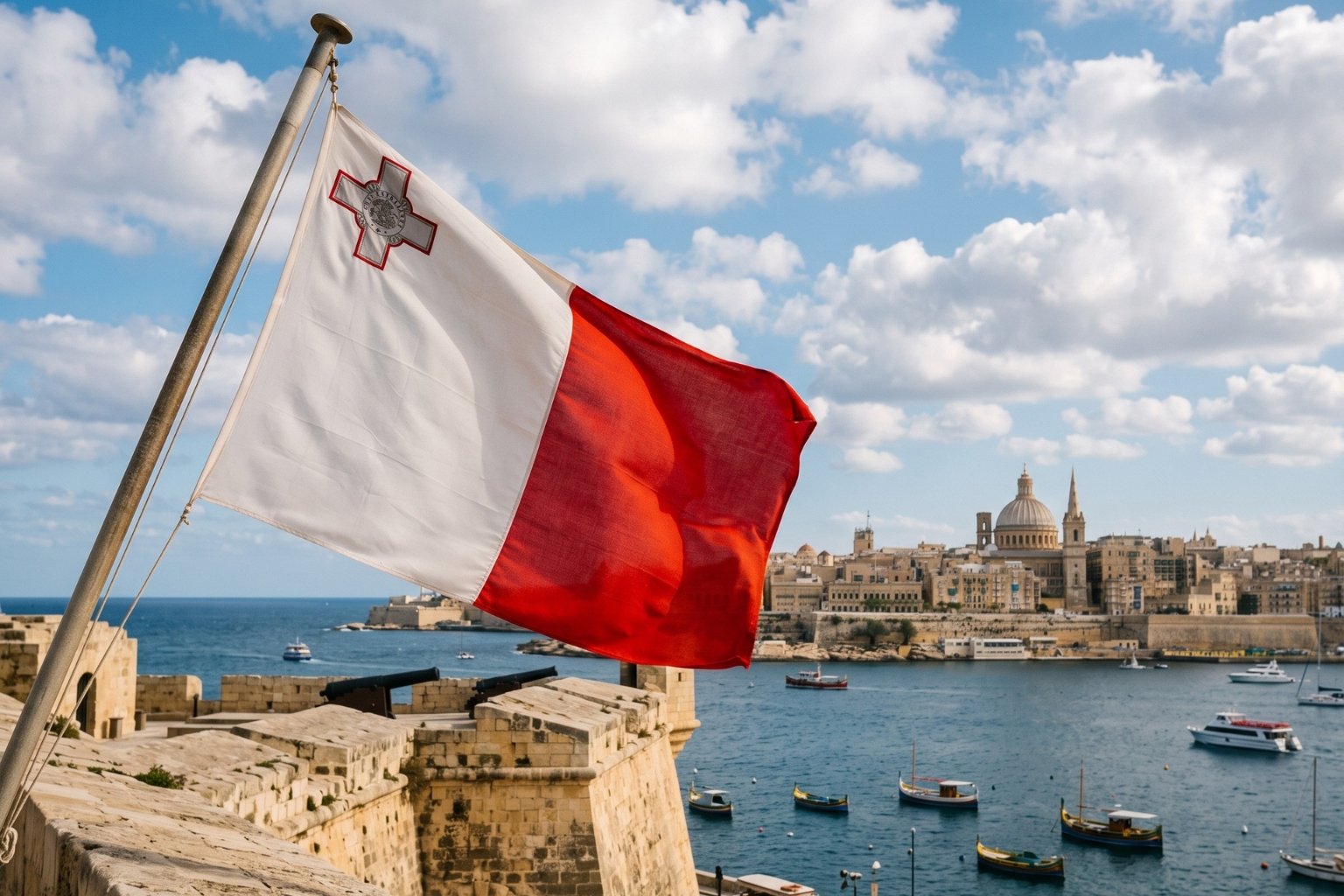

Fly into Malta and past the honey colored bastions of Valletta, the first Maltese symbol you actually notice is the flag: white and red, split clean down the middle, with a small cross tucked into one corner. The Malta flag looks almost too simple for an island with this much history behind it. Behind that white and red sits a Norman legend, a crusading order, a wartime medal, and a young republic deciding what independence should look like on cloth.
What the Flag of Malta Looks Like Today
The flag is a vertical bicolor: white on the hoist side, red on the fly side, in equal halves. In the upper corner of the white band sits a small representation of the George Cross, edged in red, showing Saint George on horseback slaying a dragon, with the words For Gallantry inscribed beneath it.
A few details make this flag genuinely unusual among the world’s roughly 200 national banners. It is the only national flag that carries English language text. It is also one of only two national flags, alongside Belize, to depict a human figure. The design was first officially recognized in May 1952, well before Malta’s independence.
| Detail | Specification |
|---|---|
| Official adoption | 21 September 1964 |
| Layout | Two equal vertical bands, white at hoist, red at fly |
| Canton symbol | George Cross, edged in red, inscribed For Gallantry |
| Red shade | Pantone 186C, hex CF142B |
| Proportions | 2 to 3, breadth one and a half times the height |
| Legal basis | Article 3 of the Constitution of Malta |
What the Colors and the Cross Actually Mean
White and Red, Read Two Ways
In classic European heraldry, white traditionally suggests purity and clarity, while red points to sacrifice and the blood spent defending a cause. Maltese sources apply that same reading to their flag, though no surviving 11th century document actually spells out what the colors were meant to mean at the time. The symbolism, in other words, was layered on by later generations rather than declared at the outset.
The George Cross, a Medal Turned National Symbol
The George Cross is Britain’s highest civilian honor for bravery, and Malta remains the only place in the world where it decorates an entire national flag rather than a single recipient’s chest. King George VI awarded it collectively to the Maltese people on 15 April 1942, in recognition of their endurance through relentless bombing during the Siege of Malta. It joined the flag officially on 28 December 1943, a mark of survival that the newly independent nation chose to keep rather than discard.
The Legend of Count Roger of Sicily
The most repeated story about Malta’s colors goes back to 1091. Count Roger I of Sicily, having just wrested the island from Arab rule, is said to have torn a strip from his own checkered red and white banner and handed it to the Maltese as thanks for their support against the defenders. It is a tidy, flattering origin story, the kind nations like to tell about themselves.
Historians are far less convinced. Most consider the tale a 19th century invention, with no contemporary record placing a red and white flag in Malta anywhere near 1091. What does seem plausible is that Malta’s old capital, Mdina, had already linked itself to those colors by the late Middle Ages, which likely gave the later legend something real to attach itself to.
The Documented History Behind the Colors
The Knights of Malta and the Cross on Red, 1530 to 1798
When the Knights Hospitaller took control of Malta in 1530, they flew a red banner marked with a white cross, the emblem of their order. This design, not Count Roger’s supposed gift, is what most historians point to as the actual root of Malta’s palette. It also happens to be one of the oldest flag designs still recognized and used today, carried forward on Malta’s civil ensign.
Rebellion Against the French, 1798
Napoleon’s forces seized Malta in 1798, and the occupation did not sit well with the population for long. When the Maltese rose up against French rule that same year, insurgents raised a white and red standard as their rallying symbol, reasserting the old local colors against a foreign tricolor.
British Rule and a Flag of Their Own
Through most of the 19th century, Malta flew British symbols: the Union Jack and later the Blue Ensign carrying a colonial badge. In 1895, officials proposed folding Maltese heraldic elements into that colonial design, though nothing was formally settled at the time. Malta gained a measure of self government in 1921, and from then on, the Maltese were permitted to fly their own white and red flag on public holidays, alongside the Union flag rather than instead of it.
The Siege, the George Cross, and Independence
World War II reshaped everything. After the George Cross was awarded in 1942 and added to the flag in 1943, it flew on a blue canton for two decades, a visible reminder of Malta’s colonial status even as it also honored Maltese resilience. When Malta gained independence on 21 September 1964, that blue canton was dropped. The George Cross stayed, now simply edged in red against the white stripe, and that is the flag still flown today, unchanged even after Malta became a republic in 1974.
How the Flag Evolved
| Period | Design |
|---|---|
| Before 1798 | Order of St John: red field, white cross |
| 19th century | British colonial ensign, Union Jack in the canton |
| 1943 to 1964 | White and red flag, George Cross on a blue canton |
| Since 1964 | White and red flag, George Cross edged in red |
The Ongoing Debate Over the George Cross
Not every Maltese citizen is at peace with a British medal sitting on their national flag. A 1975 act of parliament made it possible to remove the George Cross with a simple majority vote, and the question resurfaces every few years. A 2013 social media campaign floated swapping it for the eight pointed Maltese cross instead. The debate flared again in 2019, when historian Charles Xuereb publicly called the George Cross a colonial gimmick, only for fellow historian Joe Pirotta to push back, arguing that removing it would insult those who lived through the siege it commemorates. For now, it stays.
Where Travelers Actually See the Flag
The flag flies year round above the Grand Master’s Palace in Valletta, but it truly takes over the islands on Independence Day, 21 September, and again on Republic Day, 13 December. Local council buildings across Malta and Gozo raise it as a matter of routine. The more memorable sightings, though, happen sideways: draped from balconies during a village festa, strung above harbor boats in Marsaxlokk, or snapping in the wind above a bastion wall as the ferry pulls into Valletta at dusk.
How Malta’s Flag Compares to a Few Others
Indonesia and Monaco both fly red and white bicolors too, but theirs run horizontally, red on top of white, and the two are nearly indistinguishable from each other at a glance. Malta’s flag shares none of that ambiguity. Its vertical split and its George Cross set it apart from that whole family of red and white flags, and the cross itself puts Malta in a very short list of countries, alongside Belize, whose national flag depicts an actual person.
