

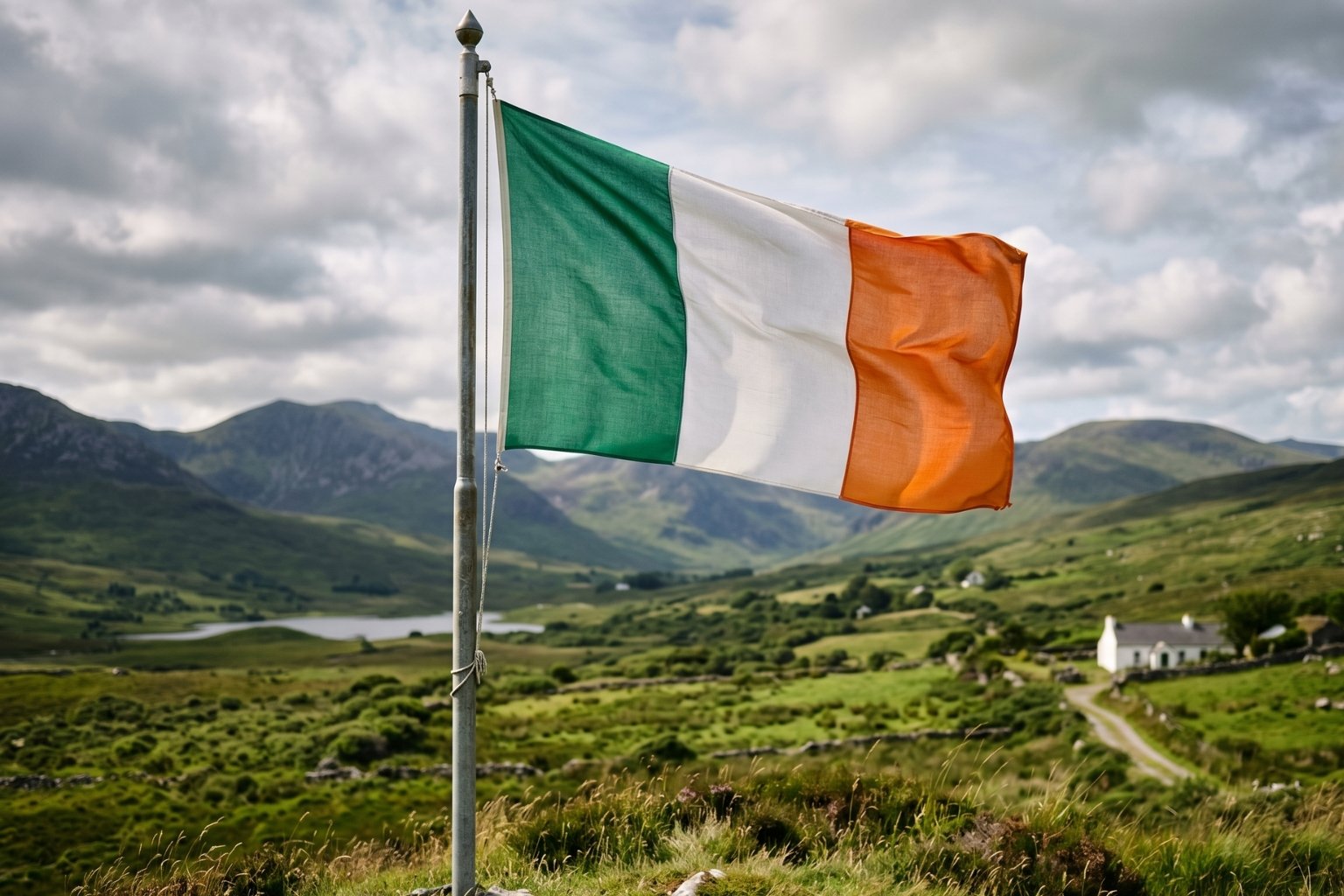

Three vertical stripes. Green, white, orange. One of the most recognized flags in the world, and also one of the most misread. The Ireland flag carries a political argument in its colors, a revolutionary moment in its origin, and a question about peace it has never fully been able to answer. To look at it closely is to look at Irish history itself.
What the Ireland Flag Looks Like
The Irish flag is a vertical tricolour in a 1:2 ratio, meaning it is exactly twice as wide as it is tall. It is divided into three equal bands: green on the hoist side (closest to the flagpole), white in the center, and orange on the fly end.
That left-to-right order is not optional. When the flag is reversed, it becomes the flag of Côte d’Ivoire, which displays the same three colors in the opposite direction: orange, white, green. The two are frequently confused, especially in stadiums and at international events. The distinction is simple: green always faces the pole on the Irish flag, always.
The flag has no coat of arms, no emblem, no text. Its power is entirely in its geometry and its colors.
The Meaning of Each Color on the Ireland Flag
Green: The Weight of a Nation’s Memory
Green had been Ireland’s color long before the tricolour existed. By the 1790s, it was the rallying color of the Society of United Irishmen, the revolutionary movement led by Wolfe Tone that sought to break from British rule and establish an independent Irish republic. Their flag was green. Their cause was green.
But the green in the tricolour carries something older still: the entire Gaelic cultural and nationalist tradition. Language, land, identity. The green harp flag flown by Irish regiments in the 17th century. The idea that Ireland had a character, a civilization, a claim to its own future.
In the context of the tricolour, green represents above all the Catholic majority and the republican tradition it was intertwined with across centuries of conflict with British Protestant rule.
Orange: William of Orange and What His Name Still Means
The orange stripe is the one most people understand least and most people get wrong. It has nothing to do with the fruit, the color as fashion, or any vague symbolism of energy or warmth. It refers to one specific man: King William III of England, known as William of Orange, who defeated the Catholic King James II at the Battle of the Boyne in 1690.
That battle became a founding myth for Irish Protestants, particularly in Ulster. William’s supporters formed what would eventually become the Orange Order, a Protestant fraternal organization still active today, most visibly in Northern Ireland. To be “Orangemen” was to celebrate that victory, that lineage, that faith.
In the tricolour, orange represents the Protestant community of Ireland, a minority on the island as a whole but a majority in much of the north. Including them in the flag was not a concession. It was an argument: that a free Ireland would be their Ireland too.
White: The Peace That Was Asked For, Not Given
The white stripe sits between green and orange for a reason. It was placed there deliberately, as a truce, a visual plea for the two traditions to coexist. Thomas Francis Meagher, the man who introduced the flag, was explicit about this when he first unfurled it in 1848. The white, he said, signified a lasting peace between the Orange and the Green.
It remains the most poignant element of the flag, because it is the one whose promise has been most tested. The white strip does not record a peace that was achieved. It expresses a peace that was hoped for.
Origin of the Ireland Flag: Thomas Francis Meagher and the Spring of 1848
To understand where the tricolour comes from, you have to understand the year 1848. Across Europe, kingdoms were shaking. France had just overthrown King Louis Philippe I. Revolutions were erupting in Vienna, Berlin, Budapest, Milan. For a generation of young Irish nationalists watching from a colonized island still reeling from the Great Famine, the moment felt electric.
A group of them, members of the Young Ireland movement, traveled to Paris to congratulate the French republicans on their revolution. Among them was Thomas Francis Meagher, a 25-year-old lawyer and orator from Waterford, passionate and reckless in equal measure.
In Paris, a group of French women sympathetic to the Irish cause presented Meagher with a flag. It was made of French silk, designed in the spirit of the French tricolour, but with colors chosen for Ireland’s own divisions. Meagher brought it home.
On April 7, 1848, he stood on the balcony of the Wolfe Tone Confederate Club in Waterford and unfurled it before the crowd below. He spoke about what each color meant, about the Gael and the Protestant settler, about the white that he hoped would replace enmity with brotherhood. The flag flew over the city for eight days before British authorities took it down.
Meagher was arrested the following year, tried for sedition, and transported to Tasmania. He escaped, made his way to the United States, became a celebrated figure in New York’s Irish community, and commanded a Union brigade during the American Civil War. The flag he had carried across the Atlantic outlasted him in ways he could not have imagined.
From Waterford to Dublin: The Long Road to 1916
After Meagher’s arrest and exile, the tricolour nearly vanished. For almost 70 years, it was a symbol without a stage, known in nationalist circles but absent from the streets of Irish cities.
That changed on the morning of Easter Monday, April 24, 1916.
As members of the Irish Volunteers and the Irish Citizen Army seized buildings across Dublin and declared an Irish Republic, Gearóid O’Sullivan raised the tricolour above the General Post Office on Sackville Street (now O’Connell Street). That single act reattached the flag to revolutionary legitimacy. The Easter Rising was crushed within a week. Its leaders were executed. But the image of the tricolour above the GPO became one of the defining symbols of the independence movement.
From that moment, the flag was no longer one option among many. It was the flag.
The Flag in Law: The 1937 Constitution
Ireland won its War of Independence from Britain between 1919 and 1921. The resulting Irish Free State used the tricolour as its national flag from 1922, though without formal legal definition.
It was the Constitution of Ireland, adopted on December 29, 1937, that gave the flag its official status. Article 7 states simply: “The national flag is the tricolour of green, white and orange.” The proportions, the order of colors, and the flag’s legal standing were fixed in law.
When Ireland left the British Commonwealth on April 18, 1949, becoming a fully independent republic, the tricolour remained unchanged. No revision was needed. The flag had already said everything.
The Ireland Flag in Northern Ireland
The tricolour is the flag of the Republic of Ireland, which covers 26 of the island’s 32 counties. Northern Ireland, which remained part of the United Kingdom after partition in 1921, has a different and more complicated story.
The official flag of Northern Ireland is the Union Jack, as it is for all parts of the United Kingdom. However, many in Northern Ireland use the Ulster Banner, a white flag bearing a red cross and a crowned red hand, though it has no current official status.
For unionists and loyalists, the tricolour is not their flag. It is the flag of another state, one that laid constitutional claim to their territory until 1998. Flying it can be, in certain contexts, a political act. For nationalists and republicans in Northern Ireland, it is the opposite: an expression of identity and aspiration.
The flag intended to unite two traditions has, in Northern Ireland, remained a line between them. This is not a failure of design. It is a reflection of unresolved history.
Before the Tricolour: Ireland’s Earlier Flags
The tricolour is young by the standards of Irish history. Long before it existed, other symbols carried the weight of Irish identity.
The oldest association is with Saint Patrick’s Blue, a deep azure that appeared on medieval banners and was used by the Order of Saint Patrick, founded in 1783. It is still the color of the Irish presidential standard today.
From the 13th century onward, the golden harp on a blue field was the primary heraldic symbol of Ireland, used by English and Irish rulers alike. By the 17th century, that harp had migrated to a green field, the version now recognized worldwide.
The green harp flag flew with Owen Roe O’Neill in the 1640s, with the United Irishmen in the 1790s, and alongside the tricolour during the 1916 Rising. It never disappeared. Today it appears on the President of Ireland’s standard, on Guinness labels, on Irish passports, and in the emblem of the Irish rugby team.
The harp is older than the flag. In some ways, it is more Ireland than anything else.
Common Questions About the Ireland Flag
Why is green on the left and not the right? Because on a flag, the side closest to the pole is the position of honor. Green, representing the majority tradition and the national character, takes that position. It also ensures the flag cannot be mistaken for Côte d’Ivoire’s when flown correctly.
Is the Ireland flag the same as the Ivory Coast flag? Almost. The Côte d’Ivoire flag uses the same three colors but in the reverse order: orange on the hoist, white in the center, green on the fly. The two are mirror images of each other, with no shared meaning or historical connection.
Does Northern Ireland have its own flag? There is no officially designated flag for Northern Ireland as a devolved region. The Union Jack is the legal flag. The Ulster Banner, based on the arms of the former Parliament of Northern Ireland, is widely used but has no statutory basis. The question of a shared, neutral flag for Northern Ireland has never been resolved.
What is Saint Patrick’s Blue? A deep, rich blue associated with Ireland since the medieval period. It is the color of the Irish presidential flag and appears in formal state heraldry. It predates the green-and-orange story entirely.
