

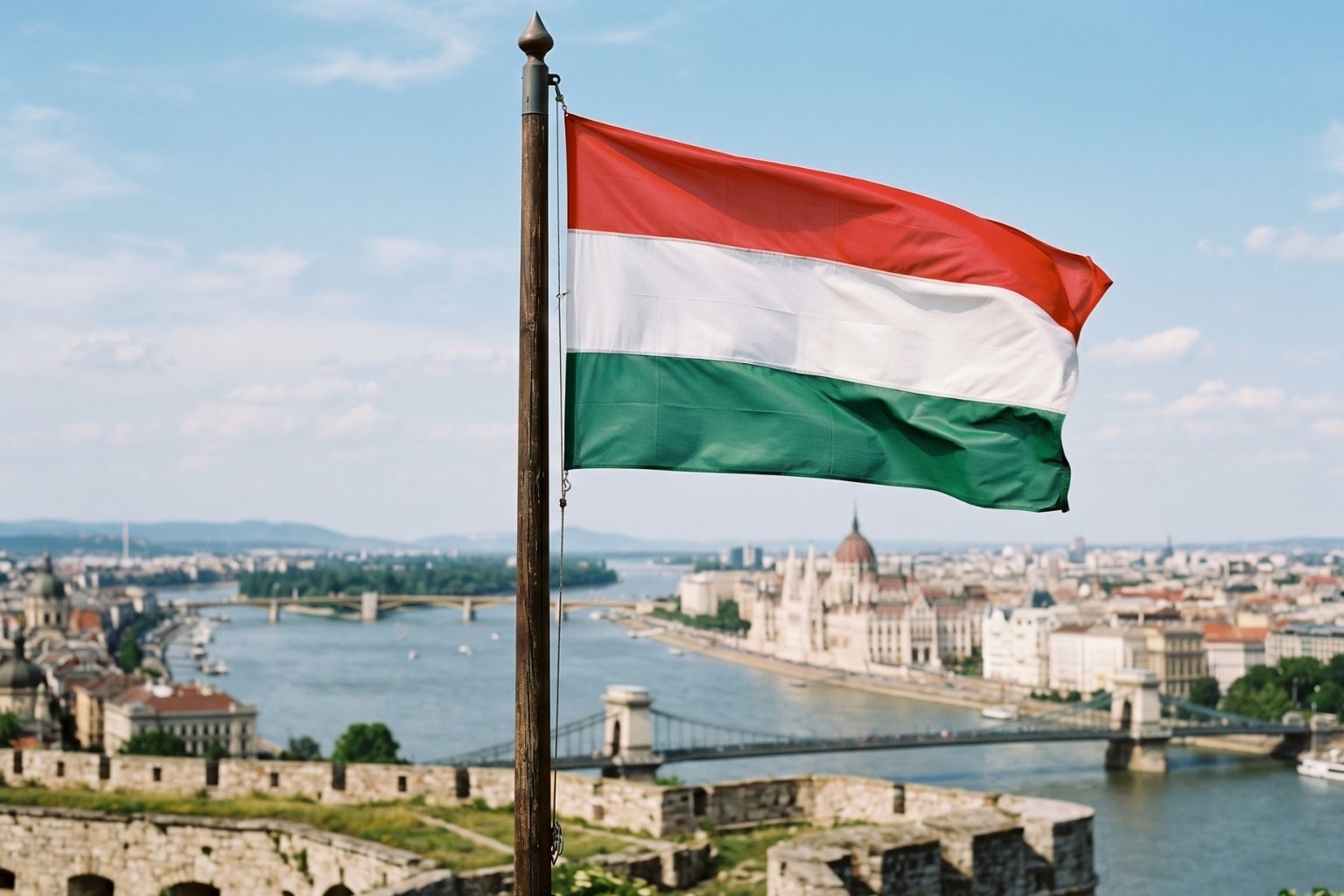

Three horizontal stripes. No emblem on the civilian version. Nothing ornate, nothing borrowed from a colonial past. The Hungary flag looks, at first glance, like one of the simpler tricolors in Europe. Look closer and each color carries the full weight of a nation that has spent centuries refusing to disappear.
What the Hungary Flag Looks Like
The flag is a horizontal tricolor in the ratio 1:2, with three equal bands stacked top to bottom: red, white, and green. The order is fixed and meaningful. Inverting it would produce something closer to the Bulgarian flag, an entirely different story.
The proportions are sober and balanced. No canton, no star, no crescent. The civil flag used by ordinary citizens and most institutions is deliberately plain.
The Coat of Arms Variant
A second official version exists for state and government use. On this variant, Hungary’s coat of arms sits centered on the white stripe. The shield displays the alternating red and white horizontal stripes of the ancient Árpád dynasty on one half, and a green triple hill with a double apostolic cross on the other. Above it sits St. Stephen’s Crown, the medieval coronation crown of the first Hungarian king, identifiable by its distinctive bent cross at the top.
This state flag appears on government buildings and in certain military and diplomatic contexts. The plain tricolor remains the primary national symbol in everyday life.
The Colors of the Hungary Flag and What They Mean
There is no single official legal text assigning precise meanings to each color. What exists instead is a layered tradition rooted in heraldry, revolutionary poetry, and collective memory. The meanings carried by red, white, and green are not decorative. They were forged in specific moments.
Red
Red is the oldest of the three colors in Hungarian symbolism. It appears in the coat of arms of the Árpád dynasty, the founding royal house of the Hungarian kingdom, going back to at least the 12th century. The red stripes of that shield represented the seven Magyar chieftains who united to form the kingdom around 895 CE.
By the time of the 1848 revolution, red had become inseparable from the idea of sacrifice. It represented the blood shed in every uprising against foreign domination, Ottoman and Habsburg alike. Strength, valor, and the willingness to pay the highest price for self-determination.
White
White carries two registers at once. In the natural geography of Hungary, it evokes the great rivers that define the landscape, principally the Danube and the Tisza, both of which have shaped Hungarian civilization, trade routes, and borders for over a millennium.
In the political and moral tradition, white stands for faithfulness and freedom. On March 15, 1848, the day the revolution broke out in Pest, young intellectuals and students pinned red, white, and green cockades to their coats as an act of public defiance. White was the center of that cockade, literally and symbolically.
Green
Green is the most geologically grounded of the three colors. It entered the Hungarian heraldic tradition through the Angevin dynasty, the French-origin kings who ruled Hungary from 1301 to 1387 and incorporated green into the royal symbolism to represent the country’s fertile plains and forested hills.
Over time, green took on the forward-looking meaning of hope. It became the color of what Hungary was fighting toward rather than what it was protecting. When the tricolor was assembled into its modern form, green completed the sequence with the sense of a future worth bleeding for.
The Origins of the Hungarian Flag: From Medieval Heraldry to the Nation
The colors of the Hungary flag did not appear on a committee table in the 19th century. They had been accumulating meaning for six hundred years before anyone thought to stitch them into a tricolor.
The Árpád dynasty, which ruled from the foundation of the kingdom under King Stephen I in the year 1000 until 1301, used red and white as its heraldic colors. These stripes appear on the oldest known Hungarian royal seals. When the Angevins succeeded them, they added green to the palette, embedding it into the visual language of Hungarian kingship.
By the 15th and 16th centuries, these three colors appeared together in various forms on banners, shields, and ceremonial objects. A coronation ceremony in 1608 already mentioned them in combination. They were not yet a flag in the modern sense. They were a chromatic identity waiting for a revolution to give them a defined form.
1848: The Revolution That Made the Flag
On March 15, 1848, the poet Sándor Petőfi stood in front of a café in Pest and read aloud his Nemzeti dal, the National Song, a call to arms against Habsburg rule. By the end of the day, thousands of people had joined a march through the city. Within hours, the red, white, and green tricolor had become the emblem of a popular uprising.
The choice of colors was deliberate and charged. The French Tricolor had already demonstrated that a simple arrangement of bands could carry a revolutionary idea. Hungary borrowed the format but not the colors. The tricolor it raised was rooted in its own heraldic past, not imported from Paris.
The revolution proclaimed Hungarian independence and a constitutional government. It was one of the great liberal uprisings of 1848, which swept across much of Europe in the same months. The Habsburgs suppressed it by August 1849, with the help of Russian troops called in by Emperor Franz Joseph. The republic lasted less than eighteen months.
The flag survived the defeat. It went underground, was carried in private, was printed in small formats and hidden in books. The colors had already become something the empire could not fully eradicate because they lived in the memory of everyone who had seen the revolution.
After 1867, when Hungary and Austria formed the Austro-Hungarian dual monarchy, the Hungarian colors were incorporated into the merchant flag of the empire. They were official again, though within a structure that limited Hungarian sovereignty. Full independence only returned after the collapse of Austria-Hungary in 1918, and with it, the tricolor became the national flag of an autonomous Hungarian state.
The Twentieth Century: A Flag Under Pressure
The flag of Hungary in the 20th century is not a static symbol. It was altered, contested, physically destroyed, and physically repaired. Its modern form is, in the most literal sense, a survivor.
The Soviet Emblem and the Flag’s Disfigurement
After World War II, Hungary fell under Soviet influence and became a communist people’s republic in 1949. The new government replaced the traditional coat of arms at the center of the white stripe with a Soviet-style emblem: a red star, a hammer and wheat sheaf, encircled in the national colors. The change was not subtle. It was a visual declaration that the old Hungary had been replaced.
For Hungarians who remembered 1848, who associated the tricolor with the fight against foreign domination, the imposed emblem was a form of insult written directly onto the flag.
1956 and the Hole Flag
In October 1956, a popular uprising broke out in Budapest against Soviet domination. It became one of the most significant acts of resistance of the Cold War era. In the first days of fighting, protesters did something that has since become one of the most powerful political gestures of 20th-century European history.
They took the national flag. They cut out the Soviet emblem from the white stripe. And they carried what remained.
The lyukas zászló, the hole flag, is preserved in Hungarian museums and in the historical memory of the country as an image of almost unbearable clarity. A flag with a void at its center. A country refusing an identity imposed on it, even if refusal meant displaying a wound.
The uprising was crushed by Soviet tanks in November 1956. Approximately 2,500 Hungarians were killed. Tens of thousands fled the country.
October 1957: The Flag as It Stands Today
In the aftermath of the suppression, the new Hungarian government under Soviet oversight had a symbolic problem. The coat of arms that had been cut from ten thousand flags could not simply be restored. A new coat of arms was designed, one that incorporated the national colors, but it was never placed on the flag.
On October 12, 1957, the plain red, white, and green tricolor, with nothing on the white stripe, was officially adopted as the national flag of the Hungarian People’s Republic. The emblem was gone. The hole was closed. But the flag that emerged was defined, in part, by what had been removed from it.
The Hungary Flag Among Similar Flags
The first thing many people notice about the Hungary flag is that it resembles the flags of Italy and Bulgaria. The resemblance is real but superficial.
The Italian flag uses the same three colors but arranges them vertically, not horizontally, and in a different order: green, white, red from the hoist. It emerged from a different political tradition with different symbolic roots.
The Bulgarian flag uses white, green, and red in horizontal bands, reversing the Hungarian order entirely. The green occupies the center stripe and the red the bottom, an entirely distinct symbolic logic.
Iran’s flag shares the color sequence but adds Arabic calligraphy, a central emblem, and symbolic bands at the edges of each stripe. The resemblance to Hungary’s flag is coincidental and carries no historical connection whatsoever.
The Hungarian flag’s distinctiveness lies not in its colors taken in isolation but in the combination of their order, their horizontal orientation, and the specific history that deposited meaning into each stripe over seven centuries.
The Flag in Hungarian Life Today
In Hungary today, the tricolor is present in a way that goes well beyond official ceremony. The flag appears on national holidays with a density and sincerity that reflects a country still working through its relationship with its own history.
March 15 commemorates the 1848 revolution. August 20 is St. Stephen’s Day, celebrating the founding of the Hungarian state and the first Christian king. October 23 marks the beginning of the 1956 uprising and, since 1989, also the proclamation of the modern Hungarian Republic. On all three dates, the flag is flown from private homes, draped from windows, worn as cockades, and painted on faces at public gatherings.
The phrase piros-fehér-zöld, red-white-green, functions in Hungarian as more than a description of the flag. It is a shorthand for Hungarian identity itself, the way a native speaker might say it to mean something closer to what it means to be from here.
The flag is legally protected. Damaging or destroying it is a criminal offense under Hungarian law. Buying an officially produced flag requires purchasing from an authorized source, as dimensions and color specifications are defined and regulated.
The coat of arms version of the flag flies above the Parliament building in Budapest, one of the most elaborate legislative buildings in Europe, on a permanent basis. It is visible from across the Danube, from the hills of Buda, at a height and scale that is not accidental.
A flag with red at the top, white in the center, and green at the bottom. Three stripes that began as heraldic colors, became a revolutionary emblem, were disfigured by an empire, and were returned to their original form by people who cut the disfigurement out with their own hands.
