

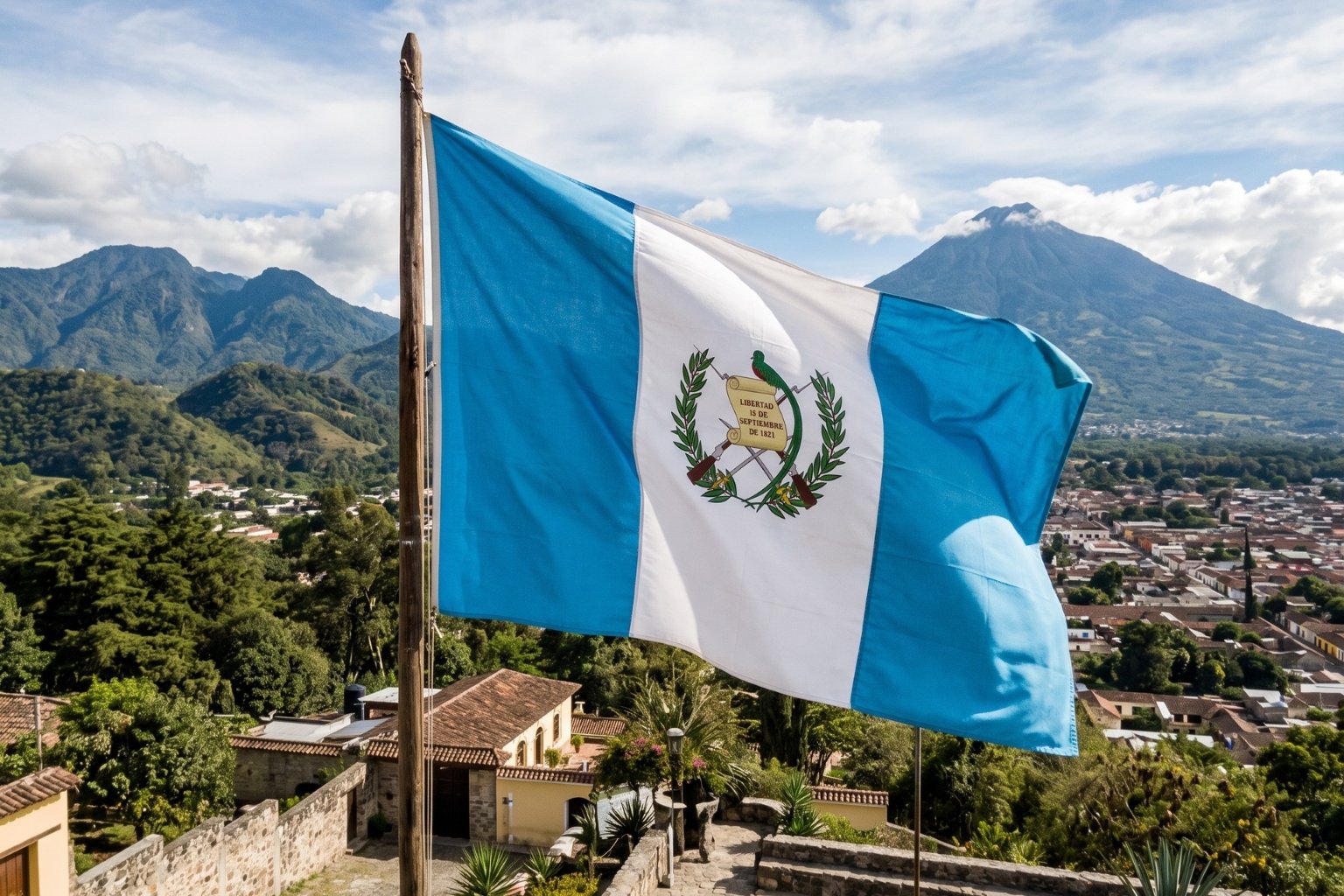

The Guatemala flag stands out the moment you see it. Two sky blue bands frame a white one, and a coat of arms carries firearms, feathers, and a strip of parchment right at the center. Most of Guatemala’s neighbors run their stripes horizontally, but Guatemala chose vertical bands, a decision made in 1871 that still sets it apart on any flagpole in the region. Behind the colors and the emblem sits a story of revolutions, borrowed symbols, and a bird Guatemalans have revered since long before the flag existed.
What the Guatemala Flag Looks Like Today
Design and Proportions
The flag is known locally as the Azuliblanco, meaning blue and white. It follows a ratio of 5 to 8, taller in proportion than most national flags, and is built from three equal vertical bands.
The two outer bands are sky blue, and the central band is white. Sitting on that white band, centered and fixed by law, is Guatemala’s national coat of arms.
The Coat of Arms at a Glance
The emblem packs a surprising amount of detail into a small space. It shows a quetzal, a parchment scroll, two crossed rifles, two crossed swords, and a wreath of laurel, all rendered in careful color and gold trim.
Each element answers to a specific moment or value in Guatemalan history, which the sections below unpack one by one.
The History Behind the Guatemala Flag
Independence and the Federal Republic of Central America
Guatemala’s flag story begins in 1821, when Central America broke from Spanish rule. After a brief and unstable period under Mexican control, five provinces including Guatemala formed the Federal Republic of Central America in 1823.
That federation flew a blue and white flag, and this is where Guatemala’s signature colors come from. Blue and white were not chosen to describe Guatemala specifically. They described a shared regional identity that no longer exists as a single nation, which is why El Salvador, Honduras, Nicaragua, and Costa Rica still carry variations of the same palette today.
The Chaotic Middle Years
The federation collapsed by 1840, splitting into separate republics after growing conflict between Liberal and Conservative factions. Guatemala raised its own flag on November 14, 1843, adding volcanoes, a rising sun, and a quiver of arrows to a blue white blue design.
In 1851, under a period of strong conservative and pro Spain influence, the flag changed again. Red and yellow, the traditional colors of Spain, were folded into part of the design, replacing sections of the original blue. It did not last.
1871, the Break That Defined the Flag
On August 17, 1871, Liberal leaders who had just taken power restored the original blue and white palette and rebuilt the flag from the ground up. This time the stripes ran vertically instead of horizontally, a deliberate choice that visually separated Guatemala from its neighbors, who kept the older horizontal format inherited from the federation.
A new coat of arms, designed by Antonio E. Molina, replaced the earlier volcano and sun emblem. It introduced the quetzal as the central figure for the first time, and this basic layout has anchored the flag ever since.
1968, the Final Retouch
The coat of arms received its last significant update in 1968, refining the proportions and details of the emblem without touching the flag’s colors or structure. Since then, the design has stayed legally fixed, down to the exact placement and size of every symbol.
What Each Color Really Means
Sky Blue
According to Guatemala’s official decree on national symbols, blue expresses strength, justice, truth, and loyalty. Guatemalans also read the two blue bands as a reference to their country’s position between two seas, the Pacific Ocean to the south and the Caribbean side of the Atlantic to the north.
White
The white band stands for peace, purity, integrity, firmness, and light, again following the language of the official decree. It is also the band that carries the coat of arms, making it visually the anchor of the whole flag.
Inside the Coat of Arms
The Resplendent Quetzal
The quetzal perched at the top of the emblem is Guatemala’s national bird, and its symbolism runs deeper than the flag itself. Long before independence, Maya communities associated the quetzal’s brilliant green plumage with freedom, since the bird was believed to die in captivity rather than live caged. That belief still shapes how Guatemalans talk about the bird today, and it is why the quetzal represents liberty on the coat of arms.
The Crossed Rifles
Few national flags feature actual firearms, and Guatemala is one of them. The emblem shows two crossed Remington Rolling Block rifles, a specific model that Guatemala’s army used at the time the coat of arms was finalized. They stand for the nation’s readiness to defend its sovereignty by force if needed.
The Scroll Dated September 15, 1821
Beneath the quetzal, a parchment scroll bears the date September 15, 1821, the day Central America declared independence from Spain. It is a small detail, but it ties the entire emblem back to the founding moment the flag ultimately commemorates.
Laurel Wreath and Crossed Swords
A wreath of bay laurel wraps around the base of the emblem, a classical symbol of victory. Two crossed swords sit within the design as well, representing honor and the authority of the state.
How Guatemala’s Flag Compares to Its Neighbors
Guatemala shares its blue and white palette with the other countries that once made up the Federal Republic of Central America, but the layout is where it breaks from the pack.
| Country | Colors | Stripe Orientation | Central Emblem |
|---|---|---|---|
| Guatemala | Blue, white | Vertical | Quetzal, rifles, scroll |
| El Salvador | Blue, white | Horizontal | National coat of arms |
| Honduras | Blue, white | Horizontal | Five stars |
| Nicaragua | Blue, white | Horizontal | Triangle emblem |
| Costa Rica | Blue, white, red | Horizontal | Coat of arms (state flag only) |
Guatemala is the only one of the five to run its stripes vertically, which is exactly why it reads as unmistakably distinct even from a distance, despite sharing the same ancestral colors.
Flag Day, Protocol and Everyday Use
Flag Day and Independence Day
Guatemalans mark Flag Day on August 17, the anniversary of the 1871 design, and Independence Day on September 15, the same date inscribed on the coat of arms itself. Both occasions bring the flag out in force, on schools, government buildings, and private homes alike.
Rules for Raising, Lowering and Retiring the Flag
Guatemalan law treats the flag with a formal set of rules. It must be raised at sunrise and lowered at sunset, flown at half mast during official periods of national mourning, and retired respectfully once it becomes worn or damaged rather than simply discarded.
Fun Facts Worth Knowing
- Guatemala is one of only five countries in the world with a flag proportion of 5 to 8, an unusually tall ratio shared by very few national flags.
- The quetzal on the coat of arms is not a generic bird illustration. It represents an actual species, the resplendent quetzal, that still lives in Guatemala’s cloud forests today.
- The rifles on the emblem are specific enough to identify by model, the Remington Rolling Block, making Guatemala one of the rare countries whose flag references a named weapon.
