

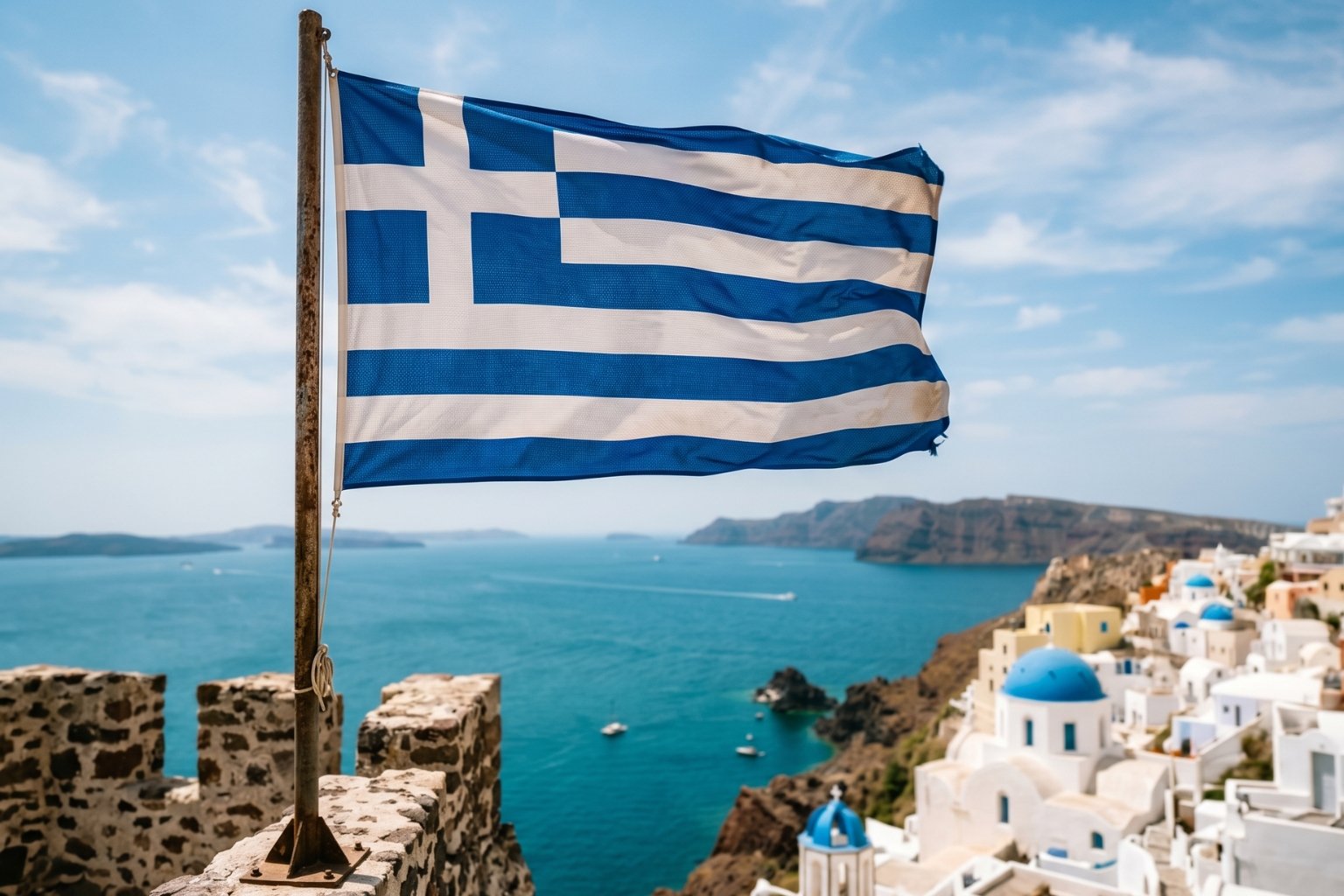

A flag that needs no caption. The blue, the white, the cross in the upper left corner: you recognize it instantly, from the bow of a Aegean ferry, from a whitewashed wall in the Cyclades, from a late-night news broadcast out of Athens. What most people read at a glance, Greeks read like a sentence, one that took two centuries and several regimes to finish writing.
What Does the Greece Flag Look Like?
The Greek national flag consists of nine horizontal stripes alternating blue and white, five blue and four white, with blue at both the top and the bottom. In the upper left corner, a blue canton bears a white Greek cross with four arms of equal length. The official width-to-length ratio is 2:3.
This design, in its current form, has been officially in use since December 22, 1978. Its roots go back to 1822 and run through a history that is anything but straightforward.
One detail consistently overlooked: the cross is a Greek cross, with equal arms, not a Latin one. That is not an accident. It is a statement.
The Colors of the Greece Flag and What They Really Mean
Blue
The blue of the Greek flag is everywhere. On the church domes of Santorini, on the doorways of houses in Mykonos, in the water that lines more than 16,000 kilometers of coastline. It is hard to think of a color more thoroughly embedded in a national geography.
Officially, blue represents the sky and the sea, the two horizons that have defined Greece since antiquity. It also evokes faith in the Greek Orthodox Church and the purity of the independence struggle in the nineteenth century.
But here is the detail almost no one mentions: the exact shade of blue has never been officially fixed. The 1978 Greek law governing the flag uses the word kyanos, which can mean light blue or dark blue depending on context. As a result, the shade has shifted with every era, often for reasons that were entirely political.
Under the Bavarian dynasty (1833 to 1862), which placed the young King Otto on the throne of a freshly independent Greece, the blue was very pale, almost milky, a direct echo of Bavarian national symbols. A deeper shade gradually took hold afterward. Under the military junta (1967 to 1974), a very dark blue was officially mandated. That was not an aesthetic preference. It was a signal of authority, of control, of weight. When democracy was restored, the blue lightened again. The color of a flag is never neutral.
Today the shade is still left to the discretion of flag manufacturers, meaning two Greek flags hanging side by side may not be the same blue. That legal ambiguity says something interesting about how nations live with their own symbols.
White
White stands for purity, for Mediterranean light, for the foam of the sea. In Orthodox Christian vocabulary it carries connotations of holiness and truth. Visually, the contrast between white and blue is immediate and unambiguous. It is the contrast of the Greek landscape itself, white stone against dark water.
What Do the Nine Stripes Mean?
The answer you will find everywhere: the nine stripes represent the nine syllables of the Greek battle cry Eleftheria i Thanatos, “Freedom or Death“, the rallying phrase of the war of independence.
What most sources fail to mention: this is not the official meaning. The 1978 law assigns no explicit significance to the number of stripes. The syllable interpretation is popular, deeply embedded in collective memory, repeated in schools, and very probably present in the minds of those who designed the flag. But it remains an interpretation, not a declaration of state.
Other theories exist. Some point to the nine Muses of Greek mythology. Others simply see the rhythm of Aegean waves, a less heroic explanation but perhaps just as accurate. The ambiguity itself is telling. A people who built their national identity around freedom may not have needed their symbols fully codified to be fully understood.
The Cross: Faith, Nation, and the Role of the Orthodox Church
The cross is the oldest element on the Greek flag. It appeared on revolutionary banners long before the stripes were standardized. To understand why, you need to understand what the Orthodox Church meant during four centuries of Ottoman rule.
Through that period, monasteries and priests kept the Greek language alive, preserved texts, maintained rites, held culture together. The Church was not simply a religious institution. It was the custodian of the nation. When the revolution broke in 1821, flags carried crosses because faith and country were, in the minds of those fighting, the same thing.
The cross sits in the upper left canton, a position of heraldic prominence. It does not dominate the center, it does not overwhelm the stripes. It is there, steady and firm, more of an affirmation than a performance.
Worth knowing: for a long time, Greece had two simultaneous official flags. A land flag consisting of a plain blue field with a white cross, and a naval ensign consisting of the nine stripes with the canton. The naval ensign only became the sole national flag for all uses in 1978.
The History of the Greece Flag
Before 1822: A Revolution Looking for Its Symbol
In 1821, when Greeks rose against the Ottoman Empire, there was no unified flag. Each region, each warlord, each village carried its own colors. Black, white and red stripes, symbols of the Society of Friends (Filiki Eteria), the secret organization that ignited the uprising. Phoenixes rising from ash. Byzantine eagles. Icons of saints. Crosses on fields of varying colors.
The oldest date commonly cited is 1807, when, according to tradition, the first blue and white flag bearing a cross was woven, blessed, and raised at the Evangelistria Monastery on the island of Skiathos. That monastery still stands. The flag it reportedly sheltered is considered the direct ancestor of the current one.
A second lead, rarely mentioned in mainstream sources: the coat of arms of the Kallergis family, a Byzantine-origin Cretan aristocratic family, bears a striking resemblance to the modern Greek flag. Some historians believe this design may have influenced, consciously or not, the choices made by the founding assembly. No official document of the time confirms it. But absence of proof is not proof of absence.
1822: The First National Assembly at Epidaurus
In January 1822, the First National Assembly convened at Epidaurus and adopted Greece’s first provisional constitution. It decided the national flag would be blue and white, and tasked the executive branch with fixing its exact form.
On March 15, 1822, Executive Decision 540 was signed. It created two flags. The land flag: a blue field with a white cross extending to all four edges, symbolizing “the wisdom of God, freedom, and country.” And the naval ensign: five blue and four white alternating stripes with the cross canton in the upper left corner.
That naval ensign, designed originally for ships, would become the flag of the entire country 156 years later.
From Kingdom to Republic: The Crown, the Junta, and a Blue That Kept Changing
| Period | Event | Impact on the Flag |
|---|---|---|
| 1833 to 1862 | Reign of Otto, Bavarian prince | Very pale blue, matching Bavarian colors |
| 1863 | Accession of George I, Danish prince | A crown added above the cross on all flags |
| 1924 | Second Hellenic Republic established | Crown removed |
| 1935 | Monarchy restored | Crown returns |
| 1967 | Military junta seizes power | Crown removed, very dark blue mandated, land flag abolished |
| 1974 | Fall of the junta, return to democracy | Progressive transition |
| December 22, 1978 | Law 851 | Naval ensign becomes the sole national flag |
Two centuries of politics, compressed into the modifications of a single symbol. Every addition or removal of a crown marks a change of regime. Every shift in blue reflects a national mood.
What Greeks Call Their Flag, and Why the Name Matters
Greeks have two names for their flag. Galanolefki (Γαλανόλευκη), meaning light blue and white. And Kyanolefki (Κυανόλευκη), meaning azure and white, a darker shade, more solemn, more literary.
The choice between the two is not trivial. Galanolefki is the everyday name, the one heard in streets and stadiums. Kyanolefki turns up in literature, official speeches, and moments of national gravity. The difference is roughly what separates “the country” from “the homeland.” Same referent, entirely different register.
The flag is officially raised on two national holidays each year. March 25, Independence Day, marking the start of the 1821 revolution. And October 28, known as Ohi Day, commemorating the moment General Metaxas refused Mussolini’s 1940 ultimatum and chose war over capitulation. On that date, the Galanolefki is not just a historical symbol. It is the answer itself.
Greece Flag: Key Facts at a Glance
| Element | Detail |
|---|---|
| Official names | Galanolefki / Kyanolefki |
| Current design adopted | December 22, 1978 |
| Proportions | 2:3 |
| Colors | Blue (shade not fixed by law) and white |
| Stripes | 9 total (5 blue, 4 white) |
| Canton | Blue field with white Greek cross |
| Cross meaning | Eastern Orthodox Christianity |
| Color meaning | Sky, sea, purity, faith |
| 9 stripes meaning | Popular interpretation: 9 syllables of Eleftheria i Thanatos |
| Flag days | March 25 (Independence) and October 28 (Ohi Day) |
