

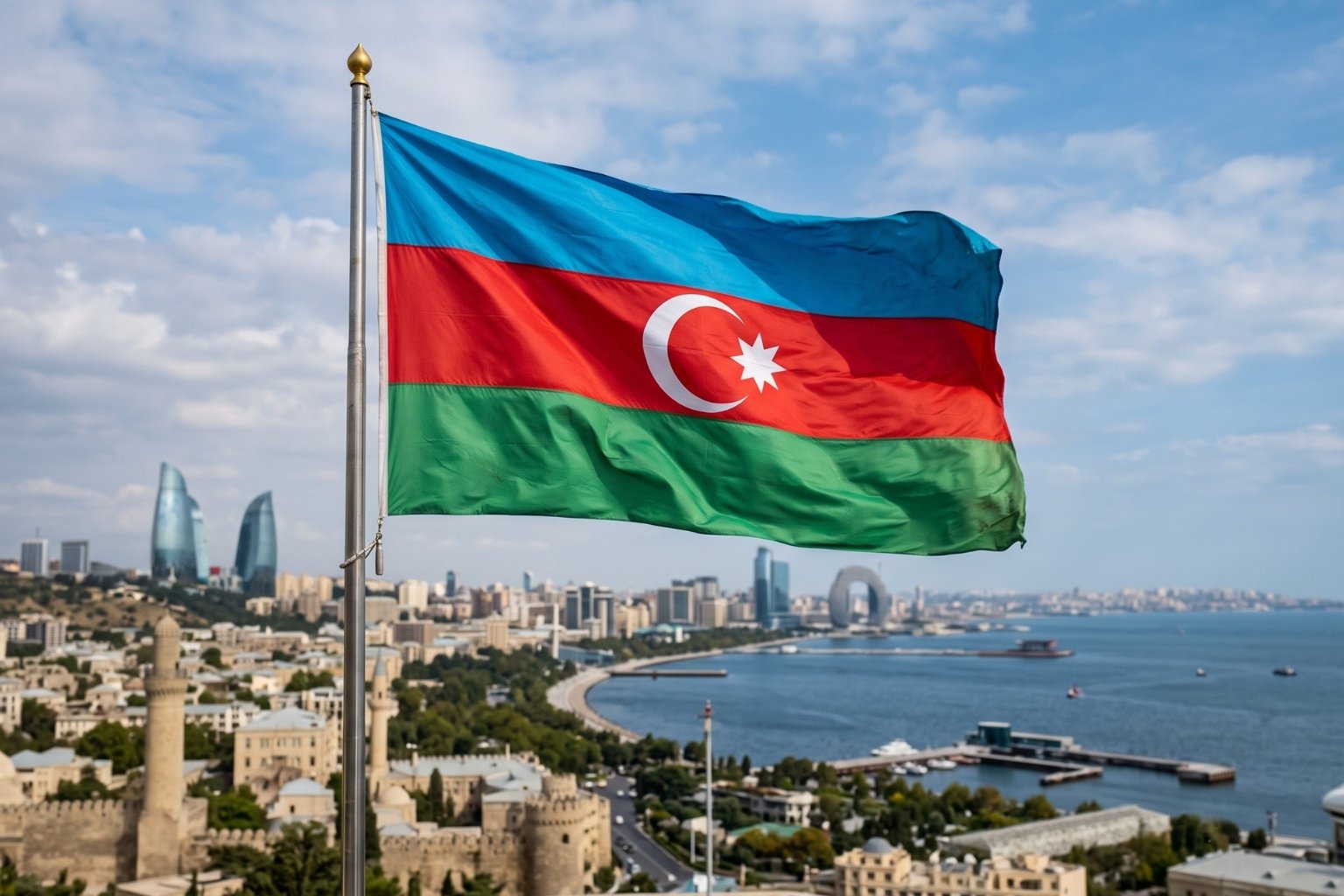

Stand on a balcony in Baku on any given morning and you will likely see it somewhere: three bright bands of blue, red and green, a small white crescent and star sitting quietly in the middle. It looks simple at first glance. It is not. Every color, every angle of that star, carries a piece of Azerbaijan’s story, from a short lived republic in 1918 to the independent nation it is today.
What the Azerbaijan Flag Looks Like
The national flag of Azerbaijan is a horizontal tricolor made of three equal stripes: blue on top, red in the middle, green on the bottom. In the center of the red stripe sits a white crescent moon and an eight pointed star, visible on both sides of the flag. The official proportion is a ratio of 1 to 2, meaning the flag is twice as long as it is tall.
It is a design that reads as modern from a distance and deeply symbolic up close, which is exactly the balance Azerbaijan’s founders were reaching for a century ago.
What Each Color Means
Blue, the Turkic Identity
The blue stripe represents Azerbaijan’s Turkic heritage. It connects the country to a much wider family of Turkic nations across Central Asia and Anatolia, a shared linguistic and cultural lineage that predates the modern state itself.
Red, Progress and a Modern State
Red stands for the country’s push toward modernization and democracy. When the flag was first adopted in 1918, this stripe was a declaration of intent as much as a color choice, a young republic announcing that it wanted to build something new.
Green, Islam and Belonging
Green reflects Azerbaijan’s connection to Islamic civilization. Around 97 percent of the population identifies as Muslim, and this stripe acknowledges a faith that has shaped local architecture, festivals and daily rhythms for generations, without making the flag feel like a religious symbol first and a national one second.
Together, the three stripes were never meant to rank one identity above another. Turkic roots, Islamic faith and a modern democratic ambition sit side by side, each given equal visual weight.
The Crescent and the Eight Pointed Star
The crescent is a familiar symbol across the Islamic world, so its presence here is straightforward. The eight pointed star is where things get genuinely interesting, because historians do not fully agree on what it means.
One theory holds that the eight points represent eight branches of the Turkic peoples, among them the Azerbaijanis, Ottomans, Tatars, Kazakhs and Turkmen. Another, credited to the jurist Fatali Khan Khoyski, suggests the points simply correspond to the eight letters used to spell “Azerbaijan” in the old Arabic script. Both explanations are still cited today, and no official ruling has ever settled the debate. That ambiguity, rather than weakening the symbol, is part of what makes it worth asking a local about if you ever get the chance.
The Origin of the Flag
The flag’s intellectual origin traces back to Ali bey Huseynzade, an Azerbaijani writer and political thinker active in the years before the Russian Revolution. He rallied his followers around a three word idea: Turkify, Islamicize, Europeanize. Each word mapped to a color, Turkic pride in blue, Islamic faith in green, and European style modernization in red.
His Musavat Party used a horizontal tricolor built on this idea as early as 1917, well before it became a national symbol. What started as a political statement became, within a year, the flag of an entire country.
A Short History of the Azerbaijan Flag
1918, the Azerbaijan Democratic Republic
On 9 November 1918, the government of the newly formed Azerbaijan Democratic Republic approved the tricolor with its white crescent and star as the official state flag. It was raised over the parliament building in Baku on 7 December 1918. In his speech that day, council chairman Mammad Amin Rasulzade called it a symbol of Turkic sovereignty, Islamic culture and modern European power, and predicted it would never come down again. The Azerbaijan Democratic Republic was, notably, the first democratic republic in the Muslim world.
1920 to 1991, the Soviet Years
The promise did not hold. In April 1920, the Red Army invaded, and by May the flag was lowered outside the parliament building. For most of the Soviet period, Azerbaijan flew a red banner marked with a hammer and sickle instead. The tricolor survived only in memory and in the hands of emigrant communities abroad.
1991, Independence and Return
As the Soviet Union began to crack in the late 1980s, the old tricolor resurfaced at protests and demonstrations. Nakhchivan adopted it as its regional flag in November 1990, and the rest of the country followed on 5 February 1991, months before full independence was declared that August. The flag that flies today carries slightly refined colors and proportions compared to 1918, but the design, and the meaning behind it, remain the same.
The Flag in Azerbaijani Life Today
National Flag Day, November 9
Every year on 9 November, Azerbaijan marks National Flag Day, commemorating that first 1918 adoption. The date was formally established by law in 2009, and it is treated as a genuine point of national pride rather than a symbolic afterthought.
National Flag Square in Baku
If you want to see the flag at its most dramatic, head to National Flag Square on Baku’s waterfront. Opened in 2010, it once held the title of the world’s tallest unsupported flagpole, standing 162 meters high and flying a flag the size of a small building. There is also a flag museum on site, worth a stop if you are curious about how deeply the symbol runs through the country’s identity.
Where Travelers Encounter the Flag
Beyond the square, the flag shows up everywhere a visitor is likely to walk: government buildings, the entrance to the Old City, hotel lobbies, taxi dashboards, football stadiums. It is painted on walls and printed on clothing around national holidays, and children learn what each color means well before they learn much else about their country’s history. For a traveler, noticing it is one of the quiet, easy ways to read a place correctly.
Quick Facts
| Element | Meaning or Detail |
|---|---|
| Blue stripe | Turkic identity and heritage |
| Red stripe | Progress, modernization, democracy |
| Green stripe | Islamic faith and civilization |
| Crescent and star | Islamic symbolism, star’s eight points debated |
| First adopted | 9 November 1918, Azerbaijan Democratic Republic |
| Readopted | 5 February 1991, after Soviet rule |
| Proportion | 1 to 2 |
| Credited designer | Ali bey Huseynzade |
| National Flag Day | 9 November |
Next time you spot those three colors, whether above a government building in Baku or stitched onto a jacket at a market stall, you will know it is not decoration. It is a century of history folded into a single piece of cloth.
