

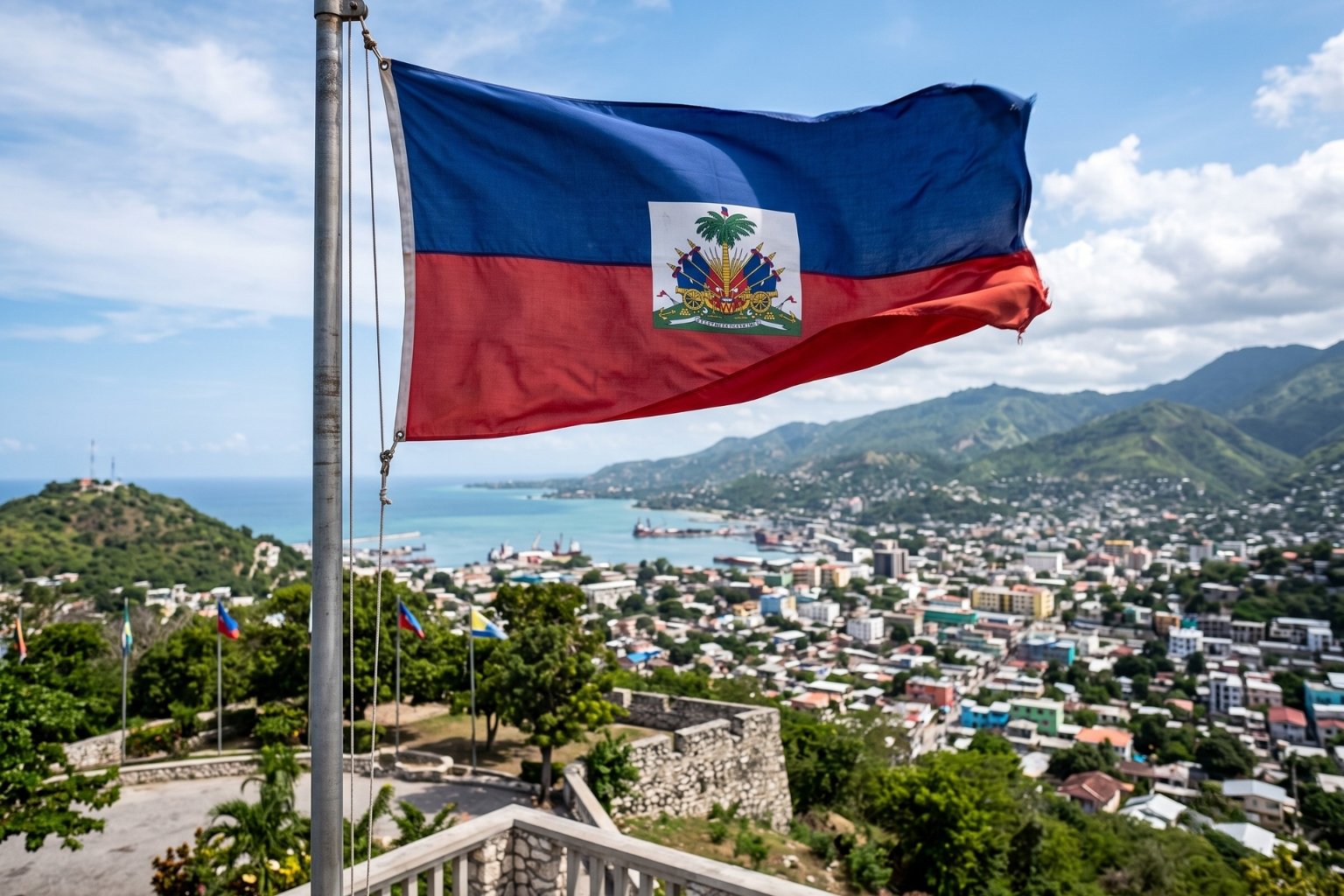

A strip of blue over red, a white square at its center, a palm tree standing guard over crossed rifles. That is the Haiti flag, and it carries more history in two colors than most flags carry in five. Born on a battlefield in 1803, it became the emblem of the first nation ever founded by formerly enslaved people. Here is what each element means, where it comes from, and how it survived an empire, a split republic and a dictatorship to reach the version flown today.
What the colors of the Haiti flag mean
The Haiti flag is built from two colors only, and each one was chosen with intent, not decoration.
Why blue
Blue sits on top of the flag and is generally read as a tribute to Haiti’s Black population and its African roots. Some historians also connect it to the Caribbean Sea that surrounds the island, tying the flag to the land itself rather than only to politics.
Why red
Red occupies the lower band and is most often linked to the mixed heritage population who fought alongside formerly enslaved Haitians during the revolution. It is also widely described as a tribute to the blood spilled during the thirteen year war for independence.
Sources disagree slightly on the exact split between “ethnic tribute” and “blood and sacrifice,” and that disagreement is itself telling. The flag was stitched together in the middle of a war, not designed by a committee with a style guide. Its meaning grew after the fact, shaped by the people who carried it.
Why the white stripe was removed
Haiti’s flag exists because a white stripe was torn away. The original French tricolor of blue, white and red was the flag flown over the colony of Saint Domingue. Removing the white band was a direct, physical rejection of French colonial rule, and it turned a colonial flag into a revolutionary one in a single gesture.
The Haiti coat of arms, explained piece by piece
On the official state flag, a white square sits at the center of the blue and red bands, carrying the national coat of arms. Every element inside it was chosen to say something specific.
| Symbol | What it is | What it means |
|---|---|---|
| Palm tree | Central tree rising from a green mound | Victory and the fertility of the land |
| Phrygian cap | Cap resting on top of the palm tree | Liberty, a symbol used since Roman antiquity |
| Six flags | Three small national flags on each side of the palm tree | The unity of the young republic |
| Cannons and rifles | Weapons arranged at the base of the tree | The armed struggle for independence |
| Drums, bugles and anchors | Scattered across the green mound | Military strength and maritime defense |
| L’Union Fait la Force | Banner beneath the mound | The national motto, meaning strength through unity |
Read together, the coat of arms is not decorative. It is a small, encoded account of how independence was won and what it would take to keep it.
The origin story, May 18, 1803
The flag was born at a gathering in Arcahaie, a coastal town north of Port au Prince, during a congress meant to unite the various factions fighting French colonial forces. According to the most widely told version of events, revolutionary leader Jean-Jacques Dessalines tore the white band out of the French tricolor by hand, leaving only the blue and red.
He handed the two pieces to his goddaughter, Catherine Flon, who sewed them back together into a single banner. That flag was raised as a rallying symbol for the fighters who would go on to defeat Napoleon’s army and declare independence the following year, on January 1, 1804. May 18 is remembered today as the date the flag itself was born, distinct from Independence Day.
How the flag changed after independence
The blue and red flag did not stay unchanged for long. Its design shifted several times as Haiti’s government did.
The empire flag of 1804
After declaring himself Emperor Jacques I, Dessalines replaced the blue and red with black and red, meant to signal mourning for those lost during the war alongside a new imperial identity. The change did not outlive him.
The north south split
Following Dessalines’ assassination in 1806, the country fractured. The north kept the black and red combination, while the south returned to the original blue and red. The two flags flew simultaneously over a divided country until reunification around 1820.
The Duvalier years
Nearly a century and a half later, black and red returned once more, this time under the Duvalier dictatorship between 1964 and 1986. The choice echoed the empire era and marked a clear break from the flag’s revolutionary, blue and red roots.
The 1986 restoration
After the fall of the Duvalier regime, the blue and red flag with its coat of arms was formally reinstated, officially confirmed on February 25, 1986. That is the version flown across Haiti today.
Flag Day in Haiti today
May 18 is a national holiday in Haiti, often celebrated alongside University Day. Streets fill with parades, schools hold flag raising ceremonies, and it is common to see people wearing blue and red or painting their faces in the national colors for the day.
For a traveler in Haiti around this date, the flag stops being a symbol seen mostly on government buildings and becomes something worn, sung to and marched behind. The same is true in Haitian communities abroad, where the day is often marked with community gatherings even far from the island itself.
Frequently asked questions
Which other flag once looked identical to Haiti’s flag? Liechtenstein’s flag was a plain blue and red bicolor almost indistinguishable from Haiti’s civil flag until 1937. The similarity was only noticed at the 1936 Olympics, when both delegations realized they were carrying the same design. Liechtenstein added a gold crown the following year to tell the two apart.
What does L’Union Fait la Force mean? It translates to “strength through unity” or “in union there is strength.” It appears on a banner beneath the coat of arms and reflects the alliance between different groups that made independence possible.
What is the difference between Haiti’s civil flag and state flag? The civil flag, used by ordinary citizens, is a plain blue and red bicolor with no emblem. The state flag, used by the government and armed forces, adds the white square and coat of arms at the center.
Why does the coat of arms sit on a white square? The white square keeps the intricate coat of arms visible against the blue and red bands. It also indirectly preserves a trace of the original French tricolor, the very color the flag was created to reject.
