

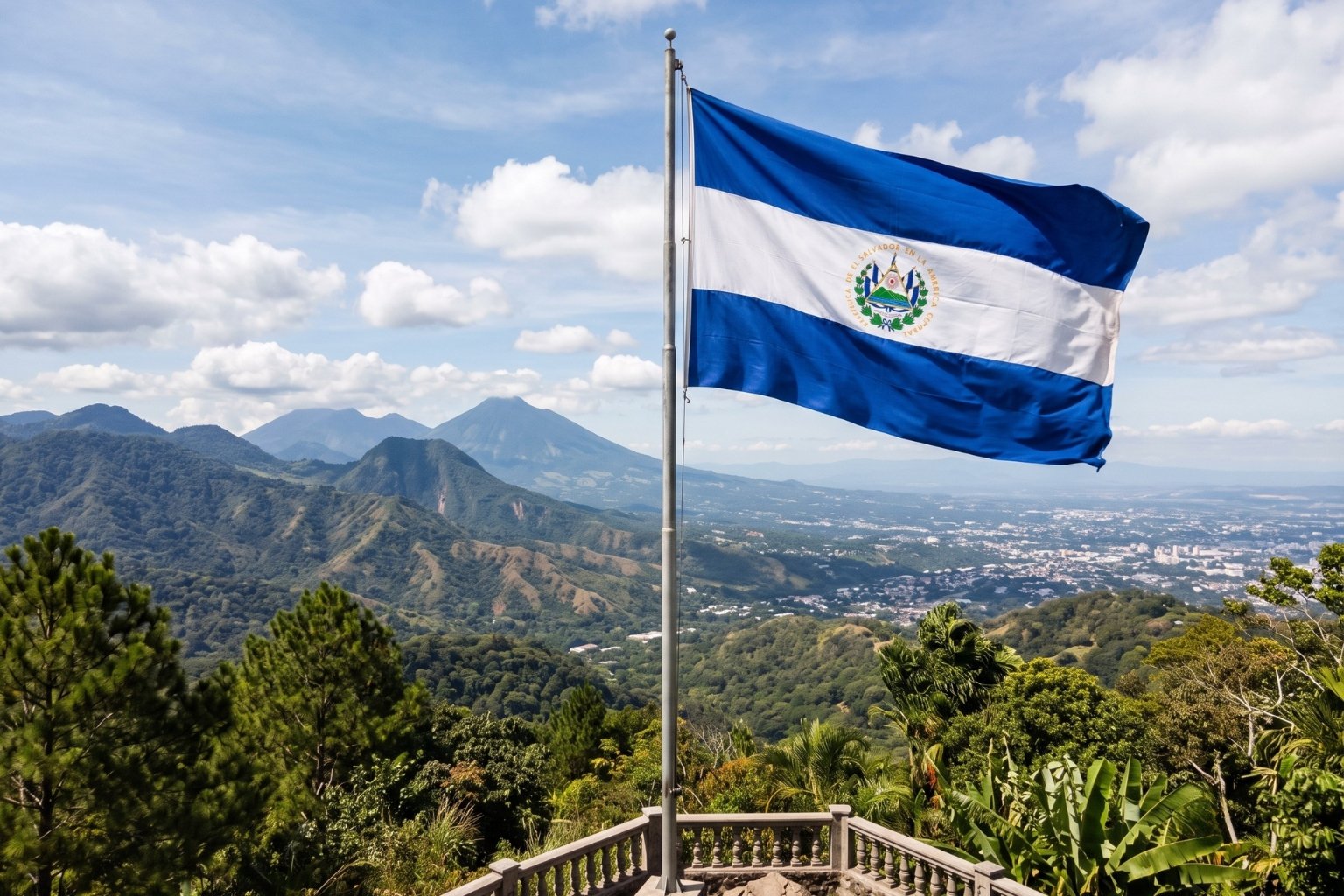

Two horizontal bands of deep blue framing a strip of white, and inside that white a small emblem packed with volcanoes, a rainbow and a golden motto. The El Salvador flag looks simple from a distance, but it carries almost two centuries of decisions about who this country wanted to be. Understanding it means understanding a piece of Central American history that most visitors never actually get explained to them.
What the Colors and Symbols of the El Salvador Flag Mean
Blue and White, Between Two Oceans and a Nod to Argentina
The two blue stripes represent the sky and the Pacific Ocean that borders the country, while the white stripe between them stands for peace. It is a clean, almost meditative palette for a country nicknamed the Land of Volcanoes. Blue also carries a quieter meaning tied to indigo, a dye once central to Salvadoran agriculture and trade, and to the country’s colonial economy long before independence.
The choice of blue and white was not accidental. It echoes the flag of Argentina, adopted in admiration of independence leaders José de San Martín and Manuel Belgrano, whose fight against Spanish rule inspired reformers across Latin America.
Reading the Coat of Arms
At the center of the white stripe sits the national coat of arms, and it rewards a closer look. Every element answers a specific idea about the young republic:
- A golden triangle representing equality, symbolizing that all citizens stand on equal footing
- Five volcanoes rising from the sea inside the triangle, one for each of the original states of the Central American federation
- A red Phrygian cap on a staff above the volcanoes, the classic symbol of liberty
- A rainbow arching over the scene, a nod to hope and peace
- Five small flags encircling the emblem, again representing the five sister nations of the former federation
- Laurel branches wrapping the whole design, a traditional mark of victory
The Motto Dios, Unión, Libertad
Underneath the triangle runs a white ribbon bearing the national motto, Dios, Unión, Libertad, meaning God, Union, Liberty. It is not decorative filler. Those three words summarize what nineteenth century Salvadoran reformers actually believed they were building: a nation rooted in faith, bound to its Central American neighbors, and finally free of colonial rule.
The History Behind the Flag
1822, a Silk Prototype Inspired by Argentina
The blue and white design traces back to 1822, when General Manuel José Arce introduced a triband modeled on Argentina’s flag. According to tradition, the very first version was sewn by hand from white and pale blue silk by Arce’s wife and sister, a detail that turns a national symbol into something personal.
The Federation Years, One Flag for Five Nations
In 1823, the newly formed Federal Republic of Central America officially adopted the blue, white, blue design as its shared flag. El Salvador used this version through its early years as part of the federation, alongside Guatemala, Honduras, Nicaragua and Costa Rica, all flying essentially the same colors under one political project.
1865, When El Salvador Looked Elsewhere
When the federation dissolved, El Salvador briefly stepped away from the shared design. Around 1865, the country adopted a flag with red and white stripes and a blue canton, visibly inspired by the flag of the United States. It was a short lived experiment, a statement of independence from the old federal identity rather than a lasting national symbol.
1912, Blue and White for Good
The blue, white, blue triband returned in 1912 and this time it stayed, formally adopted with the coat of arms placed at its center. That return marked a kind of reconciliation with the country’s federal roots, choosing to honor the shared Central American past rather than erase it. It remains the flag flown today.
Why the El Salvador Flag Looks So Much Like Its Neighbors
Anyone who has spent time in Central America has probably mixed up these flags at least once, and there is a good reason for that. Honduras, Nicaragua and El Salvador all descend from the same federal banner of the 1820s.
| Country | Stripes | Central Emblem | Quick Visual Tell |
|---|---|---|---|
| El Salvador | Blue, white, blue | Detailed coat of arms with volcanoes and rainbow | Busiest, most detailed emblem of the three |
| Honduras | Blue, white, blue | Five blue stars in an X pattern | No coat of arms, just five simple stars |
| Nicaragua | Blue, white, blue | Triangle with volcanoes and a rainbow, simpler than El Salvador’s | Plainer triangle, no laurel branches or small flags |
The stripes alone will not help identify the country. The center of the flag always will.
Where You’ll Actually See the Flag in El Salvador
The flag is far more present in daily life than a tourist might expect. It flies over government buildings and schools, but it truly comes alive on Independence Day, September 15, when streets across the country fill with parades, marching bands and blue and white everything, from face paint to bunting.
Football matches turn the flag into something closer to a shared heartbeat. When the national team plays at the Estadio Cuscatlán in San Salvador, the stands become a solid wave of blue, and the anthem before kickoff carries genuine weight rather than routine formality.
For the large Salvadoran diaspora abroad, especially in cities like Los Angeles, Houston and Washington D.C., the flag takes on an even more emotional role. It shows up at festivals, on car windows and at family gatherings, a compact way of carrying home along wherever life has taken people.
Fast Facts About the El Salvador Flag
- Adopted: May 27, 1912
- Design: Three equal horizontal stripes, blue, white, blue
- Central symbol: National coat of arms with five volcanoes, a Phrygian cap and a rainbow
- National motto: Dios, Unión, Libertad (God, Union, Liberty)
- Color inspiration: The flag of Argentina, in tribute to San Martín and Belgrano
- Closest relatives: Honduras and Nicaragua, both descended from the same 1820s federal flag
A small country, the smallest in Central America by land, wrapped its entire founding story into two colors and a triangle. Once you know how to read it, the El Salvador flag stops being background scenery and starts telling you exactly where you are.
