

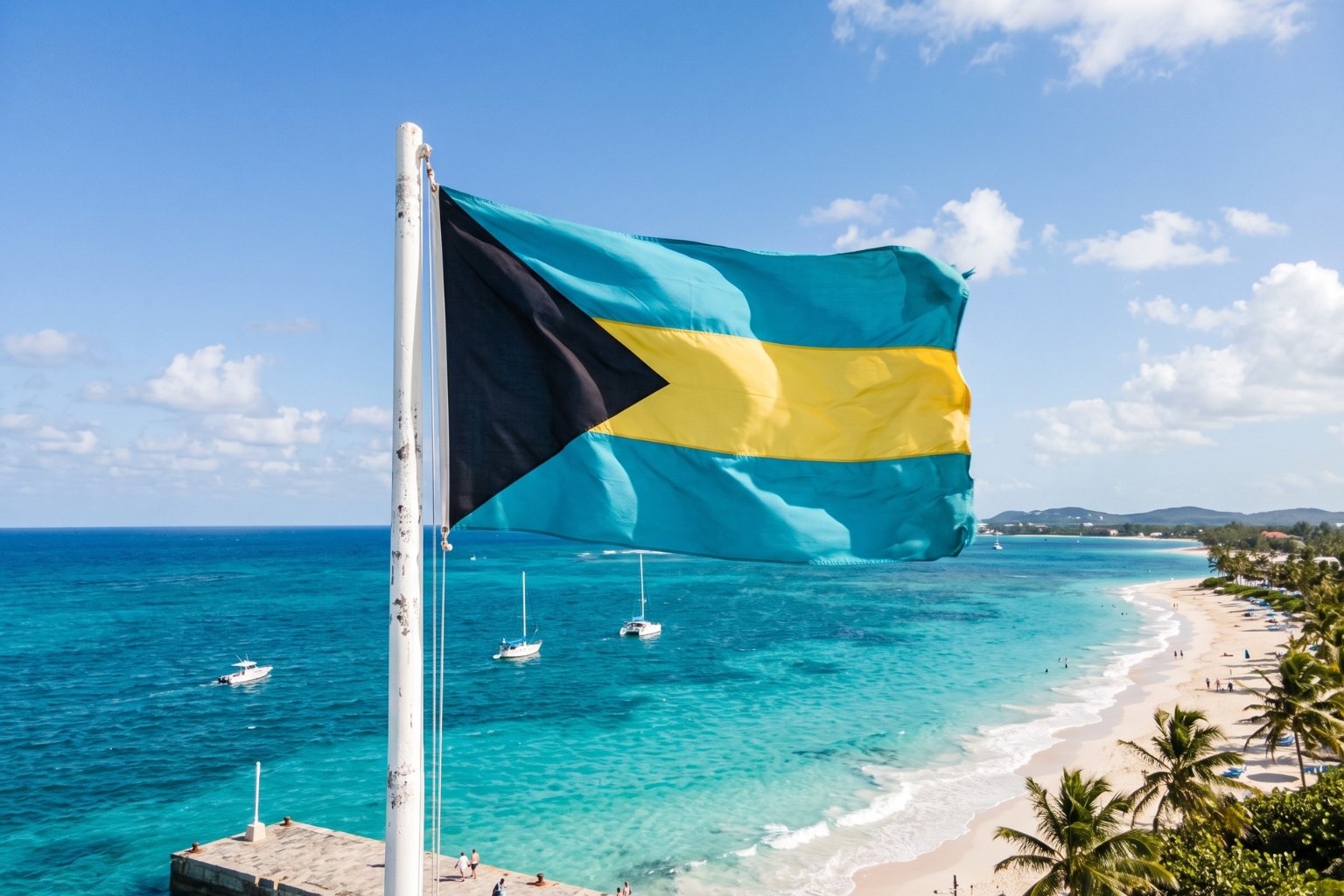

The first time you see the Bahamas flag snapping in the wind above Nassau harbour, it feels less like a national symbol and more like a postcard. Aquamarine, gold, and black, arranged with a confidence that mirrors the islands themselves. Behind that simple design sits a story of pirates, a colonial past, and a contest that shaped a young nation’s identity.
What the Bahamas Flag Looks Like
The flag is built from three equal horizontal bands: aquamarine on top, gold in the middle, aquamarine again at the bottom. A solid black equilateral triangle sits at the hoist, its tip pointing toward the center of the flag. The overall proportions follow a 1:2 ratio, meaning the flag is twice as wide as it is tall.
It is a design that reads instantly, even from a distance, which is exactly why it works so well on a boat mast in the Exumas or above a government building in Nassau.
What Each Color and Symbol Represents
Every element on the flag was chosen with intent. Nothing here is decorative filler.
Aquamarine, the color of every shoreline
The two aquamarine bands represent the water that surrounds all 700 islands and cays of the archipelago. Anyone who has snorkeled off Exuma or swum at Cable Beach will recognize the shade immediately. It is not a generic blue. It is the specific, glowing turquoise that Bahamian waters are known for worldwide.
Gold, the sun and the sand
The central gold band stands for the sun and the sand, and by extension the natural resources of the land itself. It is a nod to the light that defines the Bahamian climate almost as much as the sea does.
The black triangle, unity and determination
The black triangle symbolizes the strength and unity of the Bahamian people. Its tip pointing inward is often read as a sign of a nation reaching toward its own resources and its own future, rather than looking outward toward a colonial power.
| Element | Approximate color | Meaning |
|---|---|---|
| Top and bottom bands | Aquamarine | The sea surrounding the islands |
| Central band | Gold | The sun, the sand, and the land’s resources |
| Triangle at the hoist | Black | The strength and unity of the people |
The History Behind the Design
Before independence, the Blue Ensign and the pirate motto
For more than a century before independence, the Bahamas flew a Blue Ensign, a deep blue field with the Union Jack in the corner and a colonial badge on the fly. That badge showed a British ship in pursuit of pirate vessels, a direct reference to Nassau’s old reputation as a pirate stronghold in the early 1700s. Around the badge ran a Latin motto, roughly translated as pirates expelled, commerce restored, a small but telling detail for anyone who enjoys the region’s buccaneer history as much as its beaches.
The road to July 10, 1973
As independence approached in the early 1970s, Bahamian authorities launched a national competition to design a new flag. Rather than crown a single winning entry, organizers combined elements from several submissions to reach the final design. Architect and artist Hervis Bain is often credited as the figure who shaped the winning concept. The flag was officially hoisted for the first time on July 10, 1973, the exact date the Bahamas became an independent nation, and it has not changed since.
Where the Flag’s Story Comes Alive Today
The symbolism on the flag is not just theory. It shows up everywhere you look once you are actually on the islands.
- During Junkanoo, the explosive street parade held around Boxing Day and New Year, black, gold, and turquoise costumes echo the flag’s palette in feathers, crepe paper, and paint.
- At Fort Charlotte and around Government House in Nassau, the flag flies at full size, giving visitors a proper first look at the colors up close.
- In local straw markets, vendors weave gold and aquamarine thread into hats and bags, a quiet, everyday tribute to the same colors that fly over the harbour.
- Even Bahamian rum cake packaging and conch shell stands along the roadside tend to lean on this same trio of colors, almost by instinct.
Once you notice the pattern, it is hard to unsee it. The flag is not a symbol locked in a government building. It lives in the streets, the markets, and the parades.
Good to Know Before You Go
A few practical details worth knowing if the flag catches your eye during a trip.
The Bahamian flag is treated with real formality: it should never touch the ground and is flown at half mast only on designated days of national mourning. Visitors will also notice a family resemblance with the flag of Barbados, which uses a similar blue and gold arrangement, though Barbados adds a trident rather than a triangle, a nod to Neptune rather than to pirates and colonial trade.
Frequently Asked Questions
Why does the Bahamas flag have a black triangle? The black triangle represents the strength and unity of the Bahamian people, with its tip pointed inward to symbolize their determination to develop the country’s own land and sea resources.
When was the current Bahamas flag adopted? The flag was officially adopted on July 10, 1973, the same day the Bahamas gained independence from the United Kingdom.
What was the Bahamas flag before independence? Before 1973, the islands flew a Blue Ensign featuring the Union Jack and a colonial badge showing a ship chasing pirate vessels, framed by a Latin motto about pirates being expelled and commerce restored.
Who designed the Bahamas flag? No single entry won the national design contest. Several submissions were combined to create the final flag, with Hervis Bain widely credited for shaping the winning concept.
