

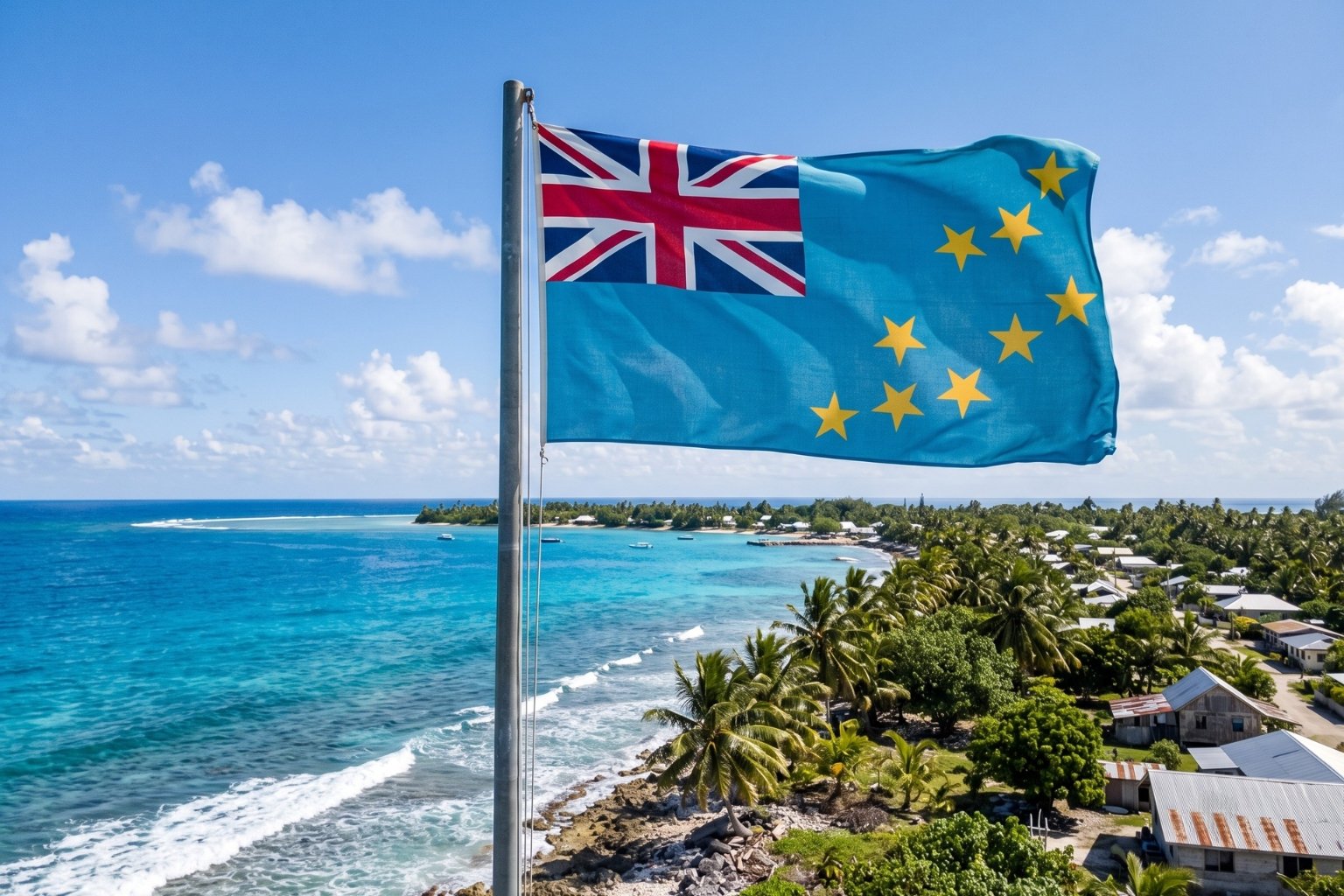

A small Pacific nation, nine islands scattered across miles of open ocean, and a corner of the Union Jack that refuses to disappear. The flag of Tuvalu tells a far more eventful story than its colors suggest. Behind the blue and yellow sits a political fight, a name that nearly cost the flag one of its stars, and an island that barely existed when the design was first drawn.
What the Tuvalu Flag Looks Like Today
The flag is a light blue field with the Union Jack placed in the canton, the upper hoist corner. In the fly, nine yellow, five pointed stars are scattered in a layout that roughly mirrors the real position of the islands on the map, with east oriented toward the top.
Nothing here is decorative. The blue chosen is lighter than the standard blue used on British ensigns, a quiet way for Tuvalu to mark its own identity while keeping a visual link to its colonial past.
| Element | Detail |
|---|---|
| Colors | Light blue, yellow, red and white (within the Union Jack) |
| Proportions | 1:2 |
| Stars | 9, yellow, five pointed |
| Status | National flag and official ensign |
| First adopted | 1 October 1978 |
| Current version | Restored on 11 April 1997 |
What Each Element of the Flag Means
The Light Blue Field: The Pacific Ocean
The blue background stands for the ocean and sky surrounding the islands of the archipelago. For a nation where no point of land rises more than a few meters above sea level, the ocean is not scenery. It shapes climate, economy, and how people move between islands.
The Union Jack: A British Legacy
The flag of the United Kingdom in the canton recalls that Tuvalu, once known as the Ellice Islands, was part of the British Empire before becoming independent. It also marks the country’s membership in the Commonwealth.
This detail nearly disappeared from the flag entirely, and the way people reacted says a great deal about what that link still means to them.
The Nine Yellow Stars: One for Each Island
Each star corresponds to one of the nine islands that make up Tuvalu. Their position on the flag roughly follows their true geographic arrangement.
| Island | Worth knowing |
|---|---|
| Funafuti | Capital and most populated atoll |
| Nanumea | Northernmost island of the archipelago |
| Nanumanga | Small volcanic island with no lagoon |
| Niutao | Densely populated relative to its size |
| Nui | Mixed Gilbertese and Polynesian settlement |
| Nukufetau | Large lagoon, former American airbase |
| Nukulaelae | Sparsely populated, strong religious traditions |
| Vaitupu | Largest island, home to a well known national school |
| Niulakita | Smallest and southernmost, uninhabited for a long time |
The Real History Behind the Flag
Independence and the Original Flag, 1978
After separating from the Gilbert Islands, which became Kiribati, the Ellice Islands became Tuvalu and gained independence on 1 October 1978. A new flag was designed for the occasion by Vione Natano, with a layout deliberately close to that of neighboring Fiji.
The Name Behind the Design
The word Tuvalu literally means “eight together,” referring to the eight islands that were historically inhabited. The ninth, Niulakita, stayed empty until after early European contact, only being settled later. The flag, however, already carried nine stars from the start, quietly anticipating that island’s future.
A Flag That Lasted Only Two Years, 1995 to 1997
In October 1995, one star was removed from the flag to match the country’s name and its eight historically inhabited islands. A few months later, in January 1996, then Prime Minister Kamuta Latasi went further and introduced an entirely new flag, dropping the Union Jack in favor of the national coat of arms.
The reaction was immediate. On the island of Niutao, residents tore the new flag down themselves the first time it was raised. Many saw it as disrespectful toward the British monarchy, to which part of the population still felt attached. The backlash weighed heavily on Latasi’s political downfall.
On 11 April 1997, following a narrow vote in parliament, the original design was restored, complete with nine stars and the Union Jack. It has not changed since.
The Coat of Arms, Briefly
Tuvalu’s coat of arms sometimes appears alongside the flag, particularly on the state ensign. It features a Maneapa, the traditional meeting house found across the islands, framed by blue and gold stripes evoking the ocean and the atolls. A coconut palm and a banana plant border the shield, two staple food sources of the archipelago. A banner below carries the national motto, “Tuvalu mo te Atua,” which translates roughly to “Tuvalu for the Almighty.”
Why This Flag Still Matters Today
Tuvalu is among the nations most exposed to rising sea levels. Several of its nine islands could become uninhabitable within decades, a reality the country raises regularly on the international stage.
Seen in that light, a flag built around nine specific points on a map takes on a different weight. It is no longer only a symbol of unity between islands scattered far apart. It is also a visible record of a geography the country intends to hold onto, one star at a time, for as long as it can.
