

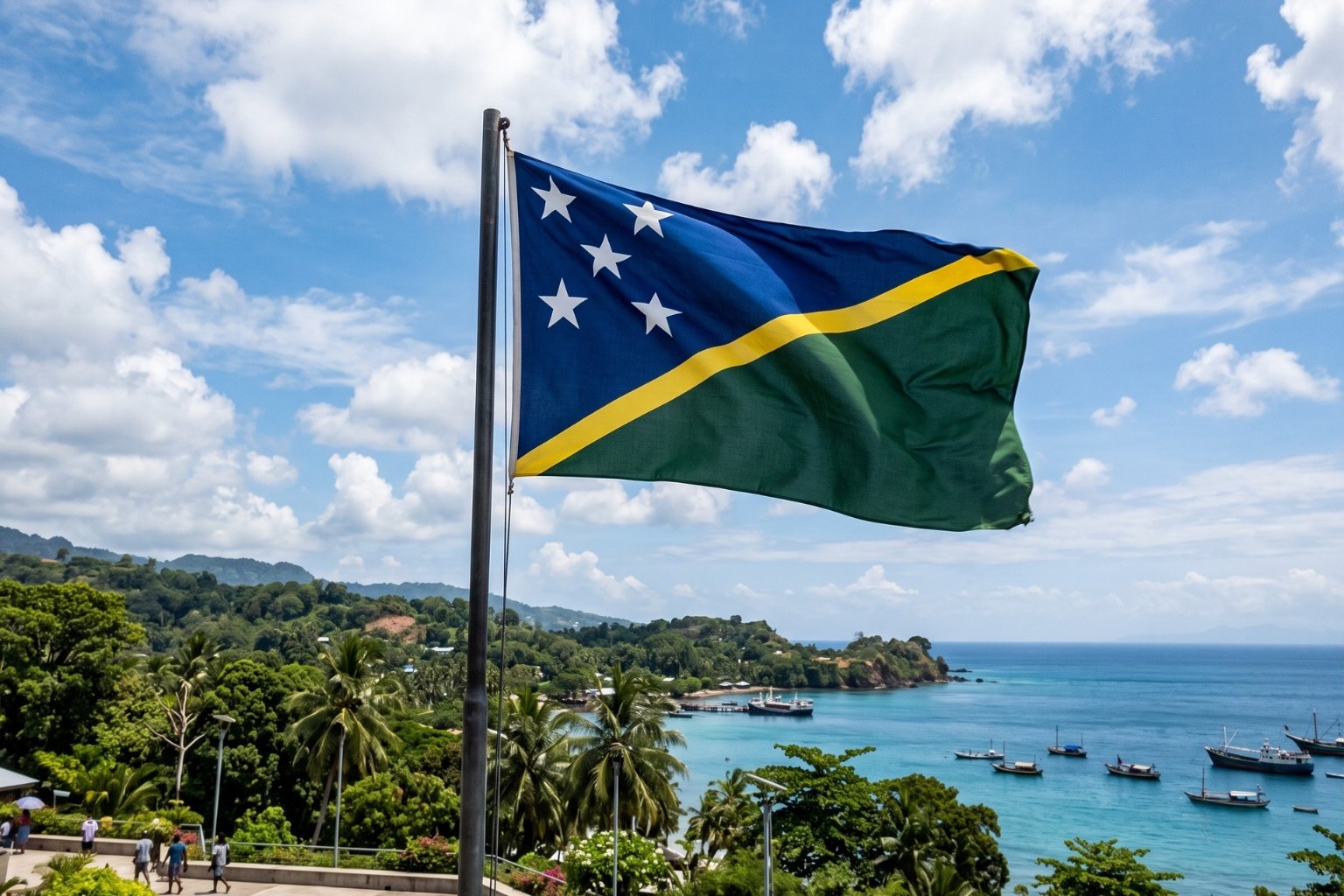

The Solomon Islands flag splits a field of blue and green with a single diagonal stripe of yellow, and five white stars sit clustered near the hoist like a small constellation. It looks simple from a distance, but the story behind it involves a rejected design about the trauma of colonial labor practices, a chief minister’s public competition, and a symbolism that quietly stopped matching the country’s own map decades ago. Understanding the Solomon Islands flag means understanding both what its colors were built to say and what got left behind in the final version.
What the Flag Actually Looks Like
The design is deceptively minimal. A thin yellow diagonal stripe runs from the lower hoist corner to the upper fly corner, cutting the flag into two triangles. Above it sits a blue triangle carrying five white five pointed stars, grouped near the hoist in an X shaped pattern. Below the stripe, the second triangle is a plain green.
| Element | Position | Detail |
|---|---|---|
| Diagonal stripe | Lower hoist corner to upper fly corner | Yellow, divides the field |
| Upper triangle | Hoist side, above the stripe | Blue, holds the five stars |
| Lower triangle | Fly side, below the stripe | Solid green |
| Five stars | Clustered inside the blue triangle | White, five pointed, X pattern |
| Flag ratio | Overall proportions | 1 to 2, width to length |
Nothing about the layout is decorative filler. Every triangle, every star, and the stripe itself were chosen to say something specific about the islands.
The Meaning Behind Every Color and Star
Blue Is Rivers, Rain, and Ocean at Once
The blue triangle is usually read as simply the ocean, and it is that. But the original intent behind the color folds in more than the sea around the archipelago. It also stands for the rivers and rainfall that shape daily life across the islands, since fresh water has always mattered as much as the Pacific itself to how people here live and farm.
Green Is the Fertile Land
The green triangle represents the land itself, specifically its trees and crops. Agriculture still anchors much of the economy across the provinces, so the color reads less like a scenic backdrop and more like an economic statement folded into the flag.
Yellow Is the Line Between Sea and Soil
The yellow stripe stands for sunshine, but its placement carries its own logic. It physically separates the blue from the green, so the design literally draws the line between water and land the same way geography does across a nation made of hundreds of islands.
Five White Stars, an Old Map Frozen in Time
This is where most explanations get sloppy, and it is worth being precise. The five stars originally represented the five administrative districts the territory was divided into at the time of independence. Since then, the Solomon Islands has grown to nine provinces plus the capital territory of Honiara, yet the flag was never redesigned to add more stars. The number stayed fixed even as the map underneath it kept changing, which makes the stars less a literal count of regions today and more a fossil of how the country was organized the moment it became sovereign.
A Flag Born From a Contest, Not a Committee
Long before this design existed, the territory went through a public search for its national symbol. In 1975, Chief Minister Solomon Mamaloni opened a competition inviting citizens to submit flag ideas that could represent the coming transition to self government.
The early front runners were far bolder than what eventually won. One proposal centered on a frigate bird set against a yellow disc. Another used a red field marked with chained figures, a direct reference to the history of blackbirding and forced labor that had scarred the islands during the colonial period. Both were dropped, seen as either too visually complex or too politically loaded to represent a new nation on its first flag.
What replaced them was the plain diagonal design still flying today, officially adopted on November 18, 1977, a full eight months before the Solomon Islands became independent. The choice favored clarity and natural symbolism over confrontation, which says something about how the new state wanted to present itself on day one.
From Colonial Ensigns to a Sovereign Flag
Before 1977, nothing about the flag over these islands was locally designed. Britain and Germany carved up the archipelago between themselves in 1886, and Britain formally declared its Solomon Islands Protectorate in 1893. For decades afterward, the territory flew standard British colonial flags, the Union Jack and the Blue Ensign, each dressed up with a local badge rather than a true national symbol.
That badge changed more than once. An early version simply carried the protectorate’s name beneath the royal crown. A 1947 redesign replaced it with a stylized black and white sea turtle. By 1956, the badge grew into a full quartered coat of arms featuring an eagle, a turtle, a lion, a frigate bird, and traditional weapons, an attempt to represent the territory more completely rather than lean on a single symbol tied to one district.
All of that colonial layering ended on July 7, 1978, when the Solomon Islands gained full independence in a ceremony held in Gizo, in Western Province, becoming the last British protectorate in the Pacific to do so.
Telling It Apart From Other Pacific Flags
The diagonal split immediately calls to mind Tanzania’s flag, though the resemblance stops at geometry. Tanzania’s diagonal carries entirely different colors and a different national story, so the shared shape is coincidence rather than shared meaning.
Stars are a recurring motif across the Pacific too. Papua New Guinea and Micronesia both use stars in their own national flags, but in each case the count and placement point to a different local reality, whether that is provinces, island groups, or federated states. Spotting a flag with stars in this part of the world is only the first step. What the stars count, and why, is where the real distinction sits.
Where You Will Actually See It
The flag is most visible each July 7, when the Solomon Islands marks Independence Day with public ceremonies centered in Honiara. Outside of that date, it flies over government buildings in the capital and over provincial offices across the country, a routine marker of administration rather than a special occasion.
It also travels with the people. Solomon Islanders living abroad raise it at community gatherings, and it appears reliably at international sporting events, where it doubles as a quick, recognizable stand in for a nation many visitors know more through its diving and its history than its politics.
Quick Answers on the Solomon Islands Flag
When was the flag adopted? November 18, 1977, eight months ahead of full independence.
Why five stars if there are nine provinces now? The stars represented the five original administrative districts at independence. The design was never updated as the country restructured into more provinces.
What flew before this flag? British colonial ensigns, including the Union Jack and the Blue Ensign, each carrying a local badge that changed design several times between the 1890s and the 1950s.
