

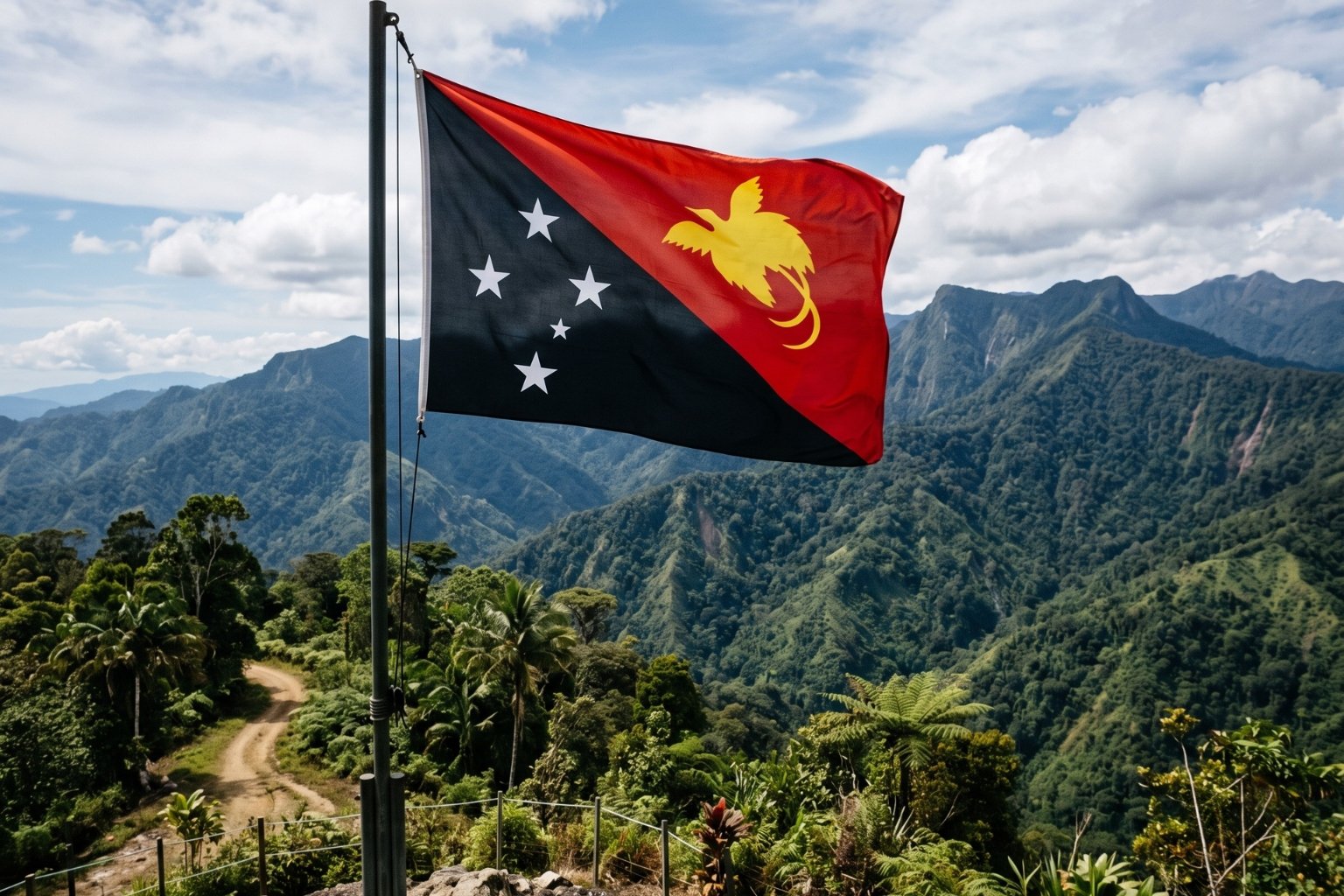

Cut diagonally in half, one triangle red, the other black, a golden bird caught mid flight above five white stars. The flag of Papua New Guinea looks like nothing else flying today. It was not designed by a committee of diplomats or a paid graphic artist. It was sketched by a 15 year old schoolgirl on a page torn from her exercise book, and against all odds, parliament chose it.
What the Papua New Guinea flag looks like
The flag is split diagonally from the upper hoist corner to the lower fly corner. The upper triangle is red and carries a soaring golden Raggiana bird of paradise. The lower triangle is black and carries five white stars forming the Southern Cross. The official proportion is 3 to 4, slightly taller in relation to its width than most national flags.
A diagonal cut that breaks every convention
Most national flags rely on horizontal stripes, vertical bands, or a canton in the corner. Papua New Guinea’s full diagonal split into two triangles puts it in a small, distinctive club of world flags, and it reads as bold and immediate even at a glance, which is exactly what the 1971 design committee was hoping for.
The Raggiana bird of paradise in flight
The bird shown on the red triangle is the Raggiana bird of paradise, a species found only in the rainforests of New Guinea. Its long, fanning plumes have been worn in ceremonial headdress across the country for generations, long before anyone put the bird on a flag, which is part of why it reads as authentic rather than decorative.
The Southern Cross in five stars
The black triangle carries four larger stars and one noticeably smaller one, echoing the real proportions of the Southern Cross constellation, where the star Epsilon Crucis genuinely shines dimmer than its four companions. The same constellation appears on the flags of Australia, New Zealand, and Samoa, a quiet nod to shared skies across the Pacific.
Official proportions and a lesser known naval version
The flag was formally adopted on 1 July 1971, with a fixed 3 to 4 ratio. Fewer people know there is also a naval ensign version, a white field carrying the national flag in the canton, used specifically at sea.
What the colors and symbols actually mean
Here is where most sources get sloppy. Unlike the design itself, which is spelled out precisely in official documents, the exact symbolism of the colors was never fixed by a single government charter. Different sources genuinely disagree on the details, and a good article should say so rather than repeat one version as absolute fact.
| Element | Commonly cited meaning | Cultural root |
|---|---|---|
| Red | Bravery, or the country’s emergence into nationhood | Red ochre pigment, long used in body painting and ceremony |
| Black | The people of Papua New Guinea, ancestral connection | Traditional color across tribal art, carving, and dress |
| Gold or yellow | Mineral wealth, or the nation’s freedom | The natural color of the bird of paradise itself |
| White | The Southern Cross | Represents the stars, tied to geography rather than tribal tradition |
Red and black, colors that predate the flag by centuries
Red and black were not invented for this flag. They were already the working palette of Papua New Guinean tribal art, body decoration, and ceremonial dress, which is exactly why the design committee kept coming back to them when foreign sounding color schemes were proposed and rejected.
The bird of paradise, a living symbol before it was ever a flag
Papua New Guineans still wear real bird of paradise plumes at sing sings, the provincial festivals where clans gather in full ceremonial dress. The flag’s nickname, the Kumul flag, comes directly from the Tok Pisin word for the bird, and it tells you the emblem was culturally alive long before it became official.
The Southern Cross and a shared Pacific sky
The Southern Cross does more than mark a hemisphere. Its presence on the flag signals Papua New Guinea’s place among the constellation of Pacific and Oceanian nations, and specifically its long administrative relationship with Australia, which governed the territory before independence.
The schoolgirl who designed a nation’s flag
A nationwide competition with hundreds of entries
As Papua New Guinea moved toward self government in the early 1970s, a parliamentary committee invited the public to submit flag designs. Hundreds of entries arrived from towns, villages, and schools across the country, most of them featuring some version of the bird of paradise.
A sketch from Yule Island
At Sacred Heart Mission School on Yule Island, an art teacher named Sister Joseph Mary encouraged her best student to enter. That student was Susan Hareho Karike, 15 years old, from Meii village in the Gulf province. She drew the diagonal split herself, choosing red and black because, in her own words later recalled by those who knew her, they were simply the colors already popular across Papua New Guinea.
A tied vote and a Speaker’s decision
When the House of Assembly voted on the final design, the result came back 31 in favor and 31 against. It fell to the Speaker, Sir John Guise, to break the tie. His decision became official when the design was published in the Government Gazette on 1 July 1971.
A legacy still being honored
Karike married, raised four children, and lived quietly for decades before her death in 2017 at age 61. Her family has since spoken publicly about how little formal recognition or compensation she received during her lifetime for a design flown at the United Nations and on every government building in the country. That conversation resurfaced with new attention in 2025, as Papua New Guinea marked 50 years of independence and press coverage revisited her story.
From colonial flags to independence
Two territories, two colonial powers
Before unification, the region was split between British controlled Papua in the south, later administered by Australia from 1905, and German New Guinea in the north, which passed to Australian administration after the First World War. The two were only merged into a single administered territory in 1949.
Early proposals that never stuck
A green sports flag featuring a naturalistic bird of paradise circulated informally in 1962, and later, colonial administrators floated a vertical tricolor of blue, yellow, and green with a Southern Cross and bird silhouette. Both designs were shelved for feeling imported rather than local, which is exactly the gap Karike’s sketch filled.
From adoption to full independence
The flag became official on 1 July 1971, four years ahead of full sovereignty, and for a time it flew alongside the Australian flag at official events. It was raised alone on Independence Hill at one minute past midnight on 16 September 1975, the moment Papua New Guinea became the Independent State of Papua New Guinea.
Seeing the flag today
Independence Day and everyday presence
Every 16 September, the flag flies nationwide for Independence Day, and its red and black palette shows up well beyond flagpoles, on clothing, murals, and event branding across the country.
Where travelers actually encounter it
In Port Moresby, it flies over government buildings and the airport. At provincial sing sings, it often appears near dancers wearing the very bird of paradise plumes it depicts, a rare case of a national symbol and its living cultural source standing side by side. The National Museum and Art Gallery in Port Moresby keeps a dedicated Susan Karike gallery, where her original sketch and story are preserved for visitors who want to understand where the whole design began.
