

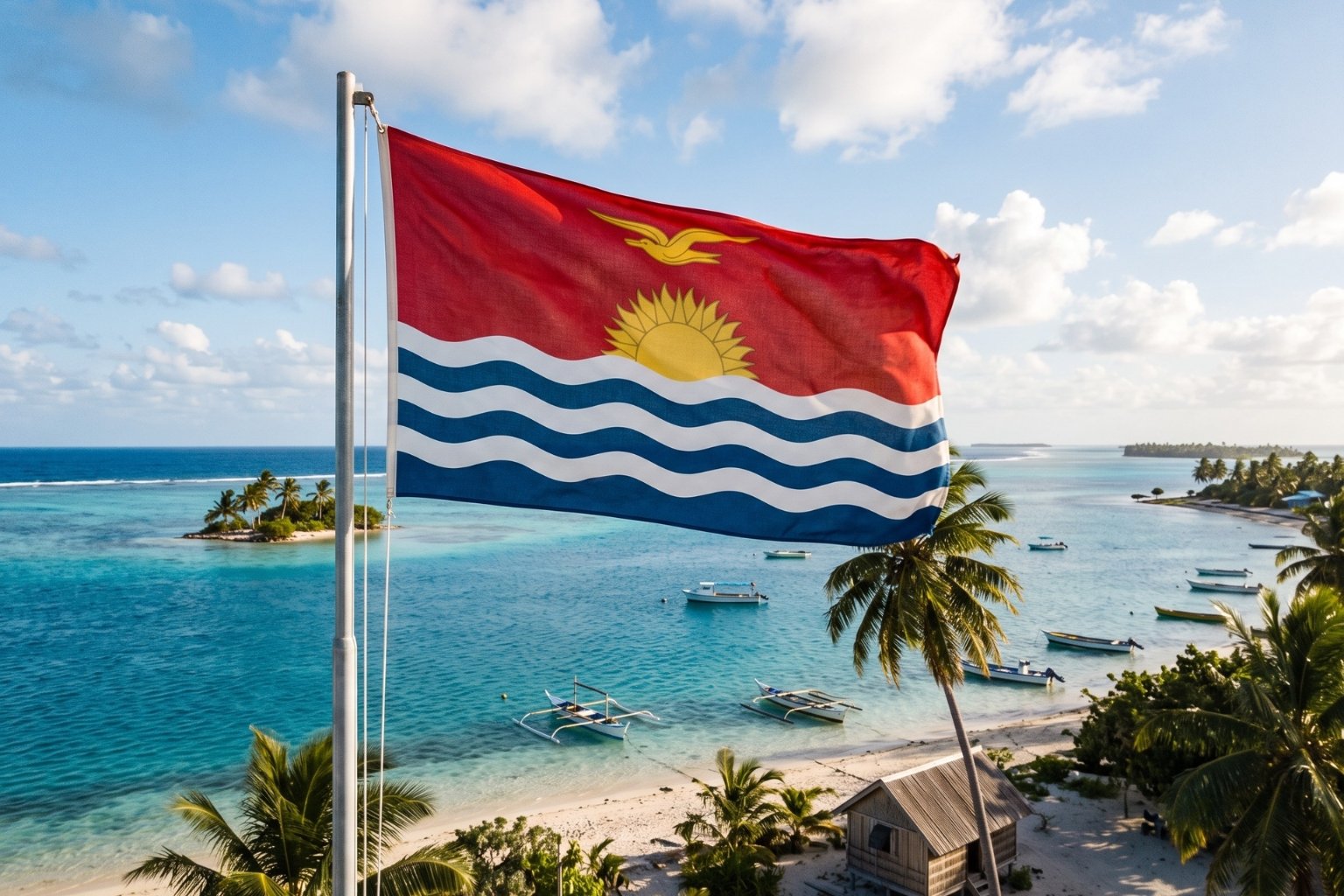

A red sky, a golden bird, a rising sun over three white waves. The Kiribati flag packs an entire nation’s geography and identity into one small rectangle, and every element on it was chosen for a reason. Here is what it actually says about the country flying it.
What the Kiribati Flag Looks Like
The flag is built on two halves. The upper half is solid red and carries a golden frigatebird flying above a rising sun with seventeen rays. The lower half is made of six alternating wavy stripes, three white and three blue, starting with white at the top.
The design follows a 1:2 ratio, meaning it is exactly twice as wide as it is tall. It is one of the rare national flags derived directly from a coat of arms rather than designed as a flag from scratch, which explains its slightly heraldic, almost illustrated feel compared to most Pacific flags.
What Each Symbol Means
Nothing on this flag is decorative. Every shape refers to something concrete about the islands and the people who live on them.
The Golden Frigatebird
The frigatebird is a seabird native to the region, and its presence on the flag is not just symbolic strength on paper. In Kiribati, frigatebirds have long been tied to real maritime life, used historically as visual markers by fishermen reading their flight patterns to locate schools of fish, and they still appear in traditional dance movements that imitate the bird’s wide, gliding wingspan. On the flag, it represents freedom, authority over the sea, and a living connection between the islands and the ocean around them.
The Rising Sun and Its Seventeen Rays
The sun sits just beneath the bird, and its seventeen rays are not an arbitrary number. They stand for the sixteen main Gilbert Islands plus Banaba, a separate outer island historically known as Ocean Island. The sun itself refers to Kiribati’s position straddling the equator, where sunrise and sunset fall almost evenly year round.
The Blue and White Waves
The lower half of the flag is where the ocean lives. The blue represents the Pacific Ocean itself, and the white wavy stripes represent its surface. Together they also nod to the three main island groups that make up the country, the Gilbert Islands, the Phoenix Islands, and the Line Islands, scattered across a vast stretch of open water.
The Color Red
Red fills the top half of the flag and gives it its immediate visual punch. It is generally read as a symbol of vitality and courage, a warm counterpoint to the blue and white calm of the ocean below it.
| Element | Color | What it represents |
|---|---|---|
| Frigatebird | Gold | Freedom, strength, command of the sea |
| Sun with 17 rays | Gold | The 16 Gilbert Islands and Banaba, equatorial position |
| Wavy stripes | Blue and white | The Pacific Ocean and its three island groups |
| Upper field | Red | Vitality and courage |
The Origins of the Design
The flag’s imagery did not appear in 1979 out of nowhere. It comes from a badge designed for the territory by Sir Arthur Grimble, a British colonial officer, later formalized into an official coat of arms granted in 1937 to the Gilbert and Ellice Islands.
At the time, the Gilbert Islands, largely Micronesian, and the Ellice Islands, largely Polynesian, were administered together as a single British colony. A 1976 referendum split the two territories in anticipation of independence, and the Ellice Islands went on to become Tuvalu. The Gilbert Islands kept the heraldic imagery from the 1937 coat of arms almost entirely intact when it came time to design a national flag.
Independence and the Flag’s Adoption
The Kiribati flag was officially hoisted on July 12, 1979, the day the former Gilbert Islands became the independent Republic of Kiribati. The country’s name is simply the local pronunciation of “Gilberts,” adapted into the Gilbertese language.
Choosing to keep the colonial era badge rather than start from a blank page was a deliberate decision. Rather than erase decades of visual history, the new nation folded it into its own identity, keeping the sun, the bird, and the waves as a continuous thread rather than a clean break.
The Flag Today
The flag flies over government buildings and schools year round, and it takes center stage every July 12 for Independence Day celebrations across the islands. It is treated with the kind of quiet respect typical across the Pacific, rarely altered and replaced once worn.
There is also a layer of meaning the flag’s original designers could not have anticipated. Kiribati is now one of the countries most directly exposed to rising sea levels, and the ocean waves stretched across the bottom of the flag read differently today than they did in 1979, less as backdrop and more as the central fact of daily life on low lying atolls. Travelers who make it to South Tarawa, the country’s capital area, will see the flag everywhere, on government buildings, on boats, and worn with real pride during community and church gatherings, a small reminder that this piece of cloth still tells the truest story of the place.
Kiribati Flag FAQ
What do the colors of the Kiribati flag mean? Red stands for vitality and courage, blue for the Pacific Ocean, white for the ocean’s waves and the country’s island groups, and gold for the sun and the frigatebird.
Why does the Kiribati flag have a bird on it? The golden frigatebird represents freedom and command of the sea, and reflects a bird historically important to local fishing and navigation traditions.
When was the Kiribati flag adopted? It was officially adopted on July 12, 1979, the day Kiribati gained independence from Britain.
