

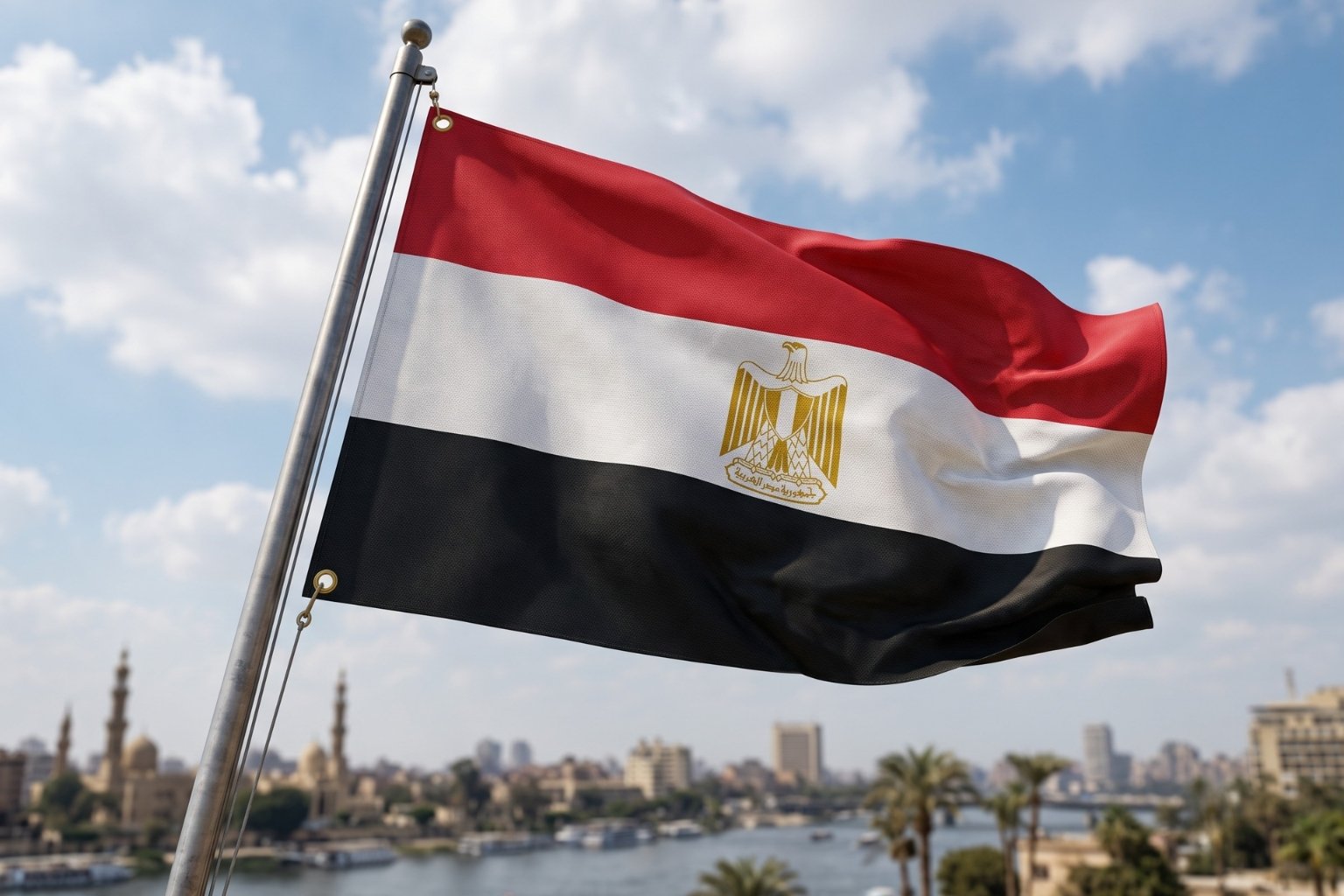

Three stripes and a golden eagle rarely carry this much political weight. Egypt’s flag has flown over an Ottoman province, a British protectorate, a monarchy, a revolution, and three separate attempts at Arab unity, and each chapter left a trace on the design that flutters over Cairo today. Behind the red, white, and black lies one of the most politically layered flags in the Arab world.
What the Egyptian Flag Looks Like Today
The current Egypt flag is a horizontal tricolor made of three equal bands: red on top, white in the middle, black on the bottom. At the center of the white band sits a golden eagle known as the Eagle of Saladin, wings spread, facing toward the hoist side.
The flag follows a width to length ratio of 2:3, set out in Egypt’s constitution. Its overall shape has stayed remarkably stable since 1984, even as the shade of gold on the eagle varies slightly from one printed flag to another.
The Colors of the Egypt Flag and What They Actually Mean
The symbolism most often repeated online is a simplified, softened version of what the Free Officers actually declared after the 1952 revolution. Here is the original meaning, next to the version you will find on most travel blogs.
| Color | Official 1952 meaning | Common simplified version |
|---|---|---|
| Red | The blood of Egyptians in the struggle against colonization | Sacrifice and courage |
| White | The purity of the revolutionaries’ hearts and the largely bloodless nature of the coup | Peace and a bright future |
| Black | The end of the darkness of foreign occupation and monarchy | The dark period now behind the country |
Red, white, and black are known as the Arab Liberation colors rather than the full Pan Arab palette, which also includes green. Egypt’s own flag has not carried green since the monarchy fell in 1952.
The Eagle of Saladin, Egypt’s National Emblem
The eagle at the center of the flag is not decorative. It carries its own separate history, tied to a very specific figure in Arab and Egyptian memory.
Who Was Saladin
Salah ad Din, known in the West as Saladin, was the twelfth century sultan who ruled Egypt and Syria and defeated the Crusaders. His personal banner featured a golden eagle, and that image survived him by eight centuries to become a symbol of Arab strength claimed by successive Egyptian governments.
What the Scroll in Its Claws Says
The eagle grips a scroll reading Arab Republic of Egypt in Arabic script. Across its chest sits a small shield colored in the flag’s own red, white, and black, a detail most visitors never notice up close but that appears on every official version of the emblem.
From Two Stars to a Hawk, and Back to an Eagle
The eagle has not always occupied that spot. It disappeared twice during the twentieth century, replaced by other symbols as Egypt entered and exited political unions with its neighbors, before returning for good in 1984. The full sequence of those changes is the subject of the timeline below.
A Timeline: How Egypt’s Flag Evolved
Ottoman Banners, 1844 to 1914
Egypt’s first modern flag appeared in 1844 under the Muhammad Ali Dynasty, while the country was formally an Ottoman province. It showed a white crescent and three white stars on a red field, a direct echo of the Ottoman flag, though its proportions were altered to signal Egypt’s growing autonomy. One theory holds that the three stars marked victories across three continents, Africa, Asia, and Europe, and Muhammad Ali’s own rule over Egypt, Sudan, and the Hejaz. Variants introduced in 1867 and 1914 drifted further from the Ottoman original as Egypt’s independence grew more real.
The 1915 British Protectorate Flag
On February 16, 1915, Britain formally declared Egypt a protectorate to sever its remaining ties to the Ottoman Empire. The Khedive’s existing red flag, with its crescent and three stars, simply became the national flag by default.
The Green Flag of the Kingdom, 1922 to 1923
The 1919 Revolution saw protesters carry a green flag bearing a white crescent and a cross, a deliberate image of Muslims and Christians standing together against British rule. When Britain recognized Egyptian independence in 1922 and King Fuad I took the throne, that cross was quietly dropped. On December 10, 1923, a new flag was formally adopted: green, with a white crescent and three white stars. Egypt’s presidency has stated the three stars represented the country’s three religions, Islam, Christianity, and Judaism, though some historians read them instead as a nod to Egypt, Sudan, and the Hejaz.
1952 and the Arab Liberation Flag
The Free Officers who overthrew King Farouk on July 23, 1952, introduced the Arab Liberation Flag: horizontal red, white, and black bands with a golden eagle in the center. It flew alongside the official flag for years before formally becoming Egypt’s national flag.
The United Arab Republic Years, 1958 to 1961
When Egypt and Syria merged into the United Arab Republic in 1958, the eagle was replaced by two green five pointed stars, one for each country. Syria withdrew from the union in 1961, but Egypt kept the official name and the two star flag until 1971, when the country was renamed the Arab Republic of Egypt.
The Federation of Arab Republics, 1972 to 1977
A new attempt at unity, this time with Syria and Libya, began on January 1, 1972. The two stars gave way to the golden Hawk of Quraysh, a symbol tied to the tribe of the Prophet Muhammad and previously used on Syria’s own coat of arms.
1984 to Today
The federation dissolved in 1977, but Egypt kept flying its flag for several more years. On October 4, 1984, the Hawk of Quraysh was finally removed and the Eagle of Saladin restored to the white band, using a slightly updated version of the 1952 design. That flag, with its noticeably darker red than the Iraqi, Syrian, or Yemeni tricolors, is the one Egypt still flies today.
How Egypt’s Flag Compares to Its Arab Neighbors
Egypt’s tricolor belongs to a family of flags that trace their roots to the Arab Revolt of 1916, when Sheikh Hussein of Mecca raised a banner in red, white, black, and green against Ottoman rule. Each color was tied to a historical caliphate: red for the Hashemites, white for the Umayyads, green for the Fatimids, black for the Abbasids.
| Country | Colors | Central emblem |
|---|---|---|
| Egypt | Red, white, black | Eagle of Saladin |
| Iraq | Red, white, black | Green Arabic script |
| Yemen | Red, white, black | None |
| Sudan | Red, white, black, green | Green triangle at the hoist |
Egypt’s own version leaves out green entirely, since its tricolor descends specifically from the three color Arab Liberation flag of 1952 rather than the fuller four color Pan Arab scheme still visible in flags like Sudan’s.
Where and When You’ll See the Flag in Egypt
The flag is raised on government buildings every Friday, on national holidays, and on any day set by the Minister of Interior, including the opening session of the House of Representatives. On border posts, customs buildings, and Egyptian embassies abroad, it flies daily, joined by extra displays on Revolution Day, July 23.
Travelers notice it most at football matches, where stands turn into blocks of red, white, and black, and around national celebrations, when the flag hangs from balconies and shop fronts across Cairo and Alexandria. Photographing it on public buildings is entirely normal and common among visitors.
One point worth knowing before you travel: Egypt’s constitution protects the flag by law, and insulting or defacing it is a punishable offense. Casual, respectful use, on a souvenir or in a photo, is not the issue; deliberate disrespect is.
Frequently Asked Questions
What do the three colors of Egypt’s flag mean?
Under the original 1952 symbolism, red stands for the blood shed in the struggle against colonization, white for the purity of the revolutionaries’ aims and the bloodless nature of the coup itself, and black for the end of foreign occupation and monarchy.
What does the eagle on Egypt’s flag represent?
It is the Eagle of Saladin, named after the twelfth century sultan who defeated the Crusaders, and it now stands for Arab strength and unity. It holds a scroll reading Arab Republic of Egypt in Arabic.
Why isn’t green on Egypt’s flag if it’s a Pan Arab color?
Egypt’s tricolor comes from the 1952 Arab Liberation flag, a three color design, rather than the fuller four color Pan Arab palette used on flags like Sudan’s. Green did appear on Egypt’s own flag once, between 1923 and 1952, under the monarchy.
When was the current Egypt flag officially adopted?
October 4, 1984, when the golden Hawk of Quraysh used during the Federation of Arab Republics was replaced by the Eagle of Saladin, the design still in use today.
Is it illegal to disrespect the Egyptian flag?
Yes. Egypt’s constitution protects the national flag, and desecrating or insulting it carries legal penalties.
