

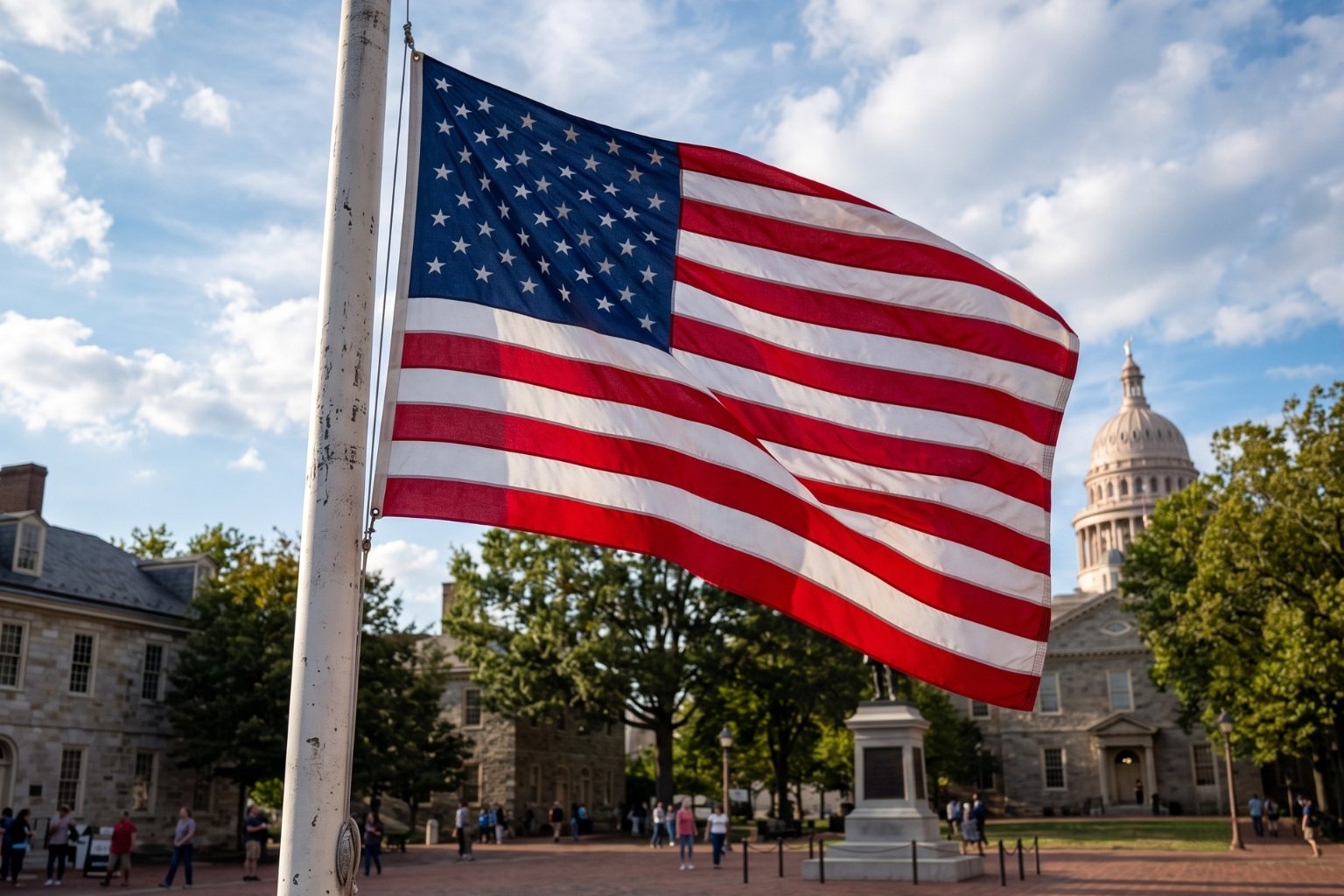

Every American flag flying outside a diner, a courthouse or a national park carries the same story most people never learned past grade school. The USA flag colors, meaning, history and origin trace back to a single congressional resolution, a color explanation added five years later almost as an afterthought, and twenty seven redesigns most Americans have never seen. Once you know what red, white and blue were actually meant to say, the flag stops being background noise and starts reading like a document.
What Red White and Blue Actually Mean
Red for Valor and Hardiness
Red is the color of endurance in the American flag’s symbolism. It was chosen to speak to the hardiness and courage of a young nation that had just fought its way out from under British rule.
White for Purity and Innocence
White carries a gentler weight. It stands for purity and innocence, an idea tied to the fresh start the colonies were claiming for themselves as a new political body.
Blue for Vigilance Perseverance and Justice
Blue is the most layered of the three. It represents vigilance, perseverance and justice, qualities meant to describe how the nation would govern itself once independence was secured, not just how it had fought for it.
The Colors Had No Official Meaning Until 1782
Here is the detail most articles skip past. When the flag was first adopted in 1777, nobody attached any meaning to its colors at all. It took five more years, until 1782, for Charles Thomson, secretary of the Continental Congress, to assign those meanings while presenting the design for the Great Seal of the United States, a document about a seal that ended up defining how an entire country reads its flag.
The Origin Story June 14 1777
The Flag Resolution and What It Actually Said
On June 14 1777 the Continental Congress passed the Flag Resolution, a short text that specified thirteen alternating red and white stripes and thirteen white stars on a blue field representing a new constellation. It described the design in plain terms and said nothing about symbolism. The country agreed on how the flag should look years before it agreed on what it should mean.
Betsy Ross Versus Francis Hopkinson
The Betsy Ross story is the one most people know: a Philadelphia seamstress sewing the first flag by hand. She did sew flags during that period, but there is no solid evidence tying her to that specific design beyond family testimony passed down for generations. Most historians instead credit Francis Hopkinson, a signer of the Declaration of Independence, with designing the first flag by reworking the earlier Continental Colors.
What Came Before the Continental Colors
Before the Stars and Stripes existed, colonial forces flew the Continental Colors, a flag that kept the British Union Jack in its corner while adding thirteen stripes underneath. It was a flag caught between two identities, still tied visually to the country it was fighting to leave. The 1777 redesign is what finally cut that cord.
From 13 Stars to 50 How the Design Evolved
Why the 13 Stripes Were Locked In for Good
Early flags briefly experimented with adding a stripe for every new state, which made the design increasingly cluttered. In 1818 Congress settled the issue permanently, fixing the number at thirteen stripes to honor the original colonies and deciding that only stars would be added going forward.
A Star for Every New State
From that point on, the rule was simple: one new star per new state, added on the July 4th following its admission to the Union. It is a quiet, almost administrative kind of ceremony, yet it means the flag has physically grown alongside the country twenty seven times since 1777.
1960 Hawaii and the Longest Serving Flag in US History
The current 50 star flag became official on July 4 1960, after Hawaii joined the Union. It has now outlasted every previous version of the flag, making it the longest serving design in the country’s history, a fact that surprises most people who assume the flag has looked this way forever.
The Stars the Stripes and What They Are Built From
The Five Pointed Star and Its Layered Symbolism
The choice of a five pointed star was not accidental. Some interpretations tie it to the four cardinal directions plus a single upward point, others connect it to the five branches of the US military, and a 1977 US House of Representatives publication described the star as representing the heavens and the divine goal to which humanity has aspired.
A New Constellation Why the Founders Chose That Phrase
The original 1777 resolution described the stars as forming a new constellation, a phrase that reads almost poetic for a legal document. It framed the young country not as a copy of anything that came before it, but as a new configuration entirely, visible against a blue field the way real stars sit against the night sky.
For anyone who works with the flag’s exact specifications, whether for design, education or manufacturing, here is what the official references confirm.
| Element | Specification |
|---|---|
| Stripes | 13, alternating red and white |
| Stars | 50, on a blue canton |
| Star arrangement | 9 staggered rows, 11 staggered columns |
| Width to length ratio | 10 to 19 |
| Old Glory Red | Pantone 193C, close to RGB 191 10 48 |
| Old Glory Blue | Pantone 281C, close to RGB 0 40 104 |
| White | Pure white, RGB 255 255 255 |
Exact digital conversions vary slightly since the official colors were originally defined through a textile based standard rather than a digital one.
Stars and Stripes Old Glory Where the Nicknames Came From
The flag picked up its most famous nicknames well after its design was settled. Stars and Stripes simply describes what people see. Old Glory has a more personal origin, tied to a 19th century sea captain who reportedly gave that name to his own flag out of genuine affection for it. Both names entered common use in the 1800s and have stuck ever since, alongside the more formal Star Spangled Banner.
How the Flag Shows Up in American Life
Flag Day the Fourth of July and Everyday Displays
Flag Day on June 14 marks the anniversary of the 1777 resolution, though the Fourth of July remains the day the flag is genuinely everywhere, from porches to parade routes to backyard cookouts. Memorial Day carries a quieter version of the same symbolism, with flags placed at veterans’ graves across the country.
What Travelers Should Know Before They Touch Fold or Photograph a Flag
The flag comes with a set of display rules that Americans take more seriously than most visitors expect. A few basics are worth knowing before an encounter with a real one:
- Never let the flag touch the ground or floor
- Never use it as clothing, bedding or decoration printed for temporary use
- Fold it properly, into the triangular shape that leaves only the blue field visible
- Fly it at half staff only during an official period of mourning
Where to See Flag History in Person
For travelers who want the physical version of this history rather than the textbook one, a few places deliver it directly. Fort McHenry in Baltimore is where the flag that inspired the national anthem actually flew. The original Star Spangled Banner itself is preserved at the Smithsonian’s National Museum of American History in Washington DC. The Betsy Ross House in Philadelphia leans into the legend, even if the historical record around it stays uncertain.
Flags Around the World That Borrowed From It
The Stars and Stripes did not stay a purely American design. Liberia’s flag closely echoes it, a direct result of the country having been founded by free people of color from the United States, its eleven stripes standing for the eleven signers of Liberia’s own declaration of independence. Malaysia’s flag carries a striking resemblance too, despite no historical connection to the United States, with some theories pointing instead to a shared influence from the flag of the British East India Company. El Salvador’s flag between 1865 and 1912 followed a similar blue and white striped pattern with a red canton, another quiet thread in a design lineage that started with thirteen colonies deciding what a new constellation should look like.
