

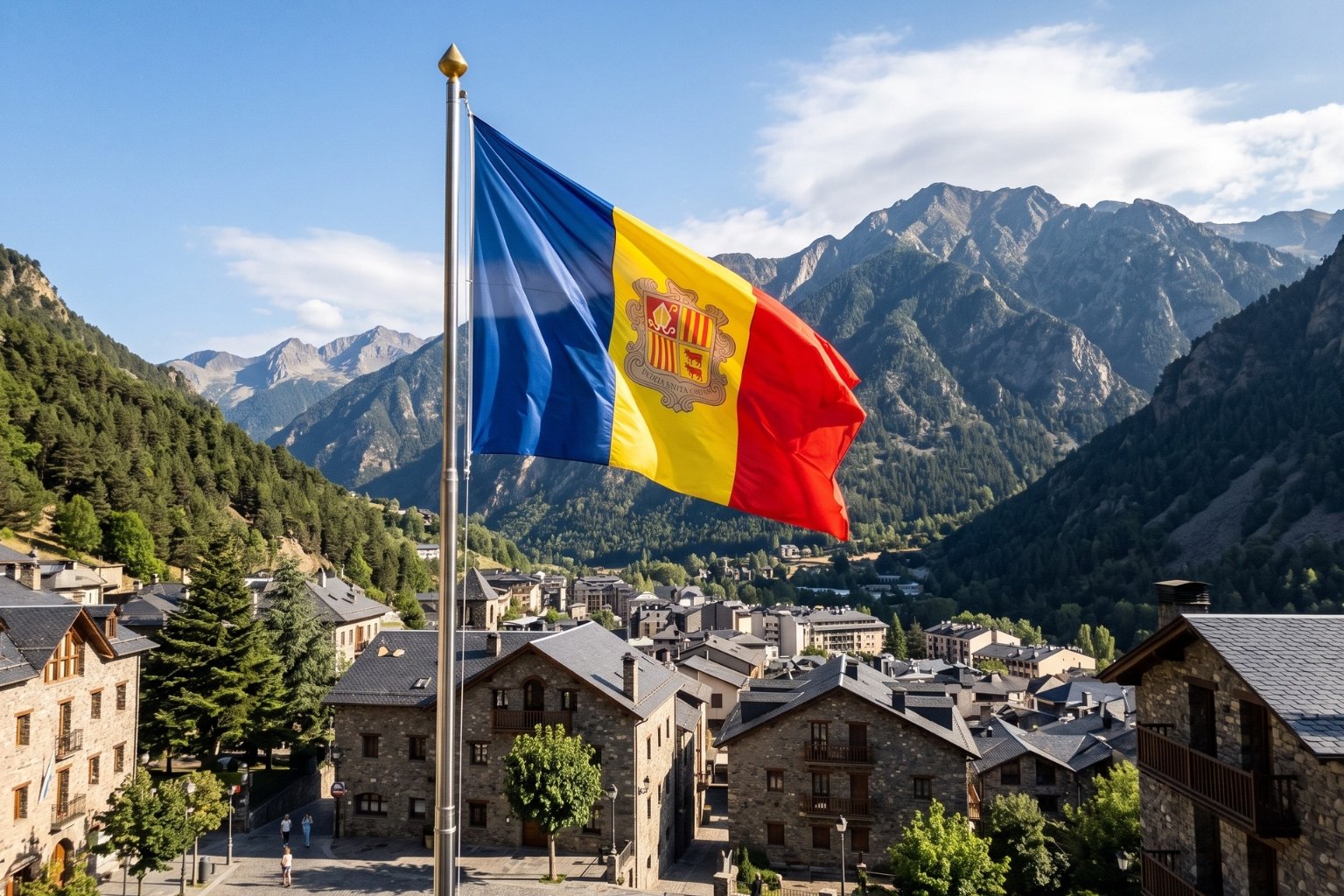

A blue, yellow and red tricolor stands guard over the Pyrenees, and it belongs to a country of just 468 square kilometers wedged between two much larger neighbors. The Andorra flag tells that story without a single word. Read its stripes and its coat of arms carefully, and you’re reading nine centuries of shared power between two nations that never quite let go.
The Colors of the Andorra Flag
The flag is a vertical tricolor: blue on the hoist side, yellow in the middle, red on the fly side. The coat of arms sits centered on the yellow band, the only part of the design unique to Andorra.
Blue, Yellow and Red, and Why Nobody Fully Agreed on What They Mean
Here’s where most sources oversimplify. Plenty of travel blogs will tell you blue stands for freedom, yellow for wealth, red for courage, as if the colors were chosen from a values chart. There is no official government document assigning that kind of symbolism to the stripes.
What is documented is where the colors come from. Blue and red belong to the French tricolor. Red and yellow belong to Catalonia and, by extension, the old Crown of Aragon and the County of Foix. Andorra didn’t invent a palette. It borrowed one from each of the two powers that have governed it jointly since the Middle Ages, the Bishop of Urgell on the Spanish side and the Count of Foix, later the President of France, on the French side.
The 8:9:8 Ratio: Why the Yellow Stripe Is Wider
Look closely and the three bands aren’t equal. The yellow stripe is slightly wider than the blue and red ones, a ratio of 8 to 9 to 8. That uneven spacing is a direct nod to Aragon, whose historical banners used the same trick.
| Element | Detail |
|---|---|
| Stripe order | Blue, Yellow, Red (left to right) |
| Width ratio | 8 : 9 : 8 |
| Overall flag ratio | 7 : 10 |
| Blue and red origin | French tricolor |
| Red and yellow origin | Catalonia and Aragon |
The Coat of Arms at the Center
The emblem in the yellow band is not decoration. It is a quartered shield, and each quarter names one of the four powers that shaped Andorra’s political existence.
Four Quarters, Four Rulers
Reading clockwise from the upper left, the shield lays out Andorra’s entire chain of historical authority in four small pictures.
| Quarter | Symbol | Represents |
|---|---|---|
| Upper left | Mitre and crosier on red | Bishop of Urgell |
| Upper right | Three red bars on yellow | Count of Foix |
| Lower left | Four red bars on yellow | Catalonia and the Crown of Aragon |
| Lower right | Two red cows on yellow | Viscounty of Béarn |
The cows are more than a heraldic curiosity. Andorra is one of only two countries whose national flag features cattle, the other being Moldova, whose emblem includes an ox head.
The Motto: Virtus Unita Fortior
Beneath the shield runs a Latin phrase, Virtus Unita Fortior, most commonly translated as strength united is stronger. It’s a fitting line for a country whose entire flag is an argument for staying independent by staying connected to both neighbors at once.
The History of the Flag, From 1806 to 1993
The tricolor Andorrans fly today took over a century to settle into its current form.
The Original Bicolor
The earliest documented version, from 1806, used only red and yellow, arranged as two equally sized vertical or sometimes horizontal fields. Those two colors already carried the weight of Catalonia and Foix, but France’s presence hadn’t yet made it onto the cloth.
1866: Blue Enters the Design
Blue joined the flag in 1866, part of a wider package of political reforms pushed through by Guillem d’Areny i Plandolit, often credited as the true architect of the modern flag even though the design is popularly attributed to Napoleon III. The reform was first adopted by the Episcopal Co Prince, Bishop Josep Caixal i Estradé, then confirmed by the French side three years later.
The Thirteen Day Reign of Boris I
One of the stranger footnotes in Andorran history involves Boris Skosyrev, a Russian émigré who declared himself King Boris I of Andorra in 1934. He adopted a horizontal version of the flag with a crown centered on the yellow stripe. His reign lasted about two weeks before he was expelled, and the crowned flag went with him.
1993: Standardization at the United Nations
The flag variants kept shifting through the early twentieth century, sometimes horizontal, sometimes without the coat of arms. Everything was locked into place with Andorra’s 1993 constitution, timed to the country’s entry into the United Nations. The exact colors, proportions and coat of arms placement used today were formally registered that year.
Why Andorra Borrowed France’s and Spain’s Colors
The choice makes more sense once you understand Andorra’s political structure. Since a 1278 agreement between the Bishop of Urgell and the Count of Foix, the country has been ruled by two co princes rather than one monarch, a system that survives today with the President of France and the Bishop of Urgell as joint heads of state. A flag built from French and Spanish colors isn’t a sign of dependence. It’s a visual record of a five hundred year old power sharing arrangement that Andorra turned into permanent sovereignty instead of letting either side absorb it.
Andorra’s Flag Next to Chad, Romania and Moldova
Travelers who’ve spent time in Central Europe or Central Africa sometimes do a double take when they first see the Andorran flag. The blue, yellow, red vertical tricolor is shared, almost stripe for stripe, with three other countries.
| Country | Stripe Order | What Sets It Apart |
|---|---|---|
| Andorra | Blue, Yellow, Red | Coat of arms centered, 8:9:8 ratio |
| Chad | Blue, Yellow, Red | Darker navy blue, no emblem |
| Romania | Blue, Yellow, Red | Equal stripe widths, no emblem |
| Moldova | Blue, Yellow, Red | Eagle and ox head emblem, equal widths |
Without its coat of arms, Andorra’s flag is nearly indistinguishable from Chad’s or Romania’s, which is part of why the civil version without the emblem is rarely flown today.
Where You Actually See the Flag in Andorra
National Day and Local Festivities
Andorra’s national day falls on September 8, the Diada Nacional, honoring the country’s patron saint, Our Lady of Meritxell. Flags line the streets of Andorra la Vella and every parish that day, and the coat of arms carved into the wall of the Casa de la Vall, the historic seat of parliament, becomes a focal point for the celebrations.
The Seven Parish Flags
Andorra’s seven parishes, Andorra la Vella, Canillo, Encamp, Escaldes Engordany, La Massana, Ordino and Sant Julià de Lòria, each fly their own version of the tricolor with a distinct coat of arms in the center. Six of them follow the same visual template as the national flag. Andorra la Vella breaks the pattern entirely with its own separate design, worth spotting if you’re wandering the capital’s old quarter and want to see how local pride layers on top of national identity.
