

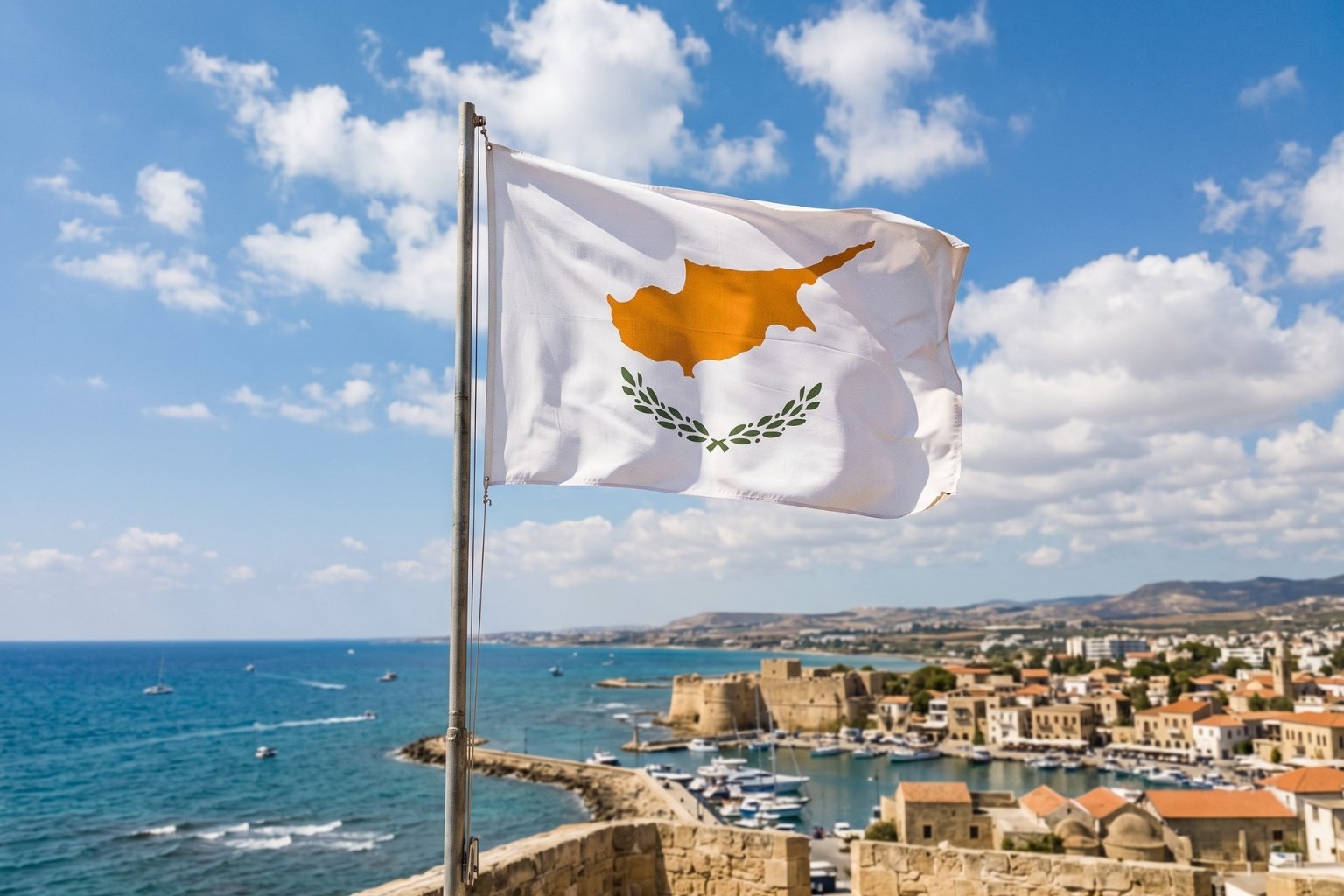

Most flags borrow something from someone. The Cyprus flag was built to borrow from no one. A white field, a copper colored island, two green olive branches, nothing pulled from Greece, nothing pulled from Turkey. It was designed at a moment when the island needed a symbol that belonged to everyone living on it, and that ambition still shapes what you see flying over Nicosia today.
What the Cyprus Flag Looks Like
The design is simple enough to describe in one sentence and layered enough to deserve a full explanation. A white background carries a copper colored silhouette of the island at its center, with two olive green branches crossed beneath it.
| Element | Color | Official reference (since 2006) |
|---|---|---|
| Background | White | Plain field |
| Island silhouette | Copper | Pantone 1385 |
| Olive branches | Olive green | Pantone 574 |
The proportions changed too. From 1960 to 2006 the flag used a 3:5 ratio. Since the 2006 revision, the official ratio is 3:2, and the shade of copper was standardized to keep every printed or woven version consistent.
The Meaning Behind Each Element
White, Chosen for What It Refuses
White was not picked for its beauty. It was picked because it carries no political weight at all. Under the terms that created the flag, no color associated with Greece or Turkey could appear, which immediately ruled out blue and red, and white filled that neutral space perfectly.
Copper, a Name Written Into the Land
The copper silhouette is the most personal detail on any national flag you will find. Cyprus is widely believed to take its name from the ancient word for copper, later shortened into the Latin cuprum, the same root that gives English the word copper itself. The island’s copper deposits, mined for thousands of years in the Troodos Mountains, are literally written into its own name and now into its own flag.
Cyprus is also one of the very few countries in the world whose flag shows the actual outline of its own territory. Anyone who has driven through the old mining villages around Troodos will recognize why that detail was chosen instead of an abstract emblem.
Olive Branches, a Wish Rather Than a Guarantee
Beneath the island sit two crossed olive branches, an old and widely understood symbol of peace. Here they carry a more specific meaning: reconciliation between the island’s Greek Cypriot and Turkish Cypriot communities. The olive tree also happens to be one of Cyprus’s oldest agricultural traditions, so the symbol reaches into daily Cypriot life as much as into diplomacy.
The History Behind the Design
Before 1960, Borrowed Flags Only
For centuries Cyprus flew flags that were never its own. Under Ottoman rule it lived under the Turkish flag. After 1878, when administration passed to Britain, the Union Jack took over official buildings across the island. Neither Greek Cypriots nor Turkish Cypriots felt any attachment to that colonial symbol, so in daily life Greek Cypriots continued raising the Greek flag and Turkish Cypriots the Turkish one, a habit that quietly foreshadowed the divisions to come.
1960, a Flag Built to Belong to No One
Independence changed everything. Under the Zurich and London Agreements, signed by the United Kingdom, Greece and Turkey, the new constitution required Cyprus to adopt a flag of neutral design and neutral color. That single clause eliminated red, blue, crosses and crescents in one move, forcing designers toward something entirely new rather than a compromise between two existing flags.
Ismet Güney, the Teacher Who Designed a Country’s Flag
The winning design came from İsmet Güney, a Turkish Cypriot art teacher, chosen over a British proposal that used a rust brown letter K on white. President Archbishop Makarios III and Vice President Fazıl Küçük both preferred Güney’s version and approved it together, a rare moment of joint decision making in the island’s fractured politics.
The story has a quieter, sadder footnote. Güney later said Makarios had promised him a yearly royalty of twenty Cypriot pounds for the design, a payment he claimed he never received. He died in 2009 at the age of seventy seven, decades after giving the island its most recognizable symbol.
2006, a Quiet Redesign
Forty six years after independence, officials revisited the flag’s specifications. The olive branches were reshaped slightly, the copper tone was standardized to Pantone 1385, the green shifted to Pantone 574, and the proportions moved from 3:5 to 3:2. Nothing about the meaning changed, only the precision behind reproducing it correctly.
Why You Will See Different Flags on the Island Today
Understanding the flag’s neutral intent only matters more once you know how unevenly that intent has played out. The 1974 division of the island, following a Turkish military intervention, split Cyprus into the Republic of Cyprus in the south and the self declared Turkish Republic of Northern Cyprus in the north, recognized only by Turkey and flying a flag modeled closely on Turkey’s own.
Travelers crossing between the two sides notice this immediately. In the south, the official Cyprus flag shares space with the Greek flag on public buildings and during national holidays. In the north, the Turkish flag and the northern administration’s own flag dominate almost entirely, and the original 1960 design is rarely seen at all. Only the Republic of Cyprus flag is recognized internationally, including at the United Nations and within the European Union.
Cyprus Flag Facts Worth Knowing
- It is one of only a small number of national flags in the world that depicts the country’s own land outline rather than an abstract emblem.
- Ships registered under the Cyprus flag make up one of the largest merchant fleets in the European Union.
- The flag has its own emoji, a small but genuine marker of how digitally present the symbol has become.
- Cyprus marks its national day on October 1 each year, a date distinct from the flag’s official adoption on August 16, 1960.
Frequently Asked Questions
Why is the Cyprus flag copper colored? The copper silhouette references the island’s ancient copper deposits, the same resource believed to have given Cyprus its name in the first place.
Why does the flag avoid red and blue? The 1960 constitution required a neutral design, which meant excluding red and blue, the dominant colors of the Turkish and Greek flags, along with any religious symbols.
Does Northern Cyprus fly a different flag? Yes. The Turkish Republic of Northern Cyprus, recognized only by Turkey, uses its own flag closely modeled on the Turkish national flag rather than the 1960 design.
What do the olive branches on the flag represent? They symbolize peace and reconciliation, specifically between the island’s Greek Cypriot and Turkish Cypriot communities.
