

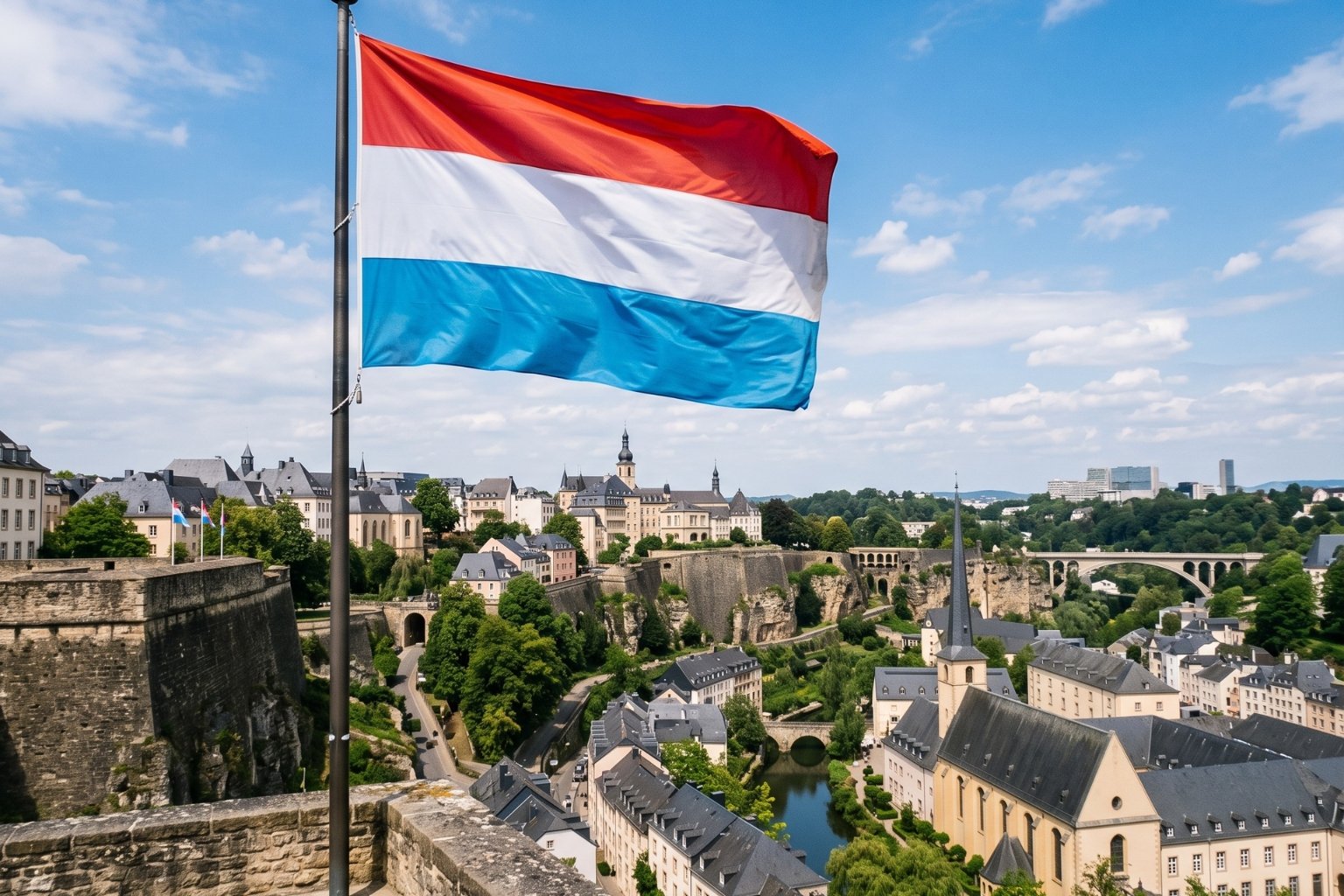

Stand on a balcony in Luxembourg City on a bright June morning and you might swear you are looking at the Dutch flag. You are not. The Luxembourg flag shares the same red, white and blue stripes as its northern neighbour, but the resemblance stops there once you know what to look for. Behind those three bands sits a story that runs from a 13th century ducal banner to a national vote nobody expected to lose.
What the Luxembourg Flag Looks Like
The Luxembourg flag is a horizontal tricolor: red on top, white in the middle, light blue at the bottom. The three stripes are equal in width, and the official ratio between the flag’s height and length is 3 to 5, though a 1 to 2 ratio is also tolerated in practice.
The three stripes
Nothing about the design is complicated at first glance. Three flat bands, no crest, no emblem in the center. It is the kind of flag you could draw from memory after seeing it once, which is exactly why the confusion with the Netherlands persists.
A shade of blue with its own name
The lower stripe is not just “blue.” It is legally defined as bleu céleste, a pale sky blue chosen specifically to set the flag apart from the darker, richer blue used in the Netherlands. Luxembourg’s red is also noticeably lighter than the Dutch red.
| Element | Luxembourg | Netherlands |
|---|---|---|
| Blue shade | Light, sky blue (bleu céleste) | Darker cobalt blue |
| Red shade | Lighter red | Deeper, more saturated red |
| Official ratio | 3:5 (also 1:2) | 2:3 |
| Design formally fixed | 1845, law passed 1972 | 1937 |
What Do the Colors Really Mean
Unlike some countries, Luxembourg’s government has never issued an official statement explaining what red, white and blue are supposed to represent. What you will find in heraldry references is an interpretation drawn from the colors’ origin rather than a decree.
Red is generally read as courage and sacrifice, tied to the rampant lion on the ducal coat of arms. White stands for peace and integrity. Light blue evokes openness and the skies over the Grand Duchy. These readings are useful and widely repeated, but worth presenting for what they are: informed interpretation, not law.
Where the Flag Comes From: The House of Luxembourg
A 13th century banner, not a national flag
Long before Luxembourg had a national flag, the dukes of Luxembourg carried a heraldic banner: horizontal stripes of white and blue, with a red lion rampant, crowned and clawed in gold. This banner dates back to the early 13th century and represented the ruling house, not the population.
From ducal colors to national colors
Everything changed after the Napoleonic Wars, when Luxembourg passed from the Holy Roman Empire into a new status under the Netherlands. During the Belgian Revolution of 1830, Luxembourgers were urged to adopt visible national colors of their own, and they reached back to the ducal coat of arms: red, white and blue, arranged as horizontal stripes rather than the old lion design. The tricolor form as we know it today was fixed on 12 June 1845.
From Ducal Banner to National Flag: A Timeline
| Year | What happened |
|---|---|
| 13th century | Ducal banner of white, blue and a red lion in use |
| 1830 | Red, white and blue adopted informally during the Belgian Revolution |
| 1845 | Horizontal tricolor design formally fixed |
| 1848 | Flag flown publicly in its modern form for the first time |
| 1914 to 1918 | Flag banned and replaced under German occupation in WWI |
| 1972 | Law formally establishes the tricolor as the national flag |
| 1993 | Ratio and exact shade of blue further regulated by law |
That gap between first use and full legal status is unusual. Luxembourgers flew this flag for well over a century before parliament made it official on paper.
The Flag That Almost Wasn’t: The Red Lion Debate
Why some Luxembourgers wanted the Roude Léiw
In October 2006, member of parliament Michel Wolter proposed scrapping the red, white and blue tricolor entirely in favor of the older Roude Léiw (Red Lion), the ducal banner with the crowned lion. His argument was straightforward: the tricolor was too easily confused with the Dutch flag, while the Red Lion carried far deeper historic and visual character. He claimed strong informal support from the public, and a radio poll at the time suggested most listeners agreed.
Why the tricolor stayed
The proposal never became law. Opposition came from within Wolter’s own party and from politicians who questioned both the cost of changing every flagpole in the country and the symbolism of reviving a distinctly nationalist emblem. A second petition surfaced in 2015, gathering under 500 signatures, and again went nowhere. The Red Lion did not disappear, though. Since 2007 it has served as Luxembourg’s official civil ensign, flown by ships registered in the country and used in sporting contexts, while the tricolor keeps its place as the sole national flag.
How to Tell It Apart From the Dutch Flag
If you are traveling between the two countries, the giveaway is rarely the color alone, since side by side comparisons are hard to do from memory. Look instead at the overall shape: Luxembourg’s flag tends to look slightly longer and more oblong, closer to a 3:5 ratio, while the Dutch flag is more compact at 2:3. If you can see the blue stripe in good light, Luxembourg’s will read as noticeably paler and softer than the deep, almost navy blue of the Netherlands.
Context also helps. A tricolor flying outside a government building in Luxembourg City, alongside the country’s small size and its bilingual or trilingual signage in French, German and Luxembourgish, is a strong hint you are not in the Netherlands anymore.
When and Where You Will See the Flag in Luxembourg
The flag reaches full visibility on 23 June, the Grand Duke’s official birthday and Luxembourg’s National Day. The date itself has history behind it: celebrations were shifted from 23 January, the birthday of Grand Duchess Charlotte, to the more reliably pleasant days of late June in 1962.
On National Day, tricolors line the streets of Luxembourg City and appear at the Gëlle Fra war memorial, alongside official ceremonies and evening festivities. Outside of National Day, the flag flies routinely over government buildings and is a common, quiet presence rather than a daily spectacle, which makes seeing it out in full force on 23 June feel genuinely special.
A Flag Worth a Second Look
The next time someone mistakes Luxembourg’s flag for the Dutch one, you will have the answer ready: a lighter blue, a longer shape, and eight centuries of history that trace back to a lion on a duke’s banner rather than a maritime republic. Small country, long memory, and a flag that has quietly earned its stripes.
Frequently Asked Questions
Why does Luxembourg’s flag look like the Netherlands flag?
Both flags use horizontal red, white and blue stripes, but they developed independently. Luxembourg’s colors come from its own 13th century ducal coat of arms, not from any borrowed Dutch design. The resemblance is coincidental rather than historical.
What do the colors of the Luxembourg flag mean?
There is no official government meaning. Heraldry-based interpretation reads red as courage, white as peace, and light blue as openness and the sky, drawn from the ducal coat of arms rather than a formal decree.
When did Luxembourg get its flag?
The tricolor design was fixed in 1845 and first flown publicly around 1848, but it only became the legally recognized national flag through a law passed in 1972, with further details regulated in 1993.
What is the Red Lion flag of Luxembourg?
The Roude Léiw is the older ducal banner, showing a crowned red lion on alternating blue and white stripes. It lost a 2006 bid to replace the tricolor as the national flag but has served as Luxembourg’s official civil ensign since 2007.
