

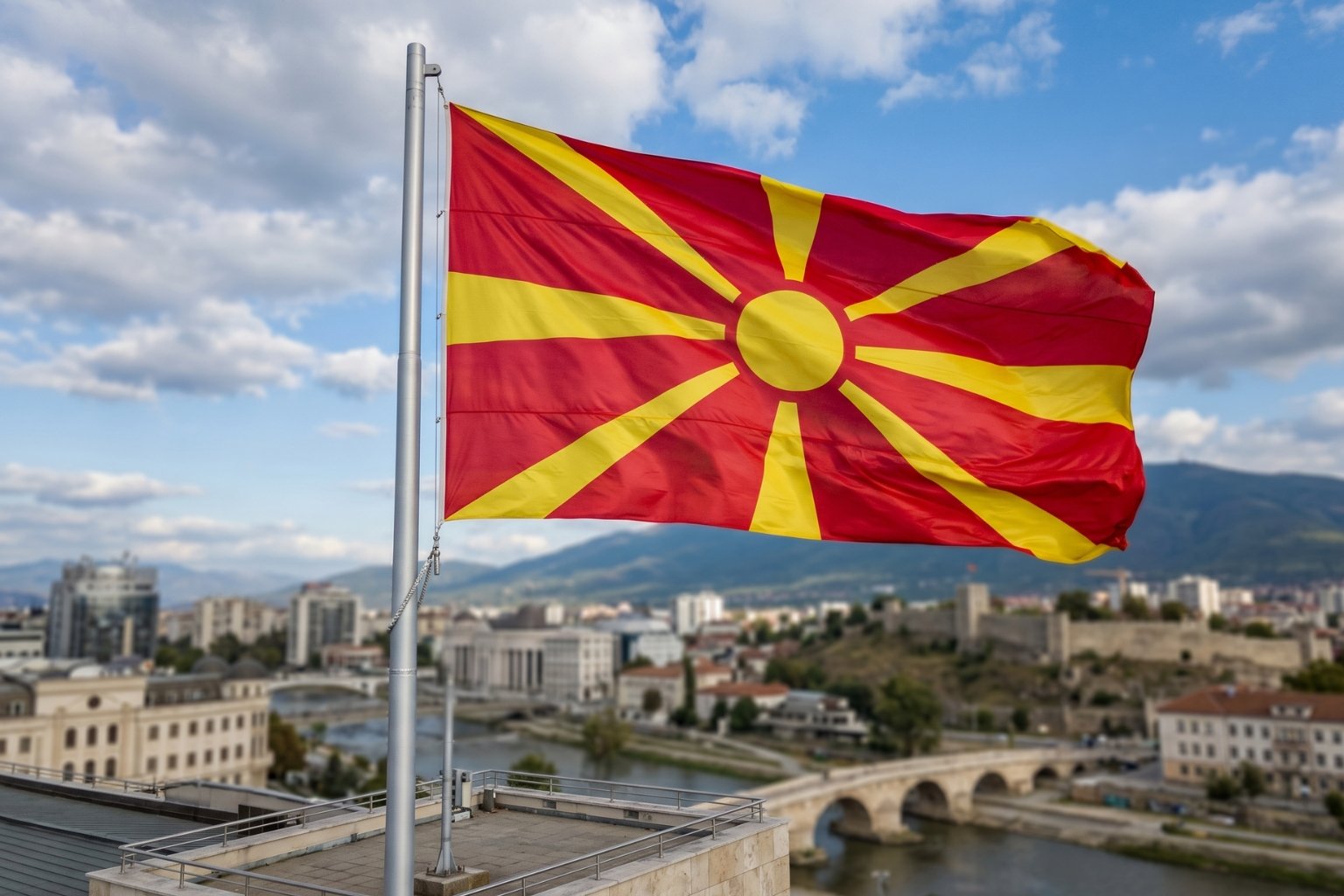

Few national flags carry a diplomatic scar quite as visible as North Macedonia’s. The crimson field and eight-rayed golden sun you see today did not emerge from a design competition or a parliamentary committee with months to deliberate. They were born from a crisis, drawn under pressure, and adopted as part of a deal that would shape the country’s identity for decades. Understanding what this flag looks like is the easy part. Understanding why it looks this way is the real story.
What the North Macedonia Flag Looks Like
The flag is immediately striking. A deep crimson red covers the entire field, and from the center, a stylized golden sun radiates outward in eight broad, symmetrical rays that extend all the way to the edges of the cloth. There is no border, no coat of arms, no additional element. Just the sun, the red, and the gold.
The proportions follow a 1:2 ratio, meaning the flag is twice as wide as it is tall. The sun disk at the center and the eight rays are precisely defined in national legislation to ensure uniform reproduction across every official use, from government buildings in Skopje to embassies abroad.
Flag at a Glance
| Element | Detail |
|---|---|
| Background color | Crimson red |
| Central motif | Stylized eight-rayed golden sun |
| Proportions | 1:2 |
| Official adoption | October 5, 1995 |
| Designer | Miroslav Grčev |
| Previous design | Vergina Sun flag (1992–1995) |
What the Colors and Symbols Mean
The Red Field
Red has been the dominant color of Macedonian political identity for well over a century. It appeared on the banners of the Ilinden Uprising of 1903, the most significant armed revolt against Ottoman rule in the region, and it carried through into the revolutionary and partisan movements of the twentieth century. This is not decorative red. It is the red of a people who fought, repeatedly, for the right to exist as a distinct entity, and who lost that fight more than once before finally winning it.
The color also connects to a broader Slavic Macedonian heraldic tradition. Red and black were the traditional colors of Slavic Macedonia. A gold lion on a red shield formed an early coat of arms. The red field on today’s flag is, in that sense, the one unbroken thread between every version of Macedonian political symbolism across the past two centuries.
The Golden Sun and Its Eight Rays
The sun at the center of the flag represents what the national anthem calls the “new sun of liberty.” The anthem, “Denes nad Makedonija” (Today Over Macedonia), speaks explicitly of a new dawn rising over the land, and the flag makes that lyric literal. It is one of the more direct correspondences between a national anthem and a national flag anywhere in the world.
The eight rays are not arbitrary. They stand for the spread of light, freedom, and progress outward from the nation’s heart, a solar metaphor rooted in both ancient Macedonian iconography and local folk art traditions. Archaeological objects from the region, including decorative roof tiles, shields, and royal insignia, have carried solar motifs for millennia.
The number eight also carries an unspoken political weight. The previous flag had used a sixteen-rayed sun, the Vergina Sun. The new design at eight rays was precise enough to be visually distinct and legally separable from its predecessor. That distinction was not aesthetic. It was diplomatic.
The History of the North Macedonia Flag
Under Yugoslavia (1944–1991)
For nearly five decades, Macedonia existed not as an independent state but as one of the six constituent republics of socialist Yugoslavia. Its flag during this period was a red field bearing a five-pointed yellow star framed in red, positioned in the upper left canton. The design evolved slightly between 1944 and 1946 in terms of the star’s size and placement, but the visual logic remained the same: a symbol embedded in the shared iconography of the Yugoslav federation, indistinguishable in spirit from the banners of the other republics.
It was a flag that belonged to a larger political project, not to a nation. When Yugoslavia began to fracture in the late 1980s, one of the most urgent tasks facing the emerging Macedonian state was to find a symbol that was entirely, unmistakably its own.
Independence and the Vergina Sun (1992–1995)
When North Macedonia declared independence on November 17, 1991, it initially continued flying the Yugoslav communist flag. But by August 11, 1992, a new flag was officially adopted, and it was a bold choice: a red field with the Vergina Sun at its center, a sixteen-rayed starburst in gold.
The Vergina Sun was not invented for the occasion. It was an ancient symbol, excavated in 1978 from a royal tomb at Aigai, the first capital and burial site of the Macedonian kings, located in what is today northern Greece. The golden starburst had appeared on a burial chest believed to contain the ashes of a member of Philip II’s dynasty, the father of Alexander the Great. For Macedonian nationalists, using this symbol felt like an act of historical reclamation: a statement that the modern republic was the legitimate heir to an ancient civilization.
Greece saw it very differently. The symbol had become, by the 1980s, a widely used emblem in the Greek region of Macedonia. Athens argued that the Vergina Sun was an integral part of Greek cultural heritage, that a neighboring state adopting it as a national flag was an appropriation with political and territorial implications.
The response was swift and severe. Greece imposed a year-long economic blockade on the landlocked republic, cutting off a critical trade route. Greek objections also led to the flag being barred from flying at the United Nations headquarters in New York City. In July 1995, Greece filed a formal trademark request with the World Intellectual Property Organization to secure exclusive rights to the Vergina Sun symbol. For a young country still building its institutions, the pressure was enormous.
The 1995 Redesign and Miroslav Grčev
The solution came through the Interim Accord signed between Athens and Skopje in October 1995. As part of the agreement, North Macedonia committed to replacing its flag with a design that removed the contested symbol.
The man given the task was Miroslav Grčev, a Macedonian graphic designer. He completed the new flag in less than a week. The brief was clear: keep the red and gold, evoke the solar tradition, but produce something visually and legally distinct from the Vergina sixteen-rayed starburst. Grčev arrived at the eight-rayed sun, simplified, stylized, and unmistakably modern, while still rooted in the regional visual vocabulary.
The flag was officially raised for the first time in Skopje on October 5, 1995. For many Macedonians, the moment was bittersweet. The new design was seen by some as a capitulation, a symbol stripped of its most powerful historical reference under foreign pressure. For others, it represented exactly what a young democracy needed: a clean, original emblem free of contested ownership.
The Prespa Agreement and the Symbol’s Afterlife
The 1995 flag change did not close the book. The underlying dispute, over the country’s name, its historical claims, and its relationship to the ancient Macedonian kingdom, continued for another two decades.
It was only with the Prespa Agreement of June 17, 2018, signed by the governments of North Macedonia and Greece on the shores of Lake Prespa, that a comprehensive resolution was reached. As part of the deal, the country officially adopted the name “North Macedonia,” and Article 8 of the agreement explicitly required the complete removal of the Vergina Sun from all public spaces, institutions, monuments, and official materials across the country. The deadline was set for August 12, 2019.
The removal was neither smooth nor universally accepted. The municipality of Lozovo, in central North Macedonia, adopted the sixteen-rayed Vergina Sun as its own official emblem, a direct defiance of the agreement. In the city of Kriva Palanka, the symbol’s removal from the town hall became a public political confrontation. In several municipalities previously governed by the nationalist party VMRO-DPMNE, the old flag had continued to fly from institution buildings for years, even after the official change in 1995.
Among diaspora communities in Australia, the United States, and Western Europe, the Vergina Sun, which some call the Kutlesh Star, continues to be displayed as a cultural and identity symbol. As recently as 2026, disputes have erupted at public events, including a parade in Melbourne, over whether diaspora groups should be permitted to carry it. The Prespa Agreement resolved a diplomatic dispute. It did not dissolve a sense of identity.
How This Flag Compares to Others in the Region
Solar motifs are rare in European vexillology, which makes the North Macedonian flag immediately distinctive on a continent dominated by crosses, stripes, and coats of arms. A few useful comparisons:
- The Greek regional flag of Macedonia uses the Vergina Sun on a blue field, making it visually the photographic negative of the 1992 Macedonian flag, same symbol, opposite color.
- Japan’s flag also centers a circular solar motif on a white field, though the intent and cultural weight are entirely different.
- Kyrgyzstan’s flag features a forty-rayed stylized sun, representing the unity of the forty Kyrgyz tribes.
None of these comparisons are more than superficial. The North Macedonian flag is singular precisely because its solar motif carries both a political origin story and an ongoing dispute, not just a symbolic tradition.
What the Flag Means Today
In Skopje, the crimson and gold flies from government buildings, football stadium facades, and the windows of apartment blocks in equal measure. For younger North Macedonians, it is simply the flag of their country, the symbol under which they were born, went to school, and came of age. The political weight of 1992 and 1995 is history to them, even if it remains a living grievance for an older generation.
For others, particularly those who grew up with the Vergina Sun as a symbol of national pride, the current flag carries an asterisk. It is a compromise made visible in cloth. A country that was asked to change its name and its flag in exchange for regional integration wears those changes differently depending on who you ask.
What is certain is that the Sun of Liberty on the North Macedonia flag is not a decorative choice. It is a statement made under constraint, refined by a skilled designer working against a deadline, and carrying within its eight rays the compressed history of a nation that has spent much of its modern existence negotiating the terms of its own identity. A flag like that does not just represent a country. It tells you something true about what it costs to become one.
