

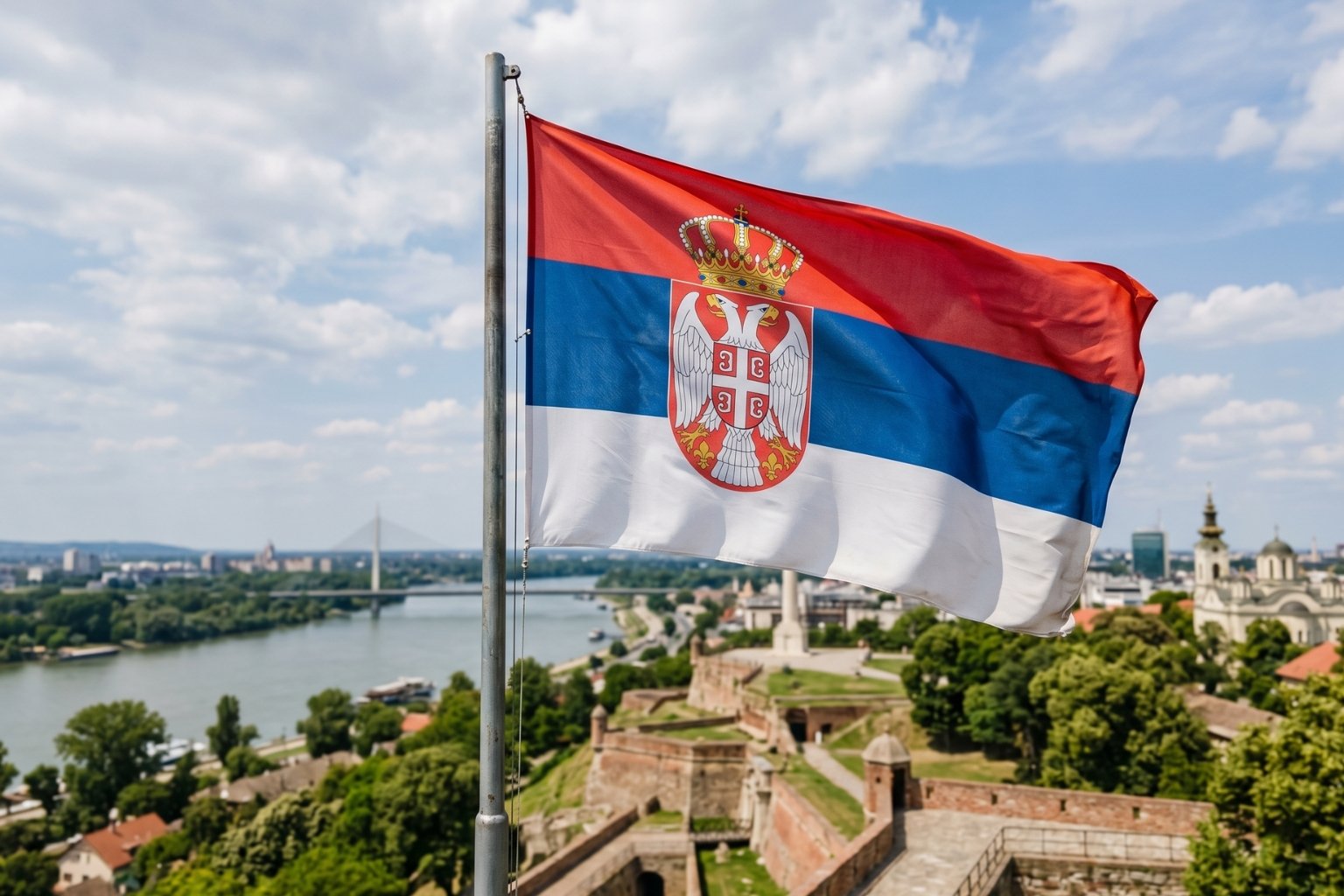

Look closely at the Serbia flag and you notice something that does not quite add up. A republic, founded in the 21st century, flying a coat of arms topped with a royal crown. Three colors borrowed from a neighbor, rearranged to say something entirely different. A motto written in four letters that Serbs have been repeating for centuries. This flag is not a design choice. It is a compressed history of a nation that has spent eight hundred years refusing to disappear.
Three Colors, One Tricolor
The Serbian flag carries three equal horizontal stripes: red on top, blue in the middle, and white at the bottom. The order matters. It is not accidental, and it is not decorative.
Officially, red represents the blood shed in the struggle for freedom. Blue stands for the open sky, and by extension for freedom, loyalty, and fidelity. White symbolizes purity and honesty.
Among Serbians, the white stripe carries a warmer meaning. It is said to represent mother’s milk, the nourishment that raises strong children and keeps a people whole across generations. That interpretation has no official standing, but it has survived in popular culture far longer than most official explanations.
Together, these three shades are known as the Pan-Slavic colors, a palette shared by Russia, Slovakia, Slovenia, Croatia, and several other Slavic nations. Serbia did not invent them. But Serbia was among the first to plant them in the ground and call them its own.
The Pan-Slavic Connection: Where the Colors Come From
In 1804, Serbia rose against Ottoman rule in what became known as the First Serbian Uprising. The Serbian delegation, in desperate need of allies, turned to Russia. The Russians offered support, but with a condition: the Serbian delegates would march in a parade under Russian colors.
They did. And when the uprising needed a flag, the Serbs took the white, blue, and red tricolor of Russia and flipped the order of the stripes. Red moved to the top. The gesture was both practical and symbolic. Serbia was declaring solidarity with the Slavic world while insisting on its own distinct identity.
This was not an isolated act. Across the revolutions of 1848, Slavic peoples from Prague to Belgrade adopted similar tricolors as statements of cultural and political solidarity against empires that had long dismissed their existence. The colors became a shared language. Serbia had already been speaking it for nearly half a century.
Eight Centuries of a Flag in Motion
The Medieval Roots
The earliest recorded description of a Serbian flag dates to the 13th century, during the reign of King Stefan Vladislav, who ruled from 1233 to 1243. Historians believe the flag predates even that mention.
Under the Nemanjić dynasty, medieval Serbia used a two-color palette of red and blue. The double-headed eagle, which would later anchor the coat of arms, was already present as a symbol of dynastic power. A 1339 map by cartographer Angelino Dulcert offers the oldest known visual record of what a Serbian imperial banner looked like under Emperor Stefan Dušan, one of the most powerful rulers in Balkan history.
These early flags were not tricolors. They were royal standards, personal emblems of ruling houses. The idea of a national flag, one belonging to a people rather than a dynasty, had not yet arrived.
The Uprising and the Tricolor
The 1804 uprising changed everything. A flag born in revolt needed to represent more than a king. It needed to represent a people fighting to exist.
The Ottoman Sultan officially recognized the Serbian flag in 1835, a significant diplomatic acknowledgment that Serbia was no longer simply a province to be administered. Recognition came again in 1869. Serbia gained full independence in 1878, and in 1882, with the proclamation of the Kingdom of Serbia, the state formalized its flag: the red, blue, and white tricolor bearing the royal Serbian coat of arms.
The flag had become a state object. It carried the weight of sovereignty.
The Yugoslav Chapter
The 20th century tested every symbol Serbia had built. When Yugoslavia was formed and later reorganized under communist rule, the Serbian flag was altered to include a red star in place of the coat of arms. The star was the emblem of socialist federation. The dynastic crown, the eagle, the cross and the motto had no place in that framework.
Yet Serbians did not forget the tricolor. It circulated quietly as a marker of national identity even when the official flag carried different symbols. The colors persisted because colors are harder to legislate than emblems.
From Federation to Republic
With the dissolution of Yugoslavia in the early 1990s, Serbia reclaimed its historical tricolor and restored the coat of arms. The red star disappeared. The eagle returned.
The current flag was officially standardized on November 11, 2010, under Serbian law. The proportions were fixed at a ratio of 2 to 3. The position of the coat of arms, offset toward the hoist side and overlapping the red and blue stripes, was codified. After two centuries of change, the flag had a legal definition.
The Coat of Arms: A Republic That Kept Its Crown
The lesser coat of arms of Serbia, the version used on the flag, is one of the more symbolically dense emblems in European vexillology. Every element has a history behind it.
At its center is a white double-headed eagle, a symbol borrowed from the Byzantine Empire and adopted by medieval Serbian rulers to project both secular and religious authority. The two heads look in opposite directions, a reference to the dual power of church and state that shaped Serbian medieval identity.
The eagle holds a red shield divided by a white cross into four equal quadrants. In each quadrant sits a Cyrillic letter that looks like the Latin letter C. The four letters stand for the phrase Samo sloga Srbina spasava, which translates as “Only unity saves the Serbs.” It is the national motto, and it has been in use since at least the medieval period.
The cross itself carries four firesteels (known in Serbian as ocila), ancient symbols of fire-making that became associated with Serbian statehood. They are sometimes interpreted as representing the four cardinal directions, or the four regions of the Serbian lands.
Above the eagle sits a royal crown. Serbia is a parliamentary republic. It has no monarchy. The crown is there because the coat of arms was inherited from the Kingdom of Serbia, and when the modern republic restored the historical emblem, it kept the crown intact. It is a deliberate act of memory. The republic chose to carry its monarchical past visibly rather than erase it.
At the base of the eagle, near each talon, sits a small fleur-de-lis, a dynastic symbol from the medieval Nemanjić era. It has survived every political transformation the flag has undergone.
How the Serbia Flag Compares to Its Neighbors
The Pan-Slavic tricolor creates genuine visual confusion for many readers. Here is how Serbia’s flag stands apart from its closest counterparts.
| Country | Stripe Order (top to bottom) | Coat of Arms | Key Distinction |
|---|---|---|---|
| Serbia | Red, Blue, White | Yes, offset left | Royal crown on a republic’s emblem |
| Russia | White, Blue, Red | No (civil flag) | Reversed order, no emblem on standard flag |
| Croatia | Red, White, Blue | Yes, centered | Checkerboard shield, different emblem entirely |
| Slovenia | White, Blue, Red | Yes, offset left | Mountain and stars replace eagle and cross |
| Slovakia | White, Blue, Red | Yes, centered | Double cross on three hills, Byzantine influence |
| Former Yugoslavia | Blue, White, Red | Red star (communist era) | Star removed after dissolution |
The shared palette tells the story of a connected cultural world. The emblems tell the story of nations that went very different ways.
Serbia Flag Day: When the Nation Looks Up
Every year on September 15, Serbia observes Unity, Freedom, and National Flag Day. The date marks the anniversary of the proclamation of the Sretenje Constitution in 1835, the document that first formalized the Serbian tricolor as a state symbol, even before the Ottomans had recognized it.
The day is not a major public spectacle. It is a moment of civic reflection. Schools discuss the flag’s history. Institutions display it with particular intention. The Serbian flag is not taken for granted on September 15. It is looked at.
For a symbol that has survived the Ottoman Empire, a kingdom, a communist federation, and a post-war reconstruction of national identity, perhaps that is the most appropriate form of celebration. Not fireworks. Just attention.
