

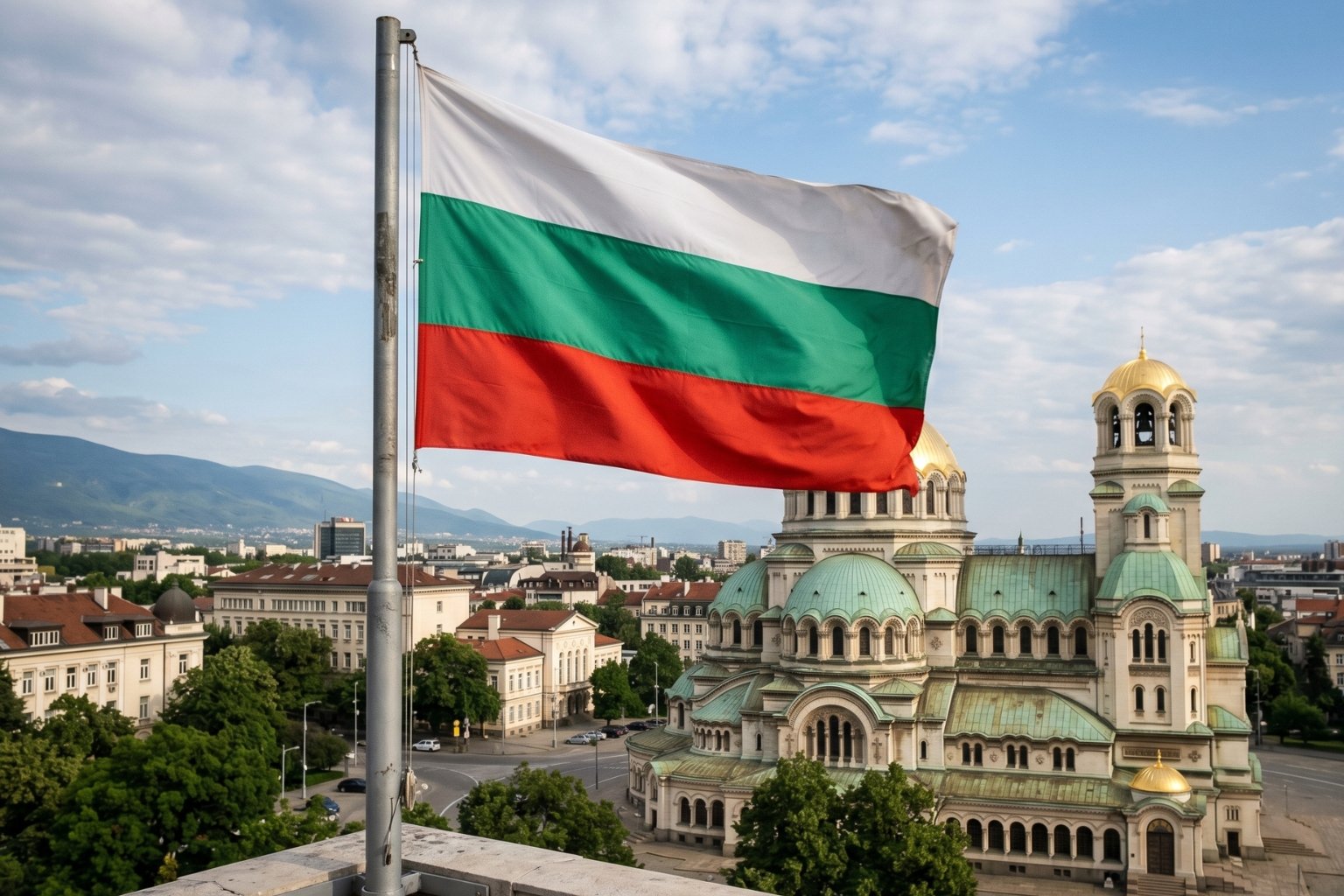

Three horizontal bands. No coat of arms on the everyday version. No complicated geometry. The Bulgarian flag looks almost austere until you understand what each color replaced, borrowed, or reclaimed across five centuries of empire, occupation, and national awakening. This is not just a tricolor. It is a compressed political biography.
What the Bulgaria Flag Looks Like
The flag of Bulgaria is a horizontal tricolor composed of three equal bands: white on top, green in the middle, and red at the bottom. Its proportions follow a 3:5 ratio, standard among European national flags.
There are technically two versions. The national flag is the plain tricolor, used by citizens, athletes, and institutions in everyday contexts. The state flag adds the national coat of arms in the upper left corner of the white stripe, extending slightly into the green band. This version is reserved for official government and diplomatic use.
The design is deliberately clean. No patterns, no stars, no inscriptions. The weight of meaning falls entirely on the colors.
The Colors of the Bulgarian Flag and What They Mean
White: Peace, Freedom, and a Russian Inheritance
The white stripe carries associations of peace, freedom, and spiritual purity. These are broadly shared values across vexillology, but in the Bulgarian context, white carries a more specific historical charge: it is the first stripe of the Russian tricolor, the direct model from which the Bulgarian flag was adapted in 1879.
That inheritance was not accidental. It was a deliberate statement of Slavic kinship at a moment when Bulgaria had just emerged from nearly five centuries of Ottoman rule, largely thanks to Russian military intervention.
Green: The Color That Makes Bulgaria Unique
Green is where the story gets interesting. Among the Pan-Slavic flags of the 19th century, which generally drew from the white, blue, and red palette of the Russian tricolor, Bulgaria substituted green for blue. This was not a design oversight. It was a conscious choice.
Green represents agricultural wealth, fertile land, and the forests and hills that define much of Bulgaria’s geography. But it also served a symbolic function: by replacing blue with green, Bulgarian leaders and revolutionaries signaled that they were building something rooted in their own soil, not simply mirroring their Russian liberators. The flag shared a family resemblance with Russia’s while asserting its own distinct identity.
This single substitution is what gives the Bulgarian flag its character within the Slavic vexillological family.
Red: Revolution, Sacrifice, and a Medieval Echo
Red occupies the bottom stripe and carries the heaviest historical freight. It represents courage, sacrifice, and the blood shed in the long struggle against Ottoman domination. The color connects directly to the revolutionary flags raised during the April Uprising of 1876, Bulgaria’s most significant pre-liberation revolt, which was crushed violently but galvanized international attention and ultimately accelerated Russian intervention.
There is also a medieval thread. The coat of arms of Tsar Ivan Shishman, the most powerful ruler of the Second Bulgarian Empire in the 14th century, featured a golden lion on a red shield. That heraldic image appeared on some of the earliest Bulgarian revolutionary banners of the 19th century, giving red a depth that reaches well beyond 1878.
The Origin of the Bulgarian Flag
A Liberation, a Model, and a Substitution
The direct origin of the Bulgarian flag lies in the Russo-Turkish War of 1877 to 1878. After nearly five centuries under Ottoman rule, Bulgaria was liberated following a series of decisive Russian military victories. The peace treaty signed at San Stefano in March 1878 established an autonomous Bulgarian principality.
In the months that followed, Bulgarian leaders needed symbols for the new state. The most natural reference point was Russia, their liberator and ethnic kin. The Russian horizontal tricolor of white, blue, and red served as the template. Blue was replaced with green, either to reflect Bulgaria’s agricultural character or to mark the new nation’s distinct identity, likely both.
The flag was officially adopted on April 16, 1879, by the Constituent Assembly convened in Tarnovo, Bulgaria’s medieval capital. That location was itself a statement: Tarnovo had been the seat of the Second Bulgarian Empire, and holding the assembly there tied the new state to a centuries-old legitimacy.
The Bulgarian Flag Through History
The Revolutionary Period
Before the 1879 adoption, Bulgarian identity had expressed itself through a scattered but passionate array of revolutionary flags. The April Uprising of 1876 produced banners that combined lions, religious imagery, and Pan-Slavic colors. These were not standardized objects; they were handmade declarations, stitched by women in local communities, carried into unequal battles.
The color red already dominated these early flags, saturated with the memory of failed uprisings and martyred fighters. When the official tricolor was formally adopted three years later, it absorbed all of that accumulated symbolism.
The Communist Chapter (1944 to 1990)
The most disruptive period in the flag’s history came with the establishment of the People’s Republic of Bulgaria in 1946. The communist government modified the flag four times over the following decades, adding and reworking a state emblem placed in the upper left corner of the white stripe.
The emblem went through several iterations, but its core elements remained consistent: a rampant golden lion (preserved from medieval heraldry), a red star at the top, a wreath of wheat, and the dates 681 (the founding of the First Bulgarian Empire) and 1944 (the year the communist-backed Fatherland Front came to power). The juxtaposition of those two dates was politically loaded: it claimed continuity between medieval Bulgarian greatness and the communist regime, a historical argument stitched into cloth.
For many Bulgarians, particularly those who lived through this period, the emblem felt like a colonization of the flag rather than an enrichment of it. The tricolor itself was unchanged, but it was no longer simply theirs.
The Restoration of 1990
On November 27, 1990, as communist rule collapsed across Eastern Europe, the Bulgarian National Assembly voted to remove the state emblem from the flag. The plain white-green-red tricolor was restored.
The moment carried enormous symbolic weight. After 45 years of emblematic overlay, the flag returned to what it had been in 1879: a clean, direct statement of national identity unmediated by political ideology. For a generation of Bulgarians who had associated the emblem with surveillance, censorship, and enforced conformity, the restoration of the plain tricolor felt like a recovered breath.
The flag in this form was formally confirmed in the Constitution of 1991, which established the Republic of Bulgaria.
The Bulgaria Flag Today
The Bulgarian flag is protected under Article 166 of the Constitution, which designates it as a state symbol. Its technical specifications, including the precise Pantone textile colors and the 3:5 proportions, are codified in law. Desecration of the national flag is a criminal offense under Article 108 of the Bulgarian Penal Code.
The flag appears at all official government buildings, diplomatic missions, and during national holidays. The most significant of these is Liberation Day on March 3, which commemorates the signing of the San Stefano peace treaty in 1878. On that date, the tricolor is displayed across the country with a collective awareness of what it cost to earn it.
Internationally, the flag is visible at the Olympics, United Nations events, and wherever Bulgaria’s significant diaspora communities gather, particularly in Spain, Germany, the United Kingdom, and the United States. For Bulgarians living abroad, the flag often carries a more acute emotional charge than it does at home. Distance has a way of concentrating symbols.
How the Bulgarian Flag Compares to Similar Flags
The Bulgarian flag is sometimes confused with those of other European nations, particularly Hungary and Russia, which share similar color palettes. The table below clarifies the key differences.
| Country | Colors (top to bottom) | Orientation | Key Distinction |
|---|---|---|---|
| Bulgaria | White, Green, Red | Horizontal | Green replaces the blue of the Russian model |
| Hungary | Red, White, Green | Horizontal | Reversed order, different historical origin |
| Russia | White, Blue, Red | Horizontal | The direct model for Bulgaria’s flag |
| Belarus | Red, Green (with ornamental stripe) | Horizontal | Green present but with decorative left band |
The Bulgarian and Hungarian flags are the most frequently confused, as they share the same three colors. The distinction is the order: Hungary runs red-white-green from top to bottom, while Bulgaria runs white-green-red. Beyond the visual difference, the two flags have entirely separate origins and carry unrelated symbolism.
Russia’s flag is the closest structural ancestor of Bulgaria’s, and the relationship between the two remains visible to anyone who knows the history. The green stripe in the middle is Bulgaria’s most eloquent departure: the point at which a borrowed form became a genuinely national one.
