

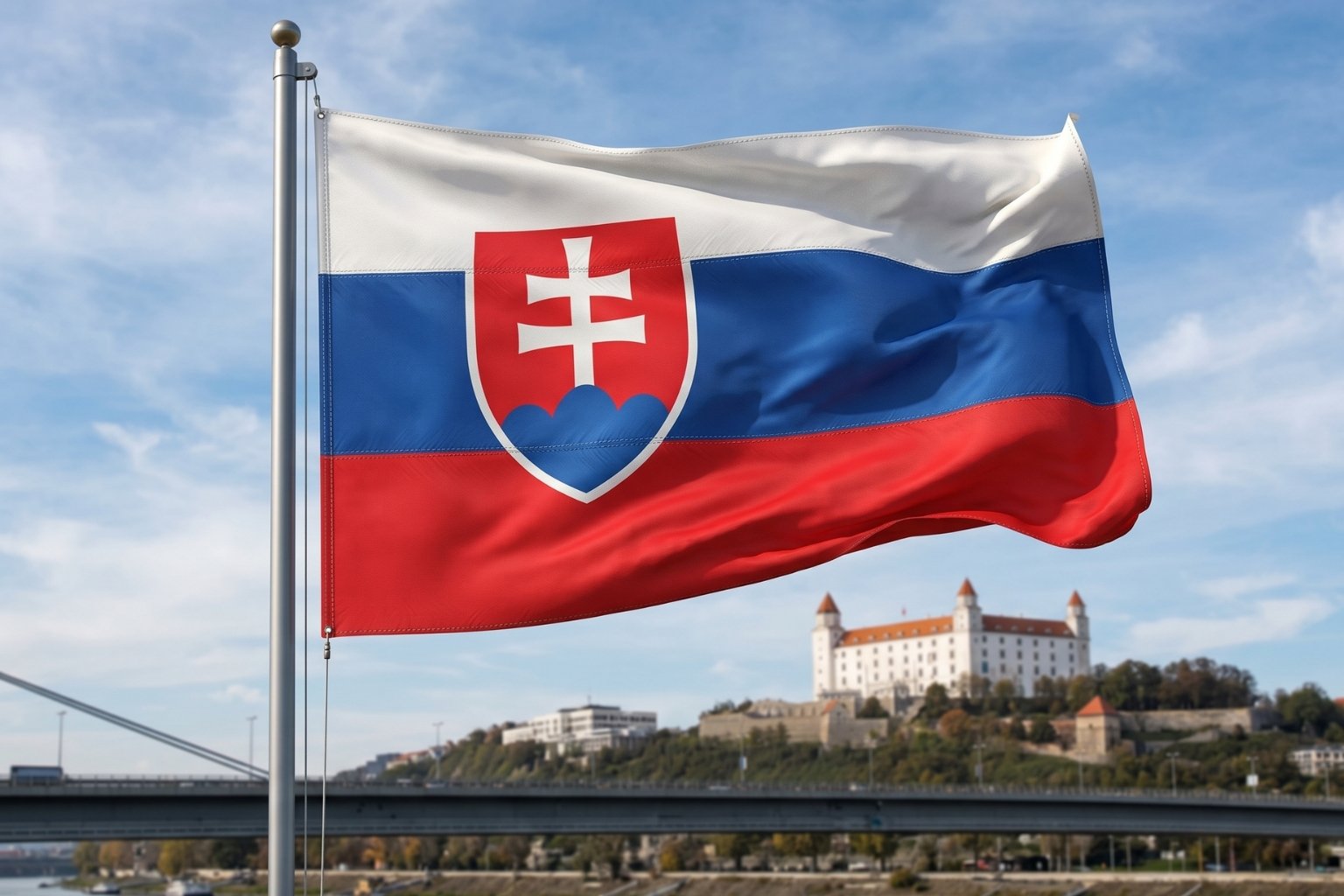

A flag that was once identical to Russia’s. A coat of arms borrowed from the kingdom that spent centuries suppressing Slovak identity. A double cross that arrived from Byzantium over a thousand years before the Slovak Republic ever existed. The flag of Slovakia is one of the most quietly layered national symbols in Central Europe, and almost nobody outside its borders knows the full story behind it.
What the Slovakia Flag Looks Like
The Slovak national flag consists of three horizontal stripes of equal width, arranged from top to bottom in white, blue, and red. On the hoist side, overlapping all three stripes, sits the national coat of arms.
The flag’s proportions are set at a ratio of 2:3, standard for most European national flags. It was officially adopted on September 3, 1992, two days before the Slovak constitution was signed, as the country prepared to formally separate from Czechoslovakia on January 1, 1993.
The position of the coat of arms is not decorative. It is legally essential. Without it, the flag is indistinguishable from Russia’s.
The Colors of the Slovak Flag and What They Mean
White, Blue, Red: The Pan-Slavic Palette
The three colors of the Slovak flag belong to a shared symbolic language across Slavic nations. They are known as the Pan-Slavic colors, and their origin traces back to a single moment: the Slavic Congress of 1848 in Prague.
That year, Slavic peoples across the Austrian and Hungarian empires rose in revolt, demanding autonomy, recognition, and in some cases independence. Slovak delegates attended the congress alongside Czechs, Poles, Croats, and others. The gathering adopted white, blue, and red as the colors of collective Slavic identity, drawing inspiration from the flag of Russia, the only fully independent Slavic power of the era. Russia had been flying its own white-blue-red tricolor since the late 17th century, when Peter the Great modeled it partly on the Dutch flag.
For smaller nations still living under foreign rule, those three colors became a declaration of belonging to something larger than any single empire allowed them to be.
What Each Color Carries
Beyond the Pan-Slavic framework, each color holds meaning specific to Slovak history and heraldry.
White is the oldest color in Slovak symbolism. In the medieval period, early Slovak banners featured red and white stripes, and white appears in the coat of arms as the color of the double cross, connecting it to the silver heraldic tradition of Central European Christianity. It represents purity, peace, and the enduring presence of faith in Slovak public life.
Blue is the color of the hills on the coat of arms, the color of Slovak rivers and the Carpathian sky. In the broader heraldic tradition it signals loyalty, vigilance, and constancy. For Slovaks, it also carries the weight of geography: Slovakia is a landlocked, mountainous country, and its relationship with its landscape is deep and central to national identity.
Red is the color of the shield on the coat of arms, the background against which the cross and the hills stand. It appears in Slovak heraldry as far back as the 13th century. It carries the standard associations of courage, sacrifice, and sovereignty, but in Slovakia’s case those associations are earned. The Slovak people fought for recognition under Hungarian rule for centuries before that flag was ever formally theirs.
The Coat of Arms: Three Hills, One Cross, Centuries of Meaning
The Double Cross and Its Byzantine Roots
The most immediately striking element of the Slovak coat of arms is the white double cross, also called a patriarchal cross or Byzantine cross, standing on a blue three-peaked hill against a red shield.
This cross did not originate in Slovakia. It arrived in the 9th century with Cyril and Methodius, two Byzantine missionaries sent by Emperor Michael III to evangelize the Slavic peoples of Great Moravia, the medieval state that covered much of present-day Slovakia, Moravia, and surrounding territories. They brought with them not only Christianity but the Glagolitic alphabet, the forerunner of Cyrillic, and a liturgy conducted in the local Slavic language rather than Latin. That decision was radical. It meant ordinary people could participate in religious life in their own tongue.
The double cross they carried was already ancient. It had appeared on Byzantine coins since the 7th century. When it became embedded in Slovak heraldic tradition, it became more than a religious symbol. It became a mark of civilizational origin, a reminder that Slovak cultural identity was shaped by an encounter between two worlds: the Latin West and the Byzantine East.
Cyril and Methodius are still patron saints of Slovakia today. The cross on the flag is their direct legacy.
The Three Hills and a Geographic Anomaly
Below the double cross, three blue peaks form the base of the coat of arms. These represent three mountain ranges: the Tatras, the Fatras, and the Matras.
The Tatra and Fatra ranges run through Slovakia. They are unmistakably Slovak landscapes, their peaks defining the northern and central skyline of the country. But the Matra mountains are in Hungary.
This is not an error. It is a historical imprint. When the triple-peaked symbol was adopted into the Hungarian royal coat of arms in the medieval period, it represented the mountain regions of Upper Hungary, the territory where the Slovak population was concentrated. The three peaks were, in effect, a geographic shorthand for Slovak-inhabited land within a kingdom that had no intention of recognizing Slovaks as a distinct people.
When Slovak national consciousness crystallized in the 19th century, the three peaks were repurposed. They became a symbol not of Hungarian dominion but of Slovak geographic identity. The Matra remained in the emblem even as borders shifted, a fossilized cartography that predates the modern state by centuries.
The Red Shield and the Hungarian Heraldic Legacy
The coat of arms as a whole derives from the Hungarian royal coat of arms, adapted and reinterpreted over several centuries. The red shield, the cross, the triple peak: all of these elements were absorbed from the heraldic vocabulary of the very kingdom that denied Slovak nationhood, banned the Slovak language from public life, and pursued a policy of Magyarization well into the 20th century.
There is an uncomfortable irony in that lineage. The symbol Slovaks chose to distinguish their flag from Russia’s, and to assert their unique identity, was built from the visual language of their historical oppressor. But heraldry has always worked that way. Symbols are claimed, repurposed, and given new meaning by the people who inherit them. The red shield became Slovak not by origin but by insistence.
A Short History of the Slovak Flag
Before There Was a Slovakia
The earliest Slovak visual identity was not a flag but a pattern. Medieval documents and banners associated with Slovak-inhabited territories showed red and white stripes, the simplest heraldic vocabulary of the Central European tradition. No unified Slovak state existed to formalize these symbols. Slovaks lived within the Kingdom of Hungary, their language and identity acknowledged only partially, and only when it was politically convenient.
The first moment of genuine Slovak symbolic assertion came in 1848, during the revolutionary upheaval that shook the Austrian Empire. The Slovak National Council, formed that year to lead the Slovak uprising against Hungarian rule, adopted a white, blue, and red tricolor for its banner. It was a deliberate political statement, aligning Slovakia with the broader Pan-Slavic movement and signaling solidarity with other Slavic peoples fighting for autonomy.
The uprising failed. Hungary reasserted control. But the tricolor had been planted.
Czechoslovakia and the Flag Question
After World War I and the collapse of Austria-Hungary, Slovakia joined the newly formed Czechoslovakia in 1918. The Slovak tricolor was folded into a new shared identity. The Czechoslovak flag, adopted in 1920, combined the white and red of Bohemia with a blue triangle on the hoist side, a compromise that satisfied neither Czechs nor Slovaks entirely but served the new republic’s need for a unified symbol.
During World War II, when Nazi Germany dismembered Czechoslovakia, a nominally independent Slovak Republic was established as a client state. The wartime Slovak government revived the white-blue-red tricolor as its national flag, a choice that associated the colors with a regime that collaborated with Nazi occupation. That association left a shadow over the symbol that Slovak national memory has had to navigate carefully ever since.
After the war, Czechoslovakia was reconstituted, first as a democracy and then, from 1948, as a communist state under Soviet influence. The Slovak tricolor returned to its subordinate role within Czechoslovak symbolism.
Independence and the Russia Problem
When the communist system collapsed in 1989 and Czechoslovakia began its transition, Slovak demands for greater autonomy intensified. In 1990, as part of constitutional negotiations, Slovakia was permitted to readopt its traditional white, blue, and red tricolor as the Slovak flag within the federal republic.
There was an immediate problem. The flag was identical to Russia’s.
Same colors, same arrangement, same proportions. For a nation just emerging from decades of Soviet-imposed communism, flying a flag indistinguishable from Moscow’s was politically untenable. It sent entirely the wrong message about what Slovak independence was supposed to mean.
The solution was the coat of arms. On September 1, 1992, the Slovak parliament approved the addition of the national coat of arms to the tricolor, anchored to the hoist side where it overlaps all three stripes. The flag was formally adopted on September 3, 1992. The Velvet Divorce, the peaceful dissolution of Czechoslovakia, took effect on January 1, 1993.
The coat of arms did not just differentiate Slovakia from Russia. It grounded the flag in a specific, irreducible history. A history of Cyril and Methodius, of medieval mountain ranges, of a people who had been claiming their identity for a thousand years before anyone recognized the country on a map.
How Slovakia’s Flag Compares to Similar Flags
The white-blue-red tricolor is shared by several nations, which creates genuine confusion. Here is how the Slovak flag differs from the most commonly mixed-up versions.
| Country | Stripe Order (top to bottom) | Coat of Arms | Key Difference |
|---|---|---|---|
| Slovakia | White, Blue, Red | Yes, on hoist side | Double cross on three hills |
| Russia | White, Blue, Red | No | No coat of arms |
| Slovenia | White, Blue, Red | Yes, on hoist side | Shield with mountains and a star |
| Czech Republic | White over Red with blue triangle | No | Blue triangle on left, no tricolor |
Slovakia and Slovenia are the most frequently confused. Both flags use the same three colors in the same order, with a coat of arms on the hoist side. The coats of arms are entirely different in design, but at a distance or on a small screen, the flags are easy to mistake for each other.
The Czech flag is structurally distinct. Its blue element is a triangle rather than a stripe, and it carries no coat of arms. The visual logic is different enough that confusion is less common, though the shared history of Czechoslovakia keeps the two flags mentally linked for many people.
The Flag Today
In Slovakia, the national flag flies on government buildings, schools, and public institutions year-round. It is displayed with particular visibility on national holidays: Constitution Day on September 1, Slovak National Uprising Day on August 29, and the Day of the Establishment of the Slovak Republic on January 1.
For Slovaks, the flag carries a weight that goes beyond standard national symbolism. It is a relatively young symbol in its current form, barely three decades old, attached to a state that itself is still finding its footing on the international stage. But the elements within it, the cross, the mountains, the colors, reach back through layers of history that most national flags do not contain.
A small country, landlocked, mountainous, long absorbed into empires that did not recognize it. The flag of Slovakia is, in the end, a record of persistence.
