

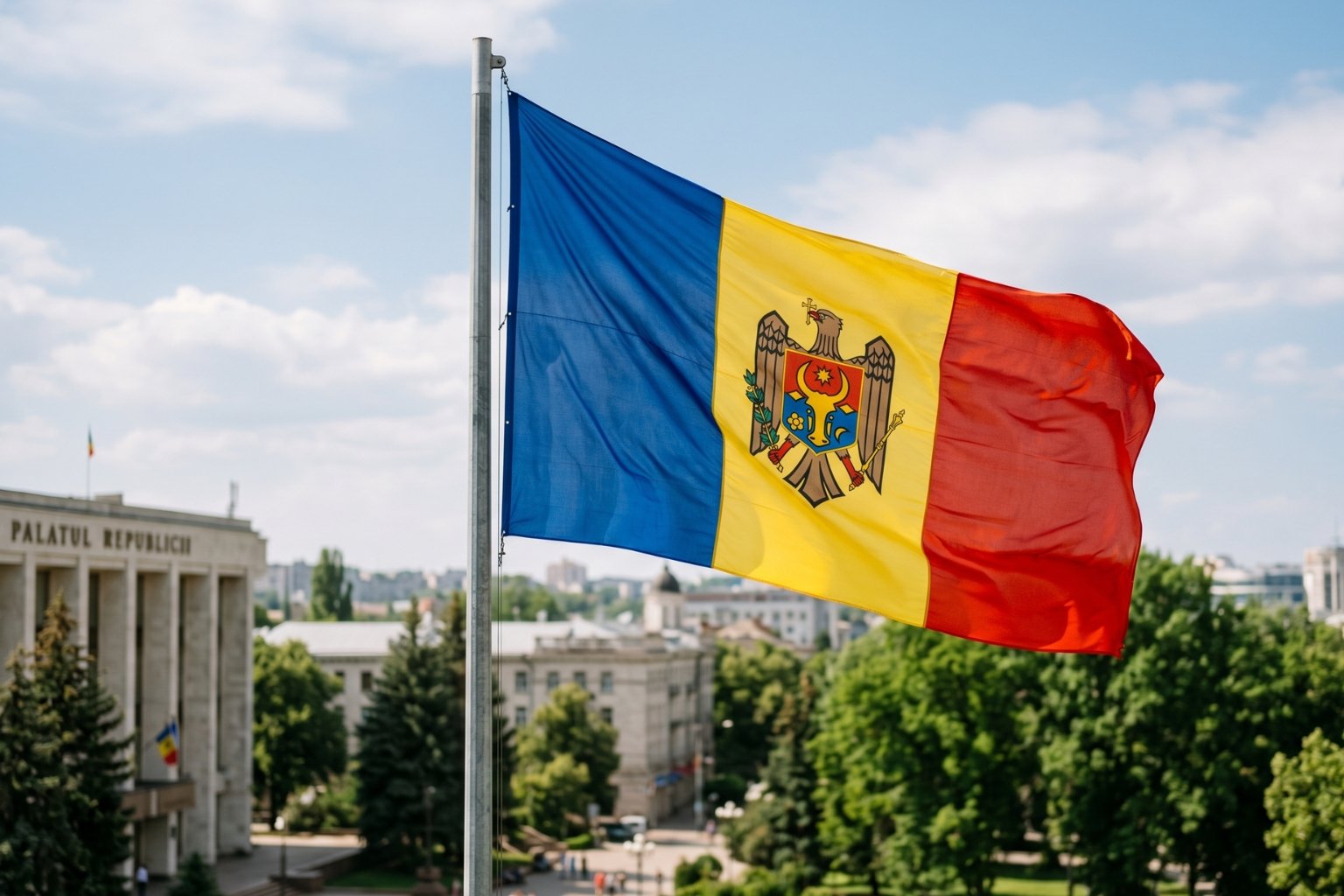

Few flags in Europe carry as much compressed history as Moldova’s. At first glance, it looks almost identical to Romania’s tricolor – a vertical arrangement of blue, yellow, and red that has flown over this corner of the world since the revolutionary 1840s. Look closer, and a richly detailed coat of arms appears on the central stripe: an eagle, a medieval ox head, an Orthodox cross, an olive branch, a crescent, a star. Each element a chapter. Each chapter, a country shaped by forces far larger than itself.
A Flag That Looks Familiar but Tells Its Own Story
The first thing most people notice about the Moldova flag is how closely it resembles Romania’s. The resemblance is not coincidental – it is the whole point. Both countries share the same blue-yellow-red vertical tricolor, rooted in the same revolutionary tradition, the same Latin cultural identity, the same linguistic and historical inheritance from the medieval Principality of Moldavia.
The difference, and it is a significant one, is the coat of arms placed at the center of Moldova’s yellow stripe. Without it, the two flags are indistinguishable. That choice – to add the emblem – was not merely decorative. It was a political statement about a country that needed to assert a distinct sovereign identity while still acknowledging where it came from.
There is also the matter of Chad. The Chadian flag uses the same blue-yellow-red sequence, a coincidence of the color palette with no shared historical meaning. Moldova’s colors come from the Pan-Romanian heraldic tradition. Chad’s come from the Pan-African movement. The visual echo has caused minor diplomatic awkwardness but carries no deeper significance.
The Three Colors and What They Actually Mean
The selection of blue, yellow, and red for Moldova’s flag was not arbitrary. These colors trace directly back to the revolutionary flags of 1848, when the Romanian principalities of Wallachia and Moldavia rose against Ottoman and Russian domination. The tricolor was modeled consciously on the French flag – a deliberate signal that the Romanian-speaking peoples of the region considered themselves a Latin people, heirs to the same republican and revolutionary tradition as France.
White, the neutral center of the French flag, was replaced by yellow – the heraldic color of Moldavian gold, prosperity, and the land. The result was a flag that said: we are Latin, we are of this soil, and we are not going back.
Blue
The blue stripe occupies the left side of the flag. In the heraldic tradition of the region, blue carries associations with freedom, the sky, and spiritual aspiration. It also connects to the historical use of blue in Moldavian princely banners. In the context of the 1990 flag adoption, it spoke to a people reclaiming a future after decades of Soviet grey.
Yellow
The yellow stripe is the widest and most loaded of the three, because it carries the coat of arms at its center. As a color, yellow in Moldavian heraldry represents wealth, the harvest, and the golden fields that have defined this landlocked agricultural country for centuries. Moldova is still one of Europe’s great wine-producing nations. Yellow is the color of that particular abundance.
Red
The red stripe on the right side is the most universal of the three in meaning: courage, sacrifice, and the blood of those who defended this territory. Moldova changed hands violently and repeatedly – Ottoman, Russian, Romanian, Soviet – and the red stripe carries the weight of those transitions.
The Coat of Arms – Symbol by Symbol
The coat of arms at the heart of the Moldova flag is the element that elevates it from a regional tricolor to a genuinely national symbol. It was designed by a commission of Moldovan artists and heraldic experts, most notably the graphic artist Gheorghe Vrabie, and officially approved on July 3, 1990.
The eagle at the center is borrowed from the heraldic tradition of Wallachia, one of the medieval Romanian principalities. Its presence is a claim of shared Latin and Roman heritage – the eagle as a symbol of power, vigilance, and continuity with a deeper past.
The Orthodox cross held in the eagle’s beak is unambiguous: Moldova is a country of deep Christian Orthodox faith, a faith that survived and in some ways defined the community through centuries of foreign rule.
The scepter and olive branch held in the eagle’s talons represent the twin poles of national life – sovereignty and peace. The scepter signals legitimate political authority. The olive branch signals a desire for coexistence and dialogue, a relevant message for a country that emerged from the Soviet collapse with territorial tensions already forming.
The shield on the eagle’s breast is where the specifically Moldavian symbolism lives. At its center is the aurochs head – the ancient wild ox that served as the emblem of the medieval Principality of Moldavia as far back as the 14th century. It appears in chronicles and on coins from the reign of Prince Bogdan I. The aurochs was already extinct by the 17th century, making it a purely historical symbol, one that reaches back to a Moldavia that predates Russia, Romania, and the Ottoman Empire by centuries.
Flanking the aurochs head on the shield are three further symbols: a five-pointed star, a rose, and a crescent moon. These represent the different historical regions that once composed greater Moldavia – each with its own traditions, its own memory. Their presence together on the shield is a statement about unity from diversity.
A Short but Turbulent Flag History
To understand why the Moldova flag matters so much, it helps to understand how many flags preceded it.
1917 – 1918: When Moldova declared itself the Moldavian Democratic Republic during the chaos of World War I and the Russian Revolution, it adopted a blue-yellow-red tricolor with an aurochs head at the center. That flag flew for less than a year before Moldova was absorbed into Romania in April 1918.
1918 – 1940: As part of Romania, Moldova flew the Romanian national flag.
1940 – 1989: The Soviet Union annexed Moldova in 1940. After a brief German and Romanian occupation during World War II, the Moldavian Soviet Socialist Republic was reestablished in 1944. Its flag, adopted in 1952, was a modified Soviet red banner with a horizontal green stripe through the center – green representing the vineyards and agricultural character of the territory. It was a Soviet flag with a local detail. Nothing more.
May 12, 1990: As communist rule crumbled, the blue-yellow-red tricolor was formally readopted. The Soviet flag was gone.
November 3, 1990: The coat of arms was added to the yellow stripe, completing the flag as it exists today.
2010: A law was passed requiring the coat of arms to appear on both sides of the flag – a technical clarification that also reinforced the symbolic importance of the emblem as inseparable from national identity.
Why 1990 Was a Turning Point, Not Just a Date
The adoption of the flag in 1990 was not an administrative formality. It was an act of cultural reclamation performed under pressure, with the Soviet Union still technically in existence and the future of Moldovan sovereignty still uncertain.
The decision to add the coat of arms to the tricolor carries a specific political logic. A plain blue-yellow-red tricolor is the Romanian flag. Moldova’s ruling class in 1990 was navigating a genuinely difficult question: was this new country a separate Moldovan nation, or was it part of a broader Romanian identity? The coat of arms was the answer – or rather, the holding of two answers at once. Yes to the shared tricolor and its Pan-Romanian symbolism. Yes also to a distinct Moldovan emblem rooted in medieval Moldavian history and not reducible to Romania.
That tension – between Moldovan national identity and Romanian cultural heritage – has never fully resolved. The flag carries it still.
The Moldova Flag in the World Today
On March 2, 1992, Moldova was admitted to the United Nations. The blue-yellow-red tricolor with its coat of arms was raised at UN Headquarters in New York – the moment when the world formally acknowledged a country that had existed in various forms for centuries but as a sovereign state for barely two years.
Since then, the flag has taken on new layers of meaning. Moldova’s recent pivot toward European Union membership – formalized as a candidate country in 2022 – has given the tricolor an additional resonance. A flag born from Latin republican idealism in the 1840s, suppressed through Soviet decades, reclaimed in 1990, now flying alongside EU candidacy paperwork. It is a long arc.
For Moldovans at home and in a substantial diaspora spread across Romania, Italy, and beyond, the flag remains a live symbol – contested, meaningful, and still in the process of being fully defined.
