

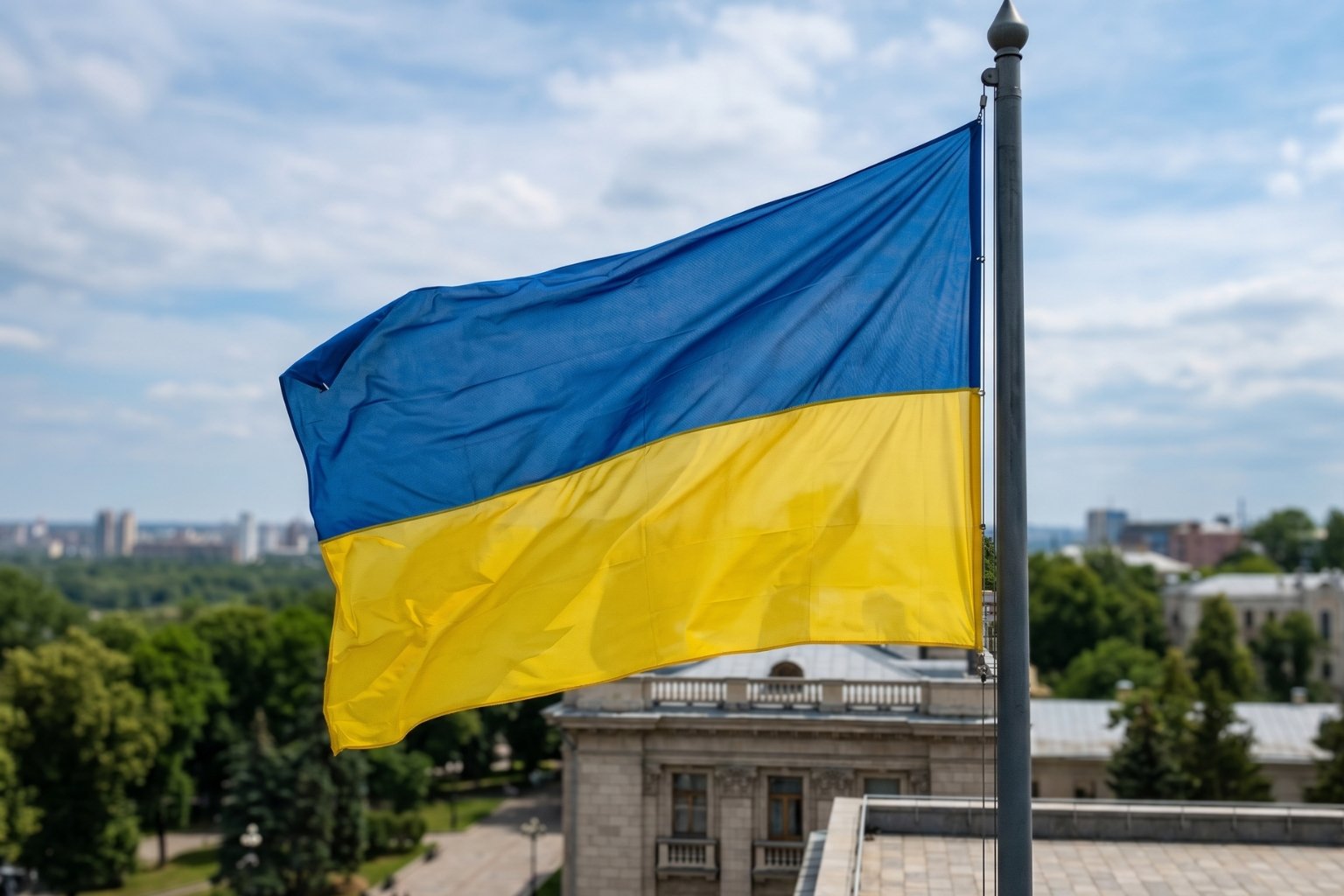

Two horizontal bands. No emblem, no inscription, no ornament. Just blue on top, gold beneath. The Ukraine flag may be one of the most graphically spare national flags in the world, yet few symbols carry as much accumulated meaning. Every shade, every proportion, every documented appearance over seven centuries adds a layer to what is, today, one of the most recognized pieces of cloth on the planet.
What the Colors of the Ukraine Flag Actually Mean
Blue: Sky, Water, and the Idea of Freedom
The upper band is officially described as azure, the heraldic term for a clear, mid-tone blue. In the most common interpretation, it represents the vast open sky that arches over the Ukrainian steppe, as well as the country’s rivers and streams, the Dnipro chief among them.
Blue carries a secondary symbolic register as well. In Christian iconography, particularly within the Eastern Orthodox tradition deeply rooted in Ukrainian culture, blue is associated with the divine, with purity, and with spiritual aspiration. It has long appeared on church walls, icons, and vestments across the region.
Yellow and Gold: Land, Wheat, and Prosperity
The lower band is gold, sometimes rendered as a warm yellow in modern reproductions. Its most immediate reading is agricultural: Ukraine has historically been one of the great breadbaskets of Europe, and the golden hue evokes the endless wheat fields that define much of the country’s landscape from late June onward.
Gold also carries dynastic and Christian weight. It appears throughout medieval Ruthenian heraldry as a marker of sovereignty and divine sanction. The color was not chosen for its prettiness. It was chosen because it already meant something.
The Heraldic Logic: Color Over Metal
There is a detail most articles skip entirely, and it matters. In classical European heraldry, there is a fundamental rule: you never place a color on a color, or a metal on a metal. Blue (azure) is a color; gold (or) is a metal. Blue over gold respects this rule perfectly, producing maximum visual contrast and marking the flag as heraldically correct, a rare distinction among national flags worldwide.
This was not an accident. The people who formalized Ukraine’s colors in the 19th century were working within a well-established heraldic tradition inherited from the medieval principalities of Ruthenia. The design was, in a sense, already written into the visual grammar of the region.
The Origins: A Symbol Rooted in Medieval Ruthenia
The Kingdom of Galicia-Volhynia and the 13th Century
The earliest firm visual link to blue and gold in Ukrainian territory dates to the Kingdom of Galicia-Volhynia, a principality that controlled much of what is now western Ukraine and parts of Poland from the late 12th to the mid-14th century. Under Prince Danylo Romanovych, who ruled in the 13th century, the coat of arms depicted a golden lion on an azure field, the same color combination that would eventually become the Ukrainian national flag.
That coat of arms is not a historical footnote. The city of Lviv, founded during this same period, still bears it today, a golden lion on blue, on its official seal and on buildings throughout the old town.
Fire, Water, and the Battle of Grunwald
Some historians trace yellow and blue even further back, into pre-Christian Ukrainian ceremonial culture, where yellow represented fire and blue represented water, two elemental forces in Slavic folk tradition. The first documented military appearance of the color combination in a Ukrainian formation is noted at the Battle of Grunwald in 1410, where militia units from the Ruthenian Voivodeship carried blue and yellow standards.
The Cossack Era and the First Political Flags
Between the 16th and 18th centuries, the Ukrainian Cossacks established themselves as one of the most powerful military and cultural forces in Eastern Europe. Their banners varied considerably: crimson, raspberry, red-black. But blue and yellow appeared repeatedly among Cossack formations, often with a gold cross, gold stars, or a gold image of a saint against a blue ground.
These were not decorative choices. For a stateless people fighting for autonomy against the Polish-Lithuanian Commonwealth, the Ottoman Empire, and eventually the Russian Tsarate, colors functioned as declarations. Blue and yellow, already connected to the Ruthenian heraldic tradition, became shorthand for a specific identity, one that was neither Russian nor Polish.
1848, the Spring of Nations, and the Flag’s Modern Birth
The year that transforms blue and yellow from a regional heraldic tradition into a modern political symbol is 1848. Across Europe, a wave of nationalist revolutions, later called the Spring of Nations, shook the established empires. In Lviv, then part of the Austrian Empire, Ukrainian political leaders founded the Supreme Ruthenian Council, the first representative Ukrainian political organization in the modern sense.
That council formally adopted light blue and yellow as the colors of the Ukrainian people. A flag was raised. It was the first time these colors flew officially over a Ukrainian political body, and the moment is now understood as the birth of the flag in its contemporary form.
At the time, the Ukrainian lands were split between the Russian and Austro-Hungarian empires, with no Ukrainian state to speak of. The flag was, for decades, the symbol of a nation that existed in language, memory, and aspiration but not yet in law.
Independence, Suppression, and Return
1918: A Republic and Its Banner
The collapse of the Russian Empire at the end of World War One opened a brief, turbulent window of Ukrainian statehood. The Ukrainian People’s Republic, declared in 1918, formally adopted the blue and yellow bicolor as its national flag. For the first time, the symbol had a state behind it.
That state lasted only a few years. By the early 1920s, the Red Army had taken control, and Ukraine was absorbed into the Soviet Union.
The Soviet Years: A Flag You Could Be Arrested For
Under Soviet rule, the blue and yellow flag was banned. Displaying it, even privately, could mean arrest, imprisonment, or worse. The Soviet Ukrainian SSR flew a red flag with Soviet insignia. The bicolor survived in the Ukrainian diaspora abroad and in the quiet, dangerous memory of those who remained.
This suppression was not incidental. The Soviet project required the erasure of pre-Soviet national symbols, and blue and yellow were too legible, too historically loaded, to be tolerated.
1989 to 1992: Return and Recognition
In the spring of 1989, as the Soviet system began to fracture, the blue and yellow flag reappeared publicly for the first time in decades. It was raised in Lviv by nationalist and human rights organizations, a deliberate provocation and a reclamation. From there it spread rapidly.
On January 28, 1992, following Ukraine’s declaration of independence, the bicolor was officially adopted as the national flag of the newly sovereign state. The exact proportion and shade were codified: the flag is a horizontal bicolor, equal bands, blue on top.
Which Stripe Goes on Top? A Question That Was Not Always Settled
This is the detail that most readers do not know, and it is genuinely interesting. In the early period of Ukrainian national politics, there was no consensus on orientation. Both blue-over-yellow and yellow-over-blue versions were used during the revolutionary years of 1917 to 1921, depending on the government, the region, or the occasion.
The argument for yellow on top rested on heraldic tradition: in many European conventions, the more prestigious element (gold, associated with sovereignty) was placed above. The argument for blue on top was more literal: the sky is above the earth. Blue over gold also follows the more common European heraldic reading of the combination.
When the flag was formalized in 1992, blue was placed on top, and that orientation has been official ever since. But the earlier ambiguity is a reminder that even the most familiar symbols have histories that are messier and more contested than they appear.
The Ukraine Flag Today
August 23rd is Ukraine’s National Flag Day, observed the day before Independence Day on August 24th. It was first established in 2004 and has grown in visibility and emotional weight with each passing year.
Since February 2022 and Russia’s full-scale invasion, the blue and yellow flag has taken on a gravity that goes far beyond national symbolism in the conventional sense. It has become, for millions of people inside and outside Ukraine, a signal of something more urgent: resistance, dignity, the refusal to disappear.
It appears on buildings in cities that have nothing to do with Ukraine. It is worn, painted, projected. For Ukrainians, it is no longer simply a flag. It is an answer to a question that is still being asked by force.
The design has not changed. Two bands, no emblem. The meaning has never been heavier.
