

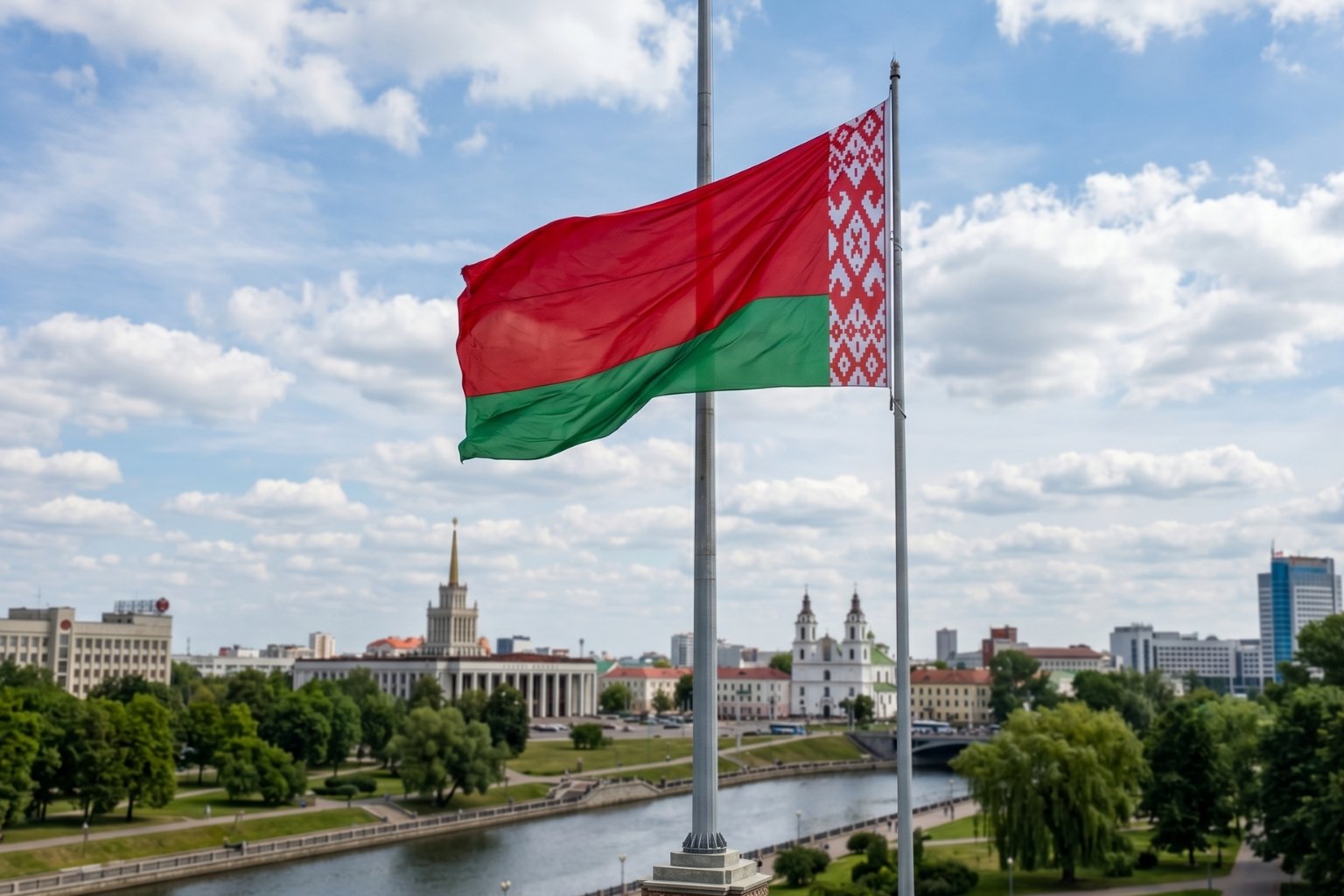

In most countries, a flag is a flag. In Belarus, it is a declaration. The flag you wave tells people which side of history you stand on, what future you believe in, and sometimes whether you are willing to risk arrest for it. The Belarusian flag carries more weight than almost any other in Europe, not because of its design alone, but because a second flag exists alongside it, fought over, suppressed, and carried by hundreds of thousands into the streets.
What the Belarusian Flag Looks Like Today
The current official flag of Belarus is composed of two horizontal stripes and a vertical ornamental band at the hoist. The upper stripe is red, the lower stripe is green, in a ratio of 2 to 1. Along the left edge, occupying one ninth of the flag’s total length, runs a white field bearing a red geometric pattern drawn from traditional folk embroidery.
Proportions and Structure
The flag follows a standard ratio of 1 to 2, width to length. The ornamental band at the hoist measures exactly one ninth of the flag’s length. The red stripe covers twice the surface area of the green stripe. These proportions are legally defined and have remained unchanged since the current design was adopted in 1995.
| Element | Description |
|---|---|
| Upper stripe | Red, two thirds of the horizontal field |
| Lower stripe | Green, one third of the horizontal field |
| Hoist band | White field with red folk pattern, one ninth of total length |
Belarus holds a rare distinction: it is the only country in the world to feature a traditional textile ornament as a core element of its national flag.
The Colors and What They Mean
Red
Red on the Belarusian flag carries two layers of meaning that sit uneasily beside each other. The official interpretation, delivered personally by President Alexander Lukashenko in the 1990s, frames it as the color of the banners carried at the Battle of Grunwald in 1410, where forces that included Belarusian ancestors defeated the Teutonic Knights. It also evokes the flags of the Red Army and the Belarusian partisan brigades who resisted German occupation in World War II, a conflict in which Belarus lost roughly a third of its population.
Beneath that political framing, red carries older meaning in Slavic tradition: the color of the sun, of life, of joy. It appears on folk textiles, ritual objects, and embroidery across centuries of Belarusian culture long before any state claimed it.
Green
Green reflects something immediately visible to anyone who has traveled through Belarus. The country is covered in forests. Around 40 percent of its territory is woodland, and its agricultural plains stretch in every direction. Green on the flag stands for that landscape, for the seasons, for spring renewal and the quiet endurance of a farming culture that runs deep in Belarusian identity.
It is the color of hope, growth, and what the official register calls natural harmony. It is also the color that most directly links the current flag to its Soviet predecessor.
White
White is the most layered color of all. In the current flag, it appears only in the background of the ornamental hoist band. But white is everywhere in Belarusian cultural memory. The name of the country itself, Belarus, translates literally as White Russia or White Ruthenia, and the origins of that name are still debated: some link it to freedom, some to a direction on the Slavic compass, some to the fair complexion of the population.
White is also the ground color of the opposition flag. That fact is not incidental.
The Rushnyk: The Pattern That Makes This Flag Unique
The vertical band at the hoist is not decorative in a generic sense. It is a rushnyk, a traditional embroidered cloth that has existed in Slavic cultures for centuries. Rushnyky were used at births, weddings, funerals, and harvests. They lined icons, greeted guests, wrapped bread. They carried the symbolic life of a community in their geometric forms.
The specific pattern used on the Belarusian flag is not anonymous folk craft. It has a precise origin.
Matrona Markevich and the 1917 Embroidery
In 1917, a peasant woman named Matrona Markevich, from the village of Kastsilishcha in the Sennin region, created an embroidery intended as part of traditional female dress. The piece was eventually archived by the Belpramsavyet, the Soviet body overseeing local crafts, where it sat unnoticed for decades.
When the Soviet authorities redesigned the flag of the Byelorussian Soviet Socialist Republic in 1951, they reached into those archives. Markevich’s embroidery was selected, slightly adapted, and placed on the flag of a republic whose ideology had little patience for folk tradition. A few new symbolic elements were introduced to the pattern during that adaptation.
The motifs themselves carry ancient meaning. The rhombus shapes at the top and bottom of the pattern represent agricultural renewal, specifically the return of the harvest cycle. Between the rhombuses and the central form sit smaller signs interpreted as votive symbols, expressions of hope and the fulfillment of wishes. Rhombuses in their various forms appear on artifacts found across the territory of present-day Belarus reaching back thousands of years. They are among the oldest symbols of farming culture in the region.
The pattern was never just decoration. It was a compressed archive of rural life and collective memory, placed on a Soviet flag almost accidentally, and surviving onto the post-Soviet one.
A Flag Built on Layers: The Full History
Before the Flag
For most of its history, the territory of present-day Belarus belonged to other powers: the Grand Duchy of Lithuania, the Polish-Lithuanian Commonwealth, the Russian Empire. No unified Belarusian national flag existed. The visual identity of the region was embedded in the heraldry of the Grand Duchy, particularly the Pahonia, a coat of arms depicting a mounted knight on a red shield. Red and white were its foundational colors.
That color vocabulary would return, again and again, at every moment of Belarusian national assertion.
The First Belarusian Flag (1918)
When the Russian Empire collapsed at the end of World War I, a Belarusian state appeared briefly. The Belarusian People’s Republic, proclaimed in March 1918, adopted a white-red-white triband as its flag. Its origins are attributed to Klawdziy Duzh-Dushewski, who designed it before 1917, drawing on the red and white of the Pahonia and on the symbolism embedded in the country’s name.
The republic lasted less than a year before Soviet and Polish forces divided the territory between them. But the flag survived in memory.
The Soviet Era
Under Soviet rule, the plain red communist flag flew over Belarusian territory. In 1951, the Byelorussian Soviet Socialist Republic received a redesigned flag: red above, green below, with the Soviet emblems of the hammer, sickle, and red star, and the folk embroidery band at the hoist. The green stripe acknowledged Belarus’s agricultural character. The ornamental band was an unusual concession to local cultural identity, even within a strictly centralized Soviet visual system.
That 1951 flag is the direct parent of the flag that flies today.
Independence and the Return of White-Red-White (1991 to 1995)
When the Soviet Union dissolved in 1991, Belarus declared independence and immediately returned to the white-red-white banner of 1918. For four years it was the official flag of the independent Republic of Belarus. The Pahonia returned as the coat of arms. It was a brief, contested window of national redefinition.
The 1995 Referendum
In 1995, President Alexander Lukashenko, who had come to power the previous year, held a referendum that included a question on the national symbols. The result, disputed by opposition observers but implemented in full, replaced the white-red-white with a design derived from the 1951 Soviet flag. The hammer, sickle, and star were removed. The red-green horizontal layout and the rushnyk band were kept. The ornamental pattern was reversed from red on white to the current form.
The message of that choice was understood clearly. The Soviet visual grammar was being rehabilitated. The 1918 flag was being buried again.
Two Flags, One Country
Since 1995, Belarus has lived with two flags that represent irreconcilable visions of the country.
The official red-green flag is the state symbol, displayed on government buildings, at official events, and in the imagery of the Lukashenko administration. It evokes Soviet continuity, stability, and a particular reading of Belarusian history in which the defining events are the victory over Nazism and the authority of the state.
The white-red-white flag is the opposition symbol, the flag of the diaspora, and for many Belarusians inside the country, the only flag they recognize as legitimate. It has been present at every major protest since 1995, consistently suppressed by authorities who confiscate it at sports events and demonstrations alike. Displaying it publicly in Belarus has led to arrests, fines, and worse.
The events of August 2020 transformed the stakes entirely. Following a presidential election whose results were widely rejected as fraudulent, hundreds of thousands of Belarusians took to the streets. The white-red-white flag appeared everywhere: in apartment windows, on factory gates, carried by pensioners and students and factory workers. The images went around the world. Telegram, the messaging app that had become central to the protest movement, temporarily changed its Belarus flag emoji from red-green to white-red-white.
<parameter name=”file_text”># Belarusian Flag: Colors, Meaning, History, and the Story Behind the Pattern
In most countries, a flag is a flag. In Belarus, it is a declaration. The flag you wave tells people which side of history you stand on, what future you believe in, and sometimes whether you are willing to risk arrest for it. The Belarusian flag carries more weight than almost any other in Europe, not because of its design alone, but because a second flag exists alongside it, fought over, suppressed, and carried by hundreds of thousands into the streets.
What the Belarusian Flag Looks Like Today
The current official flag of Belarus is composed of two horizontal stripes and a vertical ornamental band at the hoist. The upper stripe is red, the lower stripe is green, in a ratio of 2 to 1. Along the left edge, occupying one ninth of the flag’s total length, runs a white field bearing a red geometric pattern drawn from traditional folk embroidery.
Proportions and Structure
The flag follows a standard ratio of 1 to 2, width to length. The ornamental band at the hoist measures exactly one ninth of the flag’s length. The red stripe covers twice the surface area of the green stripe. These proportions are legally defined and have remained unchanged since the current design was adopted in 1995.
| Element | Description |
|---|---|
| Upper stripe | Red, two thirds of the horizontal field |
| Lower stripe | Green, one third of the horizontal field |
| Hoist band | White field with red folk pattern, one ninth of total length |
Belarus holds a rare distinction: it is the only country in the world to feature a traditional textile ornament as a core element of its national flag.
The Colors and What They Mean
Red
Red on the Belarusian flag carries two layers of meaning that sit uneasily beside each other. The official interpretation, delivered personally by President Alexander Lukashenko in the 1990s, frames it as the color of the banners carried at the Battle of Grunwald in 1410, where forces that included Belarusian ancestors defeated the Teutonic Knights. It also evokes the flags of the Red Army and the Belarusian partisan brigades who resisted German occupation in World War II, a conflict in which Belarus lost roughly a third of its population.
Beneath that political framing, red carries older meaning in Slavic tradition: the color of the sun, of life, of joy. It appears on folk textiles, ritual objects, and embroidery across centuries of Belarusian culture long before any state claimed it.
Green
Green reflects something immediately visible to anyone who has traveled through Belarus. The country is covered in forests. Around 40 percent of its territory is woodland, and its agricultural plains stretch in every direction. Green on the flag stands for that landscape, for the seasons, for spring renewal and the quiet endurance of a farming culture that runs deep in Belarusian identity.
It is the color of hope, growth, and what the official register calls natural harmony. It is also the color that most directly links the current flag to its Soviet predecessor.
White
White is the most layered color of all. In the current flag, it appears only in the background of the ornamental hoist band. But white is everywhere in Belarusian cultural memory. The name of the country itself, Belarus, translates literally as White Russia or White Ruthenia, and the origins of that name are still debated: some link it to freedom, some to a direction on the Slavic compass, some to the fair complexion of the population.
White is also the ground color of the opposition flag. That fact is not incidental.
The Rushnyk: The Pattern That Makes This Flag Unique
The vertical band at the hoist is not decorative in a generic sense. It is a rushnyk, a traditional embroidered cloth that has existed in Slavic cultures for centuries. Rushnyky were used at births, weddings, funerals, and harvests. They lined icons, greeted guests, wrapped bread. They carried the symbolic life of a community in their geometric forms.
The specific pattern used on the Belarusian flag is not anonymous folk craft. It has a precise origin.
Matrona Markevich and the 1917 Embroidery
In 1917, a peasant woman named Matrona Markevich, from the village of Kastsilishcha in the Sennin region, created an embroidery intended as part of traditional female dress. The piece was eventually archived by the Belpramsavyet, the Soviet body overseeing local crafts, where it sat unnoticed for decades.
When the Soviet authorities redesigned the flag of the Byelorussian Soviet Socialist Republic in 1951, they reached into those archives. Markevich’s embroidery was selected, slightly adapted, and placed on the flag of a republic whose ideology had little patience for folk tradition. A few new symbolic elements were introduced to the pattern during that adaptation.
The motifs themselves carry ancient meaning. The rhombus shapes at the top and bottom of the pattern represent agricultural renewal, specifically the return of the harvest cycle. Between the rhombuses and the central form sit smaller signs interpreted as votive symbols, expressions of hope and the fulfillment of wishes. Rhombuses in their various forms appear on artifacts found across the territory of present-day Belarus reaching back thousands of years. They are among the oldest symbols of farming culture in the region.
The pattern was never just decoration. It was a compressed archive of rural life and collective memory, placed on a Soviet flag almost accidentally, and surviving onto the post-Soviet one.
A Flag Built on Layers: The Full History
Before the Flag
For most of its history, the territory of present-day Belarus belonged to other powers: the Grand Duchy of Lithuania, the Polish-Lithuanian Commonwealth, the Russian Empire. No unified Belarusian national flag existed. The visual identity of the region was embedded in the heraldry of the Grand Duchy, particularly the Pahonia, a coat of arms depicting a mounted knight on a red shield. Red and white were its foundational colors.
That color vocabulary would return, again and again, at every moment of Belarusian national assertion.
The First Belarusian Flag (1918)
When the Russian Empire collapsed at the end of World War I, a Belarusian state appeared briefly. The Belarusian People’s Republic, proclaimed in March 1918, adopted a white-red-white triband as its flag. Its origins are attributed to Klawdziy Duzh-Dushewski, who designed it before 1917, drawing on the red and white of the Pahonia and on the symbolism embedded in the country’s name.
The republic lasted less than a year before Soviet and Polish forces divided the territory between them. But the flag survived in memory.
The Soviet Era
Under Soviet rule, the plain red communist flag flew over Belarusian territory. In 1951, the Byelorussian Soviet Socialist Republic received a redesigned flag: red above, green below, with the Soviet emblems of the hammer, sickle, and red star, and the folk embroidery band at the hoist. The green stripe acknowledged Belarus’s agricultural character. The ornamental band was an unusual concession to local cultural identity, even within a strictly centralized Soviet visual system.
That 1951 flag is the direct parent of the flag that flies today.
Independence and the Return of White-Red-White (1991 to 1995)
When the Soviet Union dissolved in 1991, Belarus declared independence and immediately returned to the white-red-white banner of 1918. For four years it was the official flag of the independent Republic of Belarus. The Pahonia returned as the coat of arms. It was a brief, contested window of national redefinition.
The 1995 Referendum
In 1995, President Alexander Lukashenko, who had come to power the previous year, held a referendum that included a question on the national symbols. The result, disputed by opposition observers but implemented in full, replaced the white-red-white with a design derived from the 1951 Soviet flag. The hammer, sickle, and star were removed. The red-green horizontal layout and the rushnyk band were kept. The ornamental pattern was inverted from white on red to red on white at the hoist.
The message of that choice was understood clearly. The Soviet visual grammar was being rehabilitated. The 1918 flag was being buried again.
Two Flags, One Country
Since 1995, Belarus has lived with two flags that represent irreconcilable visions of the country.
The official red-green flag is the state symbol, displayed on government buildings, at official events, and in the imagery of the Lukashenko administration. It evokes Soviet continuity, stability, and a particular reading of Belarusian history in which the defining events are the victory over Nazism and the authority of the state.
The white-red-white flag is the opposition symbol, the flag of the diaspora, and for many Belarusians inside the country, the only flag they recognize as legitimate. It has been present at every major protest since 1995, consistently suppressed by authorities who confiscate it at sports events and demonstrations alike. Displaying it publicly in Belarus has led to arrests, fines, and worse.
The events of August 2020 transformed the stakes entirely. Following a presidential election whose results were widely rejected as fraudulent, hundreds of thousands of Belarusians took to the streets. The white-red-white flag appeared everywhere: in apartment windows, on factory gates, carried by pensioners and students and factory workers. The images went around the world. Telegram temporarily changed its Belarus flag emoji from red-green to white-red-white in solidarity with the protesters.
The street protests were eventually crushed. The flag was not. It continues to fly above gatherings of the Belarusian diaspora in Vilnius, Warsaw, Berlin, and beyond. European Parliament resolutions referencing the protests cite it explicitly. For the people carrying it, the white-red-white is not a symbol of opposition. It is the original.
The Coat of Arms
The current coat of arms of Belarus is a dense, Soviet-inflected emblem that reflects the same political moment as the 1995 flag. At its center sits a golden outline of the state borders of Belarus against a silver field, superimposed on the rays of a rising sun over a globe. A red five-pointed star crowns the upper portion. The whole is framed by a wreath of wheat, clover, and flax, tied three times on each side by a red and green ribbon. The words Republic of Belarus appear in gold at the base.
The visual grammar is unmistakably Soviet: the star, the globe, the sheaves of grain. It stands in direct contrast to the Pahonia, the mounted knight that served as the coat of arms from 1918 to 1919 and again from 1991 to 1995, and that the opposition still uses alongside the white-red-white flag.
The coat of arms, like the flag, is not merely heraldic. It is an argument about which Belarus is real.
