

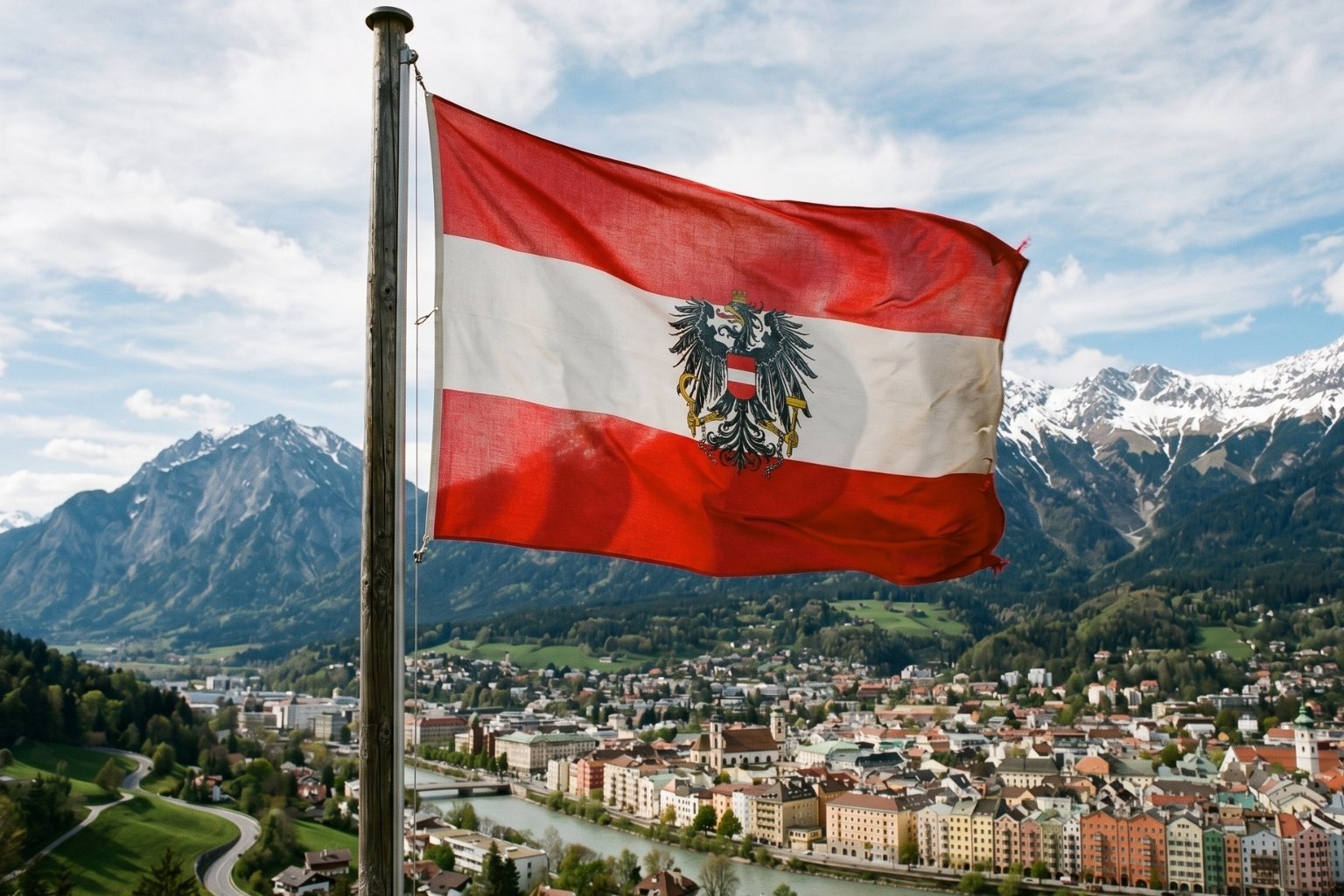

Three horizontal stripes. Two colors. Eight centuries of uninterrupted history. The Austrian flag looks almost too simple for a country that once sat at the center of a vast empire. But that simplicity is the point. What the red-white-red design has carried, survived, and been made to mean across time is anything but ordinary.
Three Stripes, Eight Centuries
The Austrian flag consists of three equal horizontal bands: red on top, white in the center, red on the bottom. Its proportions follow a 2:3 ratio, meaning it is slightly wider than it is tall, the standard for most European national flags.
Two official versions exist. The civil flag shows the three plain stripes with no additional emblem. The state flag, used by government institutions and the military, adds the Austrian coat of arms centered on the white stripe.
What makes this flag genuinely unusual in global terms is its age. The red-white-red combination appears in Austrian heraldic records as far back as 1230, making it one of the oldest continuously used national color schemes in the world. That is not a marketing claim. It is a documented historical fact that most countries cannot match.
What the Colors Actually Mean
Every flag article on the internet will tell you that red stands for bravery and white for peace. That is accurate in the broadest possible sense, and almost useless as an explanation.
In the context of medieval heraldry, red was the color of noble blood, military valor, and dynastic power. It was not a soft symbol. It marked those who fought and those who ruled. White, in the same tradition, signaled purity, truth, and legitimacy, the moral authority that justified rule.
What is more interesting is that no official document has ever assigned fixed symbolic meanings to these colors as they appear on the Austrian flag. The Britannica note that the white stripe is sometimes associated with the shining waters of the Danube River is as close as it gets to an established reading. The colors came before the explanations. They were inherited, not designed.
The Legend of Leopold V and the Siege of Acre
The story is compelling and has been told the same way for eight hundred years. During the Siege of Acre in 1191, part of the Third Crusade, Duke Leopold V of Babenberg fought in heavy combat. When the battle ended, his white surcoat was completely soaked in blood, with one exception: the strip of fabric hidden beneath his sword belt remained white. Struck by the image of red, white, red, he adopted it as his personal heraldic symbol.
It is a good story. It gives the flag a human origin, a specific moment, a drama with blood and clarity in the same image.
It is also largely rejected by modern historians.
The earliest confirmed evidence of the red-white-red arms appears on a seal of Duke Frederick II, attached to a document from Lilienfeld Abbey in Lower Austria, dated 1230, nearly forty years after the alleged moment at Acre. The poet Jan von Enickel also documented the colors in writing two years later, in a ceremonial context, not a military one.
What actually happened at the origin of this design is unclear. What is clear is that the legend served a purpose: it gave an ancient dynasty a founding myth of courage and sacrifice, legible to anyone who heard it. Legends that useful tend to survive.
From Babenberg to Habsburg: A Flag That Outlived Empires
The Babenberg dynasty ruled Austria from the 10th century until 1246. When Austria was elevated to a duchy in 1156, the coat of arms took on formal heraldic significance. The red-white-red shield became the emblem of the duchy itself, not just the ruling family.
When the Habsburgs took control of Austria in 1276, they inherited everything, including the shield. What followed was one of the most extraordinary examples of symbolic continuity in European history. The Habsburg empire eventually stretched across much of Europe and into the Americas. Their flags and heraldry became staggeringly complex, layering double-headed eagles, crowns, golden fleeces, and the emblems of dozens of territories into a visual representation of imperial ambition.
And yet the simple red-white-red shield of the Austrian duchy survived untouched through all of it. It appeared on the chest of imperial eagles for centuries. It was the foundation beneath the ornament. The duchy of Austria, as a territorial and symbolic unit, never stopped claiming it.
When the Holy Roman Empire dissolved in 1806, and again when the Austro-Hungarian Empire collapsed in 1918, the imperial superstructure fell away. The red-white-red was still there.
The Republic, the Anschluss, and the Return of Red-White-Red
1918 is one of the most consequential years in Austrian history. The empire was gone. The Habsburg dynasty was deposed. A new republic was proclaimed in the ruins of a world order that had lasted centuries. The government needed a flag, and it turned not to something new, but to something old.
The plain red-white-red triband, freed from imperial eagles and dynastic embellishments, became the flag of the First Austrian Republic. It was a deliberate act of continuity and reinvention at the same time, claiming deep historical roots while shedding the weight of empire.
Twenty years later, in March 1938, Austria was annexed by Nazi Germany in what is known as the Anschluss. The Austrian state ceased to exist. The red-white-red flag was abolished, replaced by the swastika.
It was gone for seven years.
In 1945, with the Allied liberation and the reestablishment of the Austrian republic, the flag came back immediately. But it came back with a modification that mattered. The state coat of arms was redesigned from scratch, as a conscious break from both the Habsburg eagle and everything the Nazi period represented.
The new eagle is black, with a mural crown on its head representing the citizenry and municipalities. It holds a hammer in its left talon for the working class and a sickle in its right for the farming class. The two symbols together signal a republic built on labor, not aristocracy.
Most significantly, broken chains hang from both talons. They are not decorative. They are a direct reference to liberation from National Socialism. No element of the postwar Austrian coat of arms is accidental. Every detail was chosen to say something specific about what Austria was choosing to become.
The Austrian Flag Today: Civil, State, and the Question of Identity
The Austrian flag is flown on public buildings, at official ceremonies, and on national holidays. Its display is governed by federal law, and the two versions, civil and state, are not interchangeable in official contexts.
What is worth noting is how Austrians relate to their own flag compared to some neighboring nations. Germany spent decades navigating the emotional weight of its national symbols after 1945. Austria’s postwar situation was more complicated. The country was treated, and often presented itself, as the first victim of Nazi aggression rather than a co-perpetrator, a framing that has been extensively debated by historians since.
The flag itself, untouched by that particular history and rooted in a medieval identity predating the modern state by centuries, has carried relatively less symbolic toxicity than German emblems did for postwar generations. It is displayed without the same level of political charge, which is itself a reflection of how Austrian national identity was constructed after 1945.
Flags That Look Similar, and Why They Are Not
The red-white-red horizontal triband also appears on the flags of Latvia and Lebanon. The resemblance is visual only.
| Country | Design | Origin |
|---|---|---|
| Austria | Red, white, red equal bands | Babenberg heraldry, 13th century |
| Latvia | Dark red, white, dark red (narrower white band) | Medieval Latvian tribal shield, 13th century |
| Lebanon | Red, white, red with cedar tree | Adopted 1943, cedar as national symbol |
Latvia’s red is noticeably darker, closer to crimson, and the white stripe is proportionally narrower than Austria’s. Lebanon’s flag adds a green cedar tree centered on the white band. The three designs emerged independently, on different continents of European and Middle Eastern history, with no shared lineage.
The coincidence is a reminder that simple color combinations inevitably repeat across cultures. What gives a flag its meaning is never the geometry. It is everything that happened under it.
