

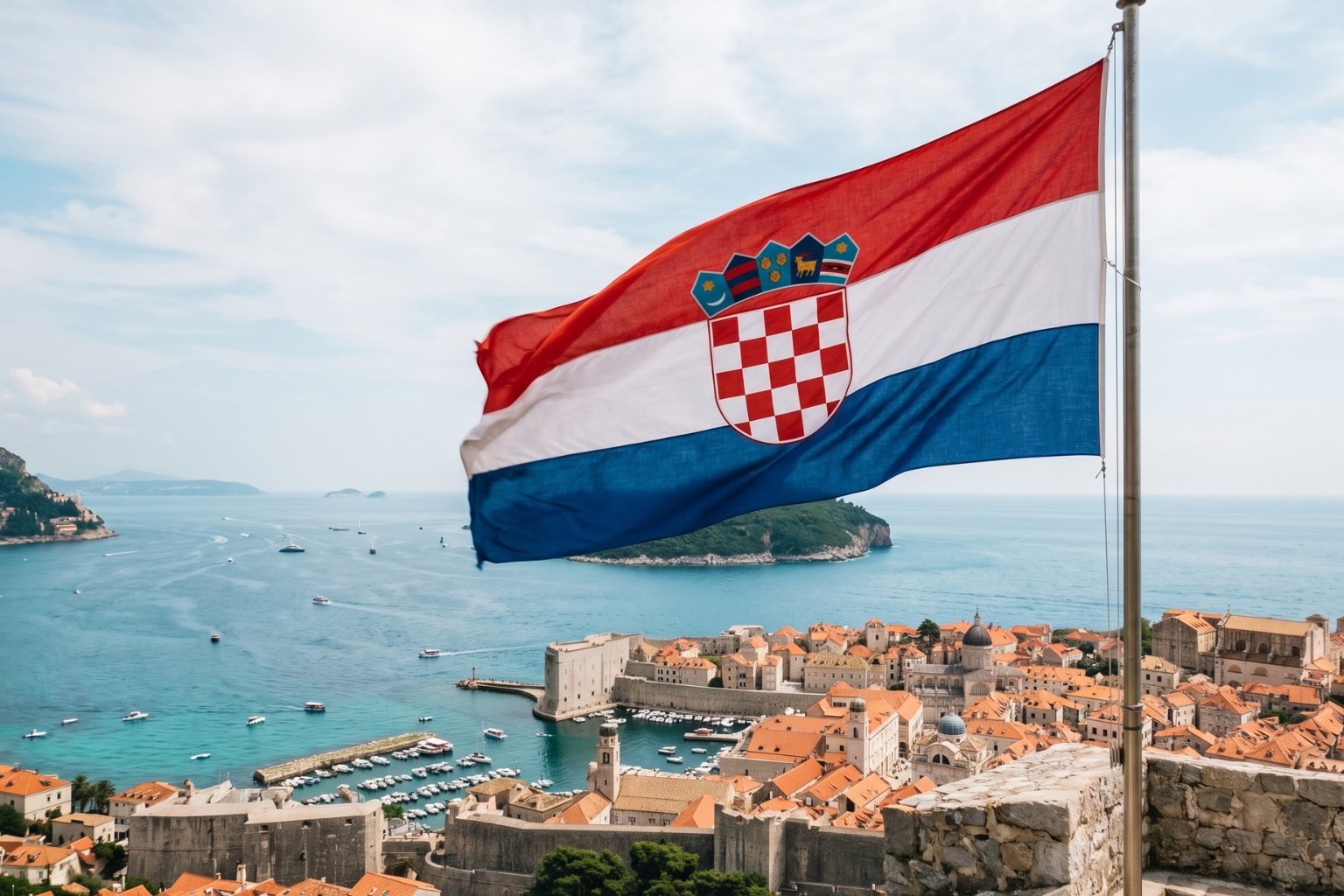

Walk into any Croatian city on a national holiday and you will notice something unusual about the flag flying above the buildings. It is not the stripes that catch your eye first. It is the shield at the center: a red and white checkerboard so bold, so geometrically precise, that it looks less like a heraldic emblem and more like a statement. For Croatians, it is exactly that. The Croatian flag is not just a piece of national fabric. It is a compressed archive of wars fought, empires endured, and an identity that refused, across centuries, to be erased.
What Does the Croatian Flag Look Like?
The flag of Croatia, officially known as the Trobojnica (meaning “the tricolour”), consists of three equal horizontal bands arranged from top to bottom as red, white, and blue. Centered across all three stripes sits the Croatian coat of arms, a shield with a distinctive red and white checkerboard pattern topped by a crown of five smaller historical shields.
The flag follows a width-to-length ratio of 1 to 2. Its proportions and heraldic details are defined by law. When flown on public buildings, it is raised at sunrise and lowered at sunset. Half-masting is reserved for days of national mourning.
Simple in its geometry, dense in its symbolism.
The Colors of the Croatian Flag and Their Meaning
Red, White, Blue: Pan-Slavic Roots with a Croatian Reading
The three colors belong to the broader Pan-Slavic tradition, a 19th-century movement that sought to visually unite Slavic peoples across Central and Eastern Europe under shared symbols. Russia, Serbia, Slovakia, and several others fly variations of the same palette.
But Croatia gives these colors a reading that is specifically its own. Each stripe is understood to represent one of the three historic constituent kingdoms that formed the Croatian realm:
- Red for the Kingdom of Croatia
- White for the Kingdom of Slavonia
- Blue for the Kingdom of Dalmatia
This triple-kingdom logic matters. Croatia was not, historically, a unified territory with clean borders. It was a collection of distinct regions, each with its own administrative identity, often under foreign control. The tricolour was a way of asserting that these lands belonged together, even when no political reality supported that claim.
Why These Colors Were Chosen in 1848
The choice was not purely aesthetic. It was geopolitical.
In the mid-19th century, Croatia was under Habsburg Hungarian rule. When Croatian nationalists rose in revolt in 1848, they needed a flag that communicated both resistance and alliance. The red-white-blue was borrowed from the imperial Russian flag, a deliberate signal: Russia was an opponent of Austria-Hungary and a potential patron for Slavic aspirations. Flying those colors was a coded message to Vienna.
Croatia did not win its independence in 1848. But the flag survived as a symbol of what the country intended to become.
The Coat of Arms: Reading the Shield
The Šahovnica, Croatia’s Checkerboard
The most instantly recognizable element of the Croatian flag is the šahovnica, the red and white checkerboard shield at its center. It appears on the football jersey of the national team, on Croatian coins, on public buildings, and on the tail fins of Croatia Airlines aircraft. Few national symbols are so thoroughly embedded in everyday visual life.
Its origins are medieval. The checkerboard appears in Croatian heraldic use as early as the 15th century, and references to red and white chequers associated with Croatian rulers date back to the 10th century. The exact number of squares is fixed: a 5×5 grid of alternating red and white fields, always beginning with a red square in the upper left corner.
A popular legend claims the design originated in a chess match between a Croatian king and a Venetian ruler, with the right to use the chequers as the prize. There is no historical evidence for this story. It persists because it is a good story, and because national symbols often need origin myths that match their weight. The šahovnica has survived without one.
The Crown of Five Shields
Above the main checkerboard shield sits a crown composed of five smaller shields, each representing a historical region of Croatia. This is where most sources become vague. It is worth being specific.
| Shield | Region Represented |
|---|---|
| 1st (left) | The oldest Croatian emblem, associated with the historic Croatian kingdom, dating to the 12th century |
| 2nd | The Republic of Ragusa (Dubrovnik), the independent city-state that maintained sovereignty for centuries as one of the Adriatic’s most powerful maritime republics |
| 3rd | Dalmatia, the long coastal region stretching along the eastern Adriatic |
| 4th | Istria, the triangular peninsula at the northern tip of the Adriatic, where Croatian, Italian, and Slovenian influences have overlapped for centuries |
| 5th (right) | Slavonia, the agricultural heartland of continental Croatia |
Together, these five shields do not simply decorate the flag. They argue for a Croatia that is larger, more historically layered, and more geographically diverse than any single moment in time would suggest.
A Brief History of the Croatian Flag
Medieval Foundations
The checkerboard has deeper roots than the tricolour. Red and white chequers appear in the heraldry of Croatian rulers from the medieval period onward, long before Croatia had a modern flag in any recognizable sense. The šahovnica was the visual anchor of Croatian identity when no unified state existed to give it a home.
1848: A Tricolour Born from Resistance
The modern flag took shape during the revolutionary wave of 1848 that swept across Europe. Croatian nationalists, led by Ban Josip Jelačić, adopted the red-white-blue tricolour as the flag of their cause against Habsburg Hungarian domination. It was officially adopted by the Croatian parliament on December 22, 1848, making it one of the oldest formally adopted national flags in Europe.
Independence did not follow. But the flag remained, waiting.
1941: The Coat of Arms Returns, Under a Dark Sign
In April 1941, the Ustaša regime used the Axis invasion of Yugoslavia to proclaim the Independent State of Croatia. For the first time, the historical checkerboard shield was formally added to the red-white-blue tricolour. The flag gained its coat of arms, but under conditions that would permanently complicate the symbol’s legacy.
Communist Yugoslavia: The Star Years
After World War Two, Croatia became a constituent republic of Tito’s Yugoslavia. The šahovnica was retained on the flag but the coat of arms was replaced by a yellow-bordered red star, the standard communist emblem. It flew over Croatian institutions for four decades.
1990: The Star Falls, the Shield Returns
When Croatia began its transition toward independence in 1990, the communist star was removed. The current national flag, featuring the tricolour and the full coat of arms with the crown of five shields, was officially adopted on December 22, 1990, exactly 142 years after the original tricolour had been chosen. Croatia declared independence the following year, in 1991.
The date was not accidental. It was a deliberate act of historical continuity.
The Šahovnica’s Complicated Legacy
This is the part of the story most articles skip, and it is too important to avoid.
The checkerboard shield was used by the Ustaša regime, which was responsible for the mass murder of Serbs, Jews, Roma, and political opponents during World War Two. When Croatia reclaimed the šahovnica in 1990 as the central emblem of its renewed independence, the symbol carried that association. For many Serbs and for international observers at the time, its reappearance felt threatening rather than merely historical.
Croatian authorities and historians have consistently argued that the šahovnica predates the Ustaša by centuries and belongs to the longue durée of Croatian identity, not to one regime’s crimes. That argument is historically sound. But the discomfort it caused in 1990 was also real, and it played a role in the tensions that preceded the Yugoslav wars.
Understanding the Croatian flag means holding both of these truths at once. A symbol that old, that resilient, and that central to a people’s self-image will inevitably accumulate history, including the kind that is painful to carry.
The Croatian Flag in Everyday Life
In Croatia, the flag is not reserved for civic ceremony. It is genuinely lived.
On national holidays such as Independence Day (October 8) and Statehood Day (May 30), it appears on private balconies and car windows as naturally as on government buildings. During World Cup cycles, the red and white checkerboard of the Vatreni (the Blazing Ones, as the national football team is known) becomes arguably the most visible Croatian symbol on the planet. The 2018 run to the World Cup final in Russia turned the šahovnica into a global image.
Along the Adriatic coast in summer, the Trobojnica flies on fishing boats, above konoba restaurants, and from the stone towers of medieval towns. In that context, against the particular blue of the Dalmatian sea, the flag stops being a symbol and becomes simply part of the landscape.
That, perhaps, is the best measure of a national flag’s success. Not what it means in a history book, but how naturally it belongs to the places and people it represents.
