

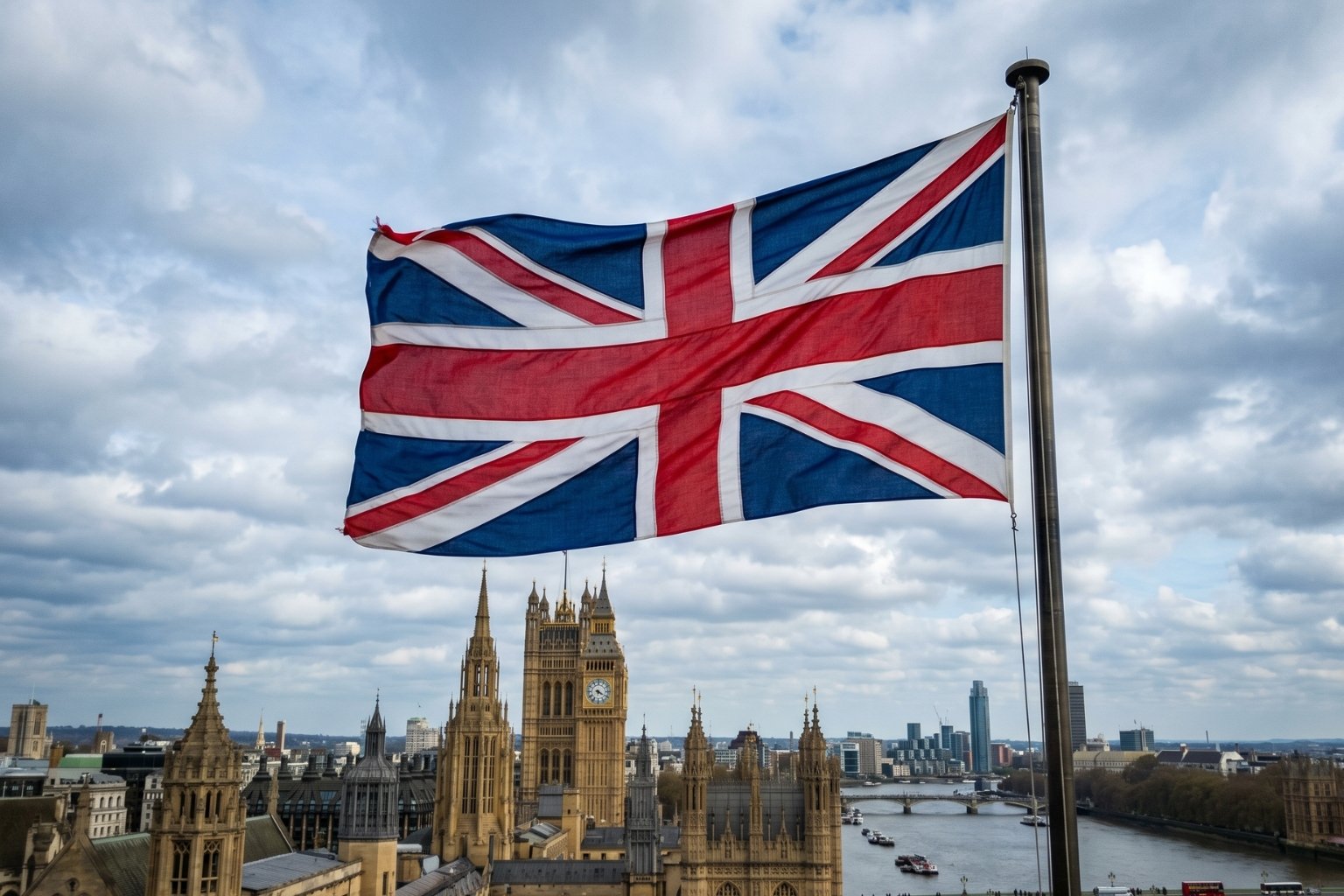

Few flags in the world read like a geopolitical treaty. The flag of the United Kingdom, known as the Union Jack, is one of them. Behind its three overlapping crosses and its counterchanged reds and whites lie four centuries of political mergers, heraldic compromises, and one conspicuous absence that is still debated today. To understand this flag is to understand how a kingdom was built and what it chose to leave out.
What You Are Actually Looking At
At first glance: a blue field, a bold red cross at the center, and a set of red and white diagonals radiating outward. What the eye reads as a coherent graphic pattern is in fact three distinct flags layered on top of one another, each belonging to a separate nation and its patron saint.
The Three Crosses That Make Up the Union Jack
The Cross of St. George is the most dominant element. A solid red cross running the full width and height of the flag, edge to edge, horizontally and vertically. It represents England and its patron saint, whose image was already carried by English crusaders in the 12th century.
The Saltire of St. Andrew is the white diagonal cross on a blue field. It represents Scotland. Its X shape recalls the martyrdom of the Apostle Andrew, who was crucified on a diagonal cross. Legend holds that in 832, the Pictish king Óengus II saw the shape traced across the sky before a decisive battle against the Angles, and adopted it as his emblem after the victory.
The Saltire of St. Patrick is a red diagonal cross on white. It represents Ireland and was added in 1801 when Ireland joined the union. Its heraldic origins are murkier than the others: the cross was originally associated with the powerful FitzGerald dynasty, not with Patrick himself, before being adopted as an official symbol of the island.
Why the Flag Has a Right Way Up
This is one of the least known and most fascinating details of the Union Jack. The flag is not symmetrical, and there is a correct way to fly it.
When the red saltire of St. Patrick was added in 1801, the designers faced a real problem: how to integrate it without erasing St. Andrew’s white saltire, since both are diagonal crosses occupying the same space. The solution was counterchanging. The two saltires share the flag asymmetrically: on the side nearest the flagpole, the wider white band sits above the red diagonal; on the other side, it falls below. This intentional asymmetry means the flag has a definite top and bottom, and it is entirely possible to hoist it upside down. In vexillological protocol, that is a serious error. In certain historical contexts, it has been read as a deliberate signal of distress.
The Colors of the United Kingdom Flag and What They Mean
The red, white, and blue of the British flag are not aesthetic choices. They are inherited heraldic colors, each tied to a specific cross and the nation it represents.
Red is the color of St. George’s Cross and St. Patrick’s Saltire. In heraldry, it signifies bravery, strength, and sacrifice, values associated with two saints who died as martyrs.
White belongs to St. Andrew’s Saltire and also serves as the fimbriation, the thin border running around the red crosses. That white border is not decorative. It is a strict heraldic rule: two colors cannot touch directly without a metal, gold or silver, separating them. Without the white edging, the red crosses would rest directly against the blue field, which no rule of blazon permits.
Blue is the background of St. Andrew’s Saltire, and it gives the flag its base. Its precise shade, known as Union blue, is formally codified for official use.
The History and Origin of the Union Jack
The story of the flag unfolds in three acts. At each step, a new cross is added, and a new political tension is stitched quietly into the fabric.
1606: The First Union Flag, England and Scotland
In 1603, James VI of Scotland ascended to the English throne and became James I. One man held two crowns, but his two kingdoms remained legally separate. The problem quickly became practical: English and Scottish sailors navigating under different flags were getting into disputes at sea over questions of precedence.
In 1606, James I settled the matter. He decreed a new flag combining St. George’s Cross and St. Andrew’s Saltire. It was the first Union Flag, an administrative fix before it was ever a national symbol. England’s red cross was laid over Scotland’s white diagonal on a blue ground.
It was not yet the flag we know today. But the logic was established: stack identities rather than erase them.
1707: The Acts of Union and the Kingdom of Great Britain
In 1707, the Acts of Union merged the English and Scottish parliaments. The Kingdom of Great Britain was officially born. The flag did not change. It was already correct, politically speaking. The constitutional reality had caught up with the symbol, not the other way around.
1801: Ireland Joins the Union and the Design Gets Complicated
On January 1, 1801, the Act of Union brought the Kingdom of Ireland into the fold. A third element had to join the flag: St. Patrick’s Saltire, a red diagonal cross on white.
The problem was both geometric and political. St. Patrick’s red saltire and St. Andrew’s white saltire are two diagonal crosses that occupy the exact same position on the flag. Lay one directly over the other and one disappears entirely. The designers solved it through asymmetric counterchanging: the two diagonals share the space in alternating fashion, each remaining visible, neither fully dominant. It was a graphic compromise that mirrored perfectly the political balance being sought, along with its inherent fragility.
The current design was officially adopted on January 1, 1801. It has not changed since.
1922 and After: A Redrawn Map, an Unchanged Flag
In 1922, most of Ireland gained independence. The Irish Free State left the union. Logically, St. Patrick’s Saltire could have been removed. It was not. Northern Ireland remained part of the United Kingdom, and with it, the symbolic justification for keeping the Irish cross. The flag stayed as it was, a political choice in itself, one that avoided reopening a vexillological argument in an already volatile moment.
Why Wales Is Missing from the Union Jack
It is the question everyone asks, and the one too few sources answer with any real depth.
Wales does not appear on the Union Jack. Not its red dragon (Y Ddraig Goch), not its green and white. And yet Wales is unambiguously part of the United Kingdom.
The explanation is historical and paradoxical: Wales is absent not because it was excluded, but because it had been absorbed too early. The Laws in Wales Acts of 1535 and 1542, passed under Henry VIII, who was himself of Welsh descent and bore the Tudor name, fully merged Wales into the Kingdom of England. By 1606, when the first Union Flag was created, Wales was not a distinct kingdom requiring union. It was already a constituent part of England.
There was therefore no reason to assign it a separate cross. The red dragon, for its part, was not officially recognized as the national flag of Wales until 1959, three and a half centuries after the Union Jack was born.
The debate remains active. Welsh and British voices periodically call for a redesign that would incorporate the dragon or the colors of St. David. No revision has ever gone forward, but the conversation itself says something important: a flag is never truly finished.
“Union Flag” or “Union Jack”? The Name That Confuses Everyone
Both names are correct, and the distinction is worth understanding.
Union Flag is the official name. It refers to the flag of the united kingdoms, used on land by government and military buildings.
Union Jack is the popular name. The word jack historically referred to a flag flown from the bowsprit of a warship, a short mast at the ship’s bow. Strictly speaking, “Union Jack” originally applied only to the naval version of the flag. By the late 17th century, however, the term had spread into common usage, and the two names became interchangeable in everyday language.
The British Parliament itself recognizes both. No law has ever officially proclaimed this flag as the national flag of the United Kingdom. Its status rests entirely on custom and precedent, which is, in its own way, entirely British.
The Union Jack Beyond the United Kingdom
The British flag has traveled far. It appears today in the canton, the upper left corner, of the flags of Australia, New Zealand, Fiji, Tuvalu, and the American state of Hawaii. Each of those appearances is a direct trace of British colonial history.
That legacy is increasingly contested. In Australia and New Zealand, recurring debates question whether the Union Jack should remain on their national flags at all, in the name of affirming a distinct identity. New Zealand held a referendum on the question in 2016. The existing flag was retained, but the vote exposed a genuine generational divide on the issue.
The Union Jack remains one of the only flags in the world capable of triggering constitutional debates on multiple continents at once.
The Union Jack in Culture
It would be reductive to see the Union Jack purely as a political object. It is also one of the rare national flags to have become, over the course of the 20th century, a genuine motif of fashion and popular art.
In the 1960s, the flag became the visual emblem of Swinging London, printed on mini dresses, guitar bodies, and record sleeves. The Who made it a symbol of youthful defiance. Twiggy wore it like a second skin.
Punk repurposed it in a harder register. Vivienne Westwood deconstructed it, burned it symbolically, turned it into provocation. The Union Jack was no longer simply flown. It was questioned, inverted, torn. What the punks understood instinctively was what historians would say later: this flag is a conversation, not a conclusion.
Today it still appears on tea mugs and telephone boxes as readily as on streetwear in Tokyo or São Paulo. Recognized everywhere, debated everywhere, claimed and criticized in the same breath. That might be the clearest sign that a symbol has truly taken on a life of its own.
