

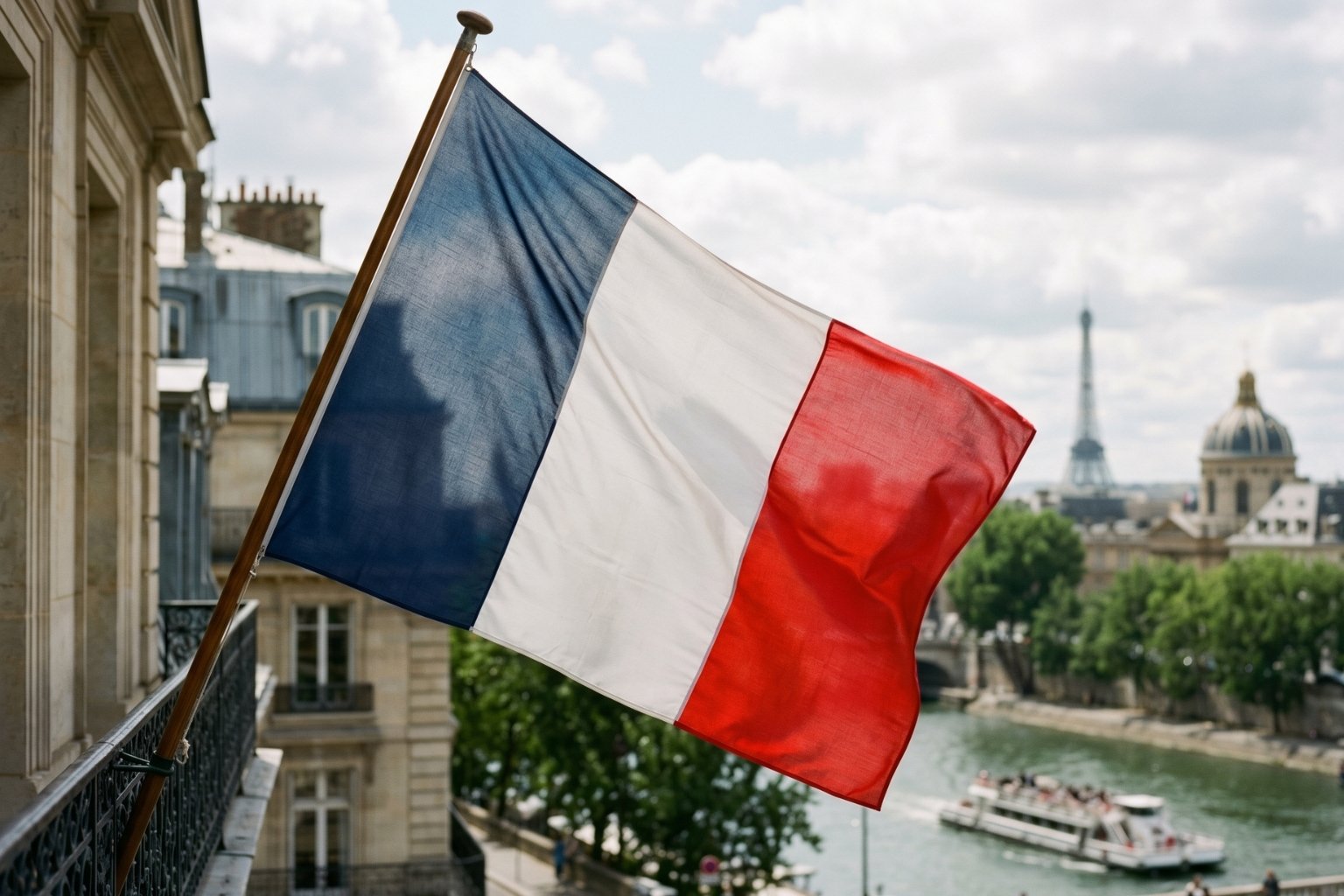

Three vertical bands, blue white red. Nothing simpler on the surface. Yet the French flag is one of the most copied, most contested, and most politically loaded objects in modern history. Its origin is not a clean design decision. It is the product of a negotiation, an improvisation, and a revolution that nearly collapsed before it could leave a mark. Understanding the French flag means understanding how a nation invents both a symbol and an identity at the same time.
Before the Tricolore: What Flag Did France Fly?
France did not always carry blue, white, and red. For centuries, the banners that represented the kingdom had nothing to do with the modern idea of a national flag. They embodied an authority, a bloodline, a god. Not a people.
The Oriflamme and the Royal Banner
The oriflamme is the oldest war standard associated with France. Orange-red, sometimes described as flame-like, it was kept at the Abbey of Saint-Denis and brought out only in moments of extreme peril. It disappears from the historical record after the Battle of Agincourt in 1415.
From the late Middle Ages onward, the French monarchy adopted fleurs-de-lis on an azure background as the royal emblem. This was not a flag in any contemporary sense. It was a mark of divine sovereignty, reserved for the person of the king and his court.
The White Standard of the Bourbons
Under the Bourbon dynasty, white became the royal color. The white naval ensign and the banners of the royal regiments all carried this shade, associated with purity, dynastic legitimacy, and Catholic devotion. This is the white the Revolution would later recover, transform, and fold into something entirely new.
The Birth of the Tricolore: Paris, Revolution, and a Cockade
The tricolor flag was not born from a decree or a design competition. It emerged from the street, in July 1789, in the days immediately following the storming of the Bastille. Its real story is far more human than the official version suggests.
Blue and Red, the Colors of Paris
Blue and red were not arbitrary choices. They were the historic colors of the city of Paris, carried by its militias since the Middle Ages. Their roots trace back to the Carolingian dynasty (blue) and the Capetian dynasty (red), two lineages that shaped medieval France. Both colors already appeared on the capital’s coat of arms.
When the National Guard formed at the outset of the Revolution, it naturally adopted these colors as a cockade, a fabric rosette worn on the hat to signal allegiance to the revolutionary cause. Blue was placed near the staff, red toward the outer edge. The arrangement was said to evoke the blood shed during the events of July.
Lafayette, Louis XVI, and the White That Joined Them
The third element of the flag, white, was not the product of symbolism but of a very specific political act. Three days after the storming of the Bastille, the Marquis de Lafayette, commander of the National Guard, met Louis XVI at the Hôtel de Ville in Paris. He convinced the king to wear the blue and red cockade as a gesture of recognition toward the Revolution.
It was Lafayette himself who, according to his own memoirs, added white to the center to symbolize the union between the king and the people of Paris. A gesture of compromise, not a philosophical statement. The white of the monarchy framed by the blue and red of the people. The geometry was political before it was aesthetic.
From Cockade to Flag: 1789 to 1794
It took five years for this improvised cockade to become an official flag. In 1790, a tricolor version was adopted for the naval ensign, but with the colors in reverse order: red, white, blue. It was only on February 15, 1794 (27 Pluviôse, Year II) that the National Convention decreed the definitive specifications: “three national colors, arranged in vertical stripes, blue at the hoist, white in the center, red at the fly.”
Legend holds that the painter Jacques-Louis David, an influential member of the Convention, helped determine this color order. Nothing proves it conclusively, but the story says something true about that era. Even a flag was a collective work, disputed and carried by men with names.
What Do the Colors of the French Flag Really Mean?
This is the question everyone asks, and the honest answer is more layered than what most sources offer.
The “Liberté, Égalité, Fraternité” Reading
The association between the three colors and the republican motto is now ubiquitous: blue for liberty, white for equality, red for fraternity. It appears on public buildings, in schoolbooks, in official speeches.
But this reading is largely retrospective. The motto “Liberté, Égalité, Fraternité” was not contemporaneous with the flag. It emerged gradually and was only written into constitutional texts under the Third Republic, at the end of the nineteenth century. The correspondence between the colors and the three terms of the motto is a later symbolic construction, coherent and powerful, but not original.
What the Colors Actually Meant in 1794
At the birth of the Tricolore, the meaning was more concrete and more political. Blue and red represented Paris and the revolutionary people. White represented the monarchy in whatever legitimate form it might retain, absorbed and neutralized by the other two. The whole symbolized a forced union between the Ancien Régime and the new nation, an unstable equilibrium that accurately reflected the situation between 1789 and 1794.
It was only gradually that the flag stopped being read as a compromise and began to be understood as an ideal.
A Flag That Nearly Vanished Several Times
The Tricolore did not have a peaceful existence. Its history is that of a symbol in permanent survival mode, repeatedly threatened by the political reversals France endured after 1789.
Under the First Empire, Napoleon kept the Tricolore but turned it into a glorious military standard, laden with eagles and embroidery, far from the civic flag of the Convention. At his fall in 1815, the Bourbon Restoration replaced the Tricolore with the white flag. Blue, white, and red disappeared from official buildings for fifteen years.
They returned with the July Revolution of 1830, when Louis-Philippe took the throne and chose to display himself under the revolutionary colors to legitimize his reign. In 1848, during the Second Republic, the red flag was briefly proposed as the symbol of the labor movement. It was the poet Lamartine, improvising as a tribune, who opposed it forcefully from the Hôtel de Ville and insisted on keeping the Tricolore. Once again, the flag survived by an act of human and political will.
Two Blues for One Flag: The Detail Almost No One Notices
There are today two versions of the blue in the French flag, and the difference between them is not trivial.
During the 1970s, France gradually adopted a lighter sky blue for its official flags, partly to harmonize with the flag of the European Union. This softer, less saturated shade moved noticeably away from the dark navy blue of the revolutionary era.
In 2020, President Emmanuel Macron decided to return to the darker navy blue, closer to the original colors, for the flags displayed at the Élysée Palace. The decision was discreet but symbolically significant. It asserted a continuity with the revolutionary Republic rather than with European institutional identity.
There is also a special version of the flag, known as the television protocol flag, in which the white stripe is slightly narrowed. The reason is entirely practical. During official televised appearances, an oversized white stripe tends to overexpose and visually erase the center of the flag. This technical version, invisible to most viewers, reveals something quietly interesting: even a national flag adapts to the constraints of how it is seen.
The Tricolore’s Global Legacy
The French flag is probably the most imitated model of national flag in history. Its influence reshaped vexillology worldwide from the nineteenth century onward.
Italy adopted a green, white, and red tricolor as early as 1797, directly inspired by the Napoleonic campaigns. Ireland chose green, white, and orange in 1848. Belgium took the three vertical stripes with black, yellow, and red. Romania adopted blue, yellow, and red. At the moment of African independence movements in the 1960s, many countries emerging from former French colonial rule adopted the tricolor structure in turn, substituting their own colors for those of the former power.
What was transmitted was not just a graphic form. It was an idea: that a flag can represent a people rather than a sovereign, a nation rather than a dynasty. The French Tricolore is not only the flag of one country. It is the template by which dozens of nations chose to represent themselves to the world.
