

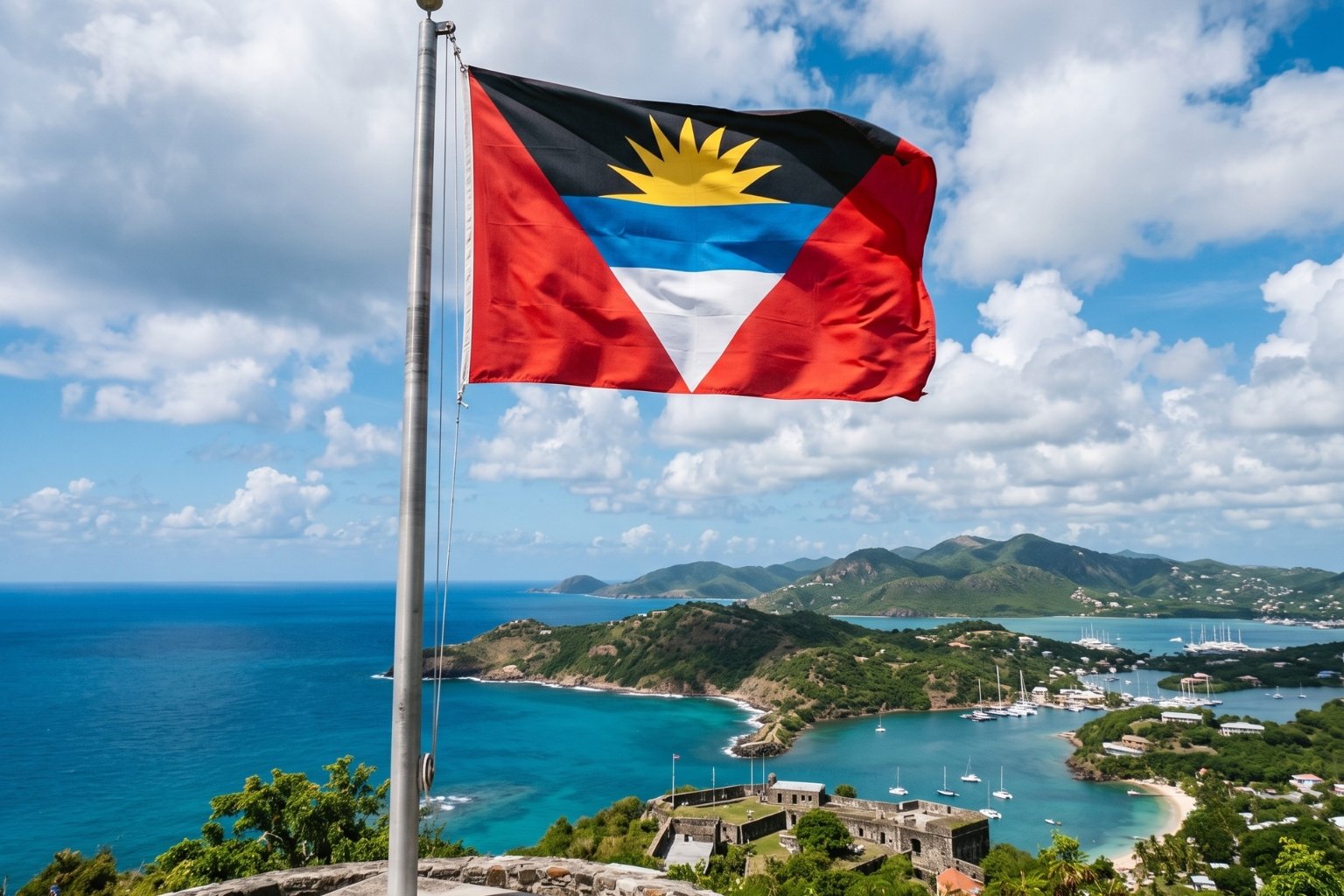

A red field split by a triangle of black, blue and white, crowned with a golden sun. That is the flag of Antigua and Barbuda, raised for the first time in 1967 and designed not by a colonial office but by a single Antiguan artist who won a nationwide contest. Every band and every ray on it points to a specific chapter of the islands’ story.
What the flag looks like
The flag is built on a red field. An inverted isosceles triangle rises from the bottom edge toward the top, forming a wide V shape that runs from hoist to fly.
Inside that triangle sit three horizontal bands, black at the top, blue in the middle at half width, and white at the base. A golden sun with seven rays is centered in the black band, appearing to rise out of the blue below it.
The flag flies at government buildings, at V.C. Bird International Airport, and on the state ensign used by the Antigua and Barbuda coast guard, which places the flag on a white field marked with a red cross.
What each color and symbol means
The palette was chosen with intent, and it carries two readings that coexist rather than compete.
| Element | Meaning |
|---|---|
| Red | Energy and dynamism of the people, the lifeblood of their ancestors |
| Black | African ancestry of the population, and the soil |
| Blue | Hope, and the surrounding Caribbean Sea |
| White | The islands’ beaches |
| Golden sun | The dawn of a new era |
| V shape | Victory |
The sun, sea and sand reading
Read from the sun downward, the same three bands tell a second story. Black stands for the soil, the golden sun for itself, blue for the sea, and white for the sand. Both interpretations are treated as equally official, one centered on heritage and struggle, the other on the physical islands themselves.
Who designed the flag, and why
The design belongs to Sir Reginald Samuel, an Antiguan art teacher, sculptor and painter. In 1966, the government opened a national competition to create a flag worthy of self government, and more than 600 entries were submitted by local residents.
Samuel’s version stood out for folding both the nation’s colonial past and its aspirations into a single, uncluttered geometry. Instead of borrowed British emblems, it offered symbols that belonged specifically to Antigua and Barbuda, its people, its coastline and its future.
From colonial badge to national flag
Before 1967, Antigua had no flag of its own to speak of. It fell under the Leeward Islands coat of arms granted in 1909, a badge remembered less for dignity than for an odd cluster of pineapples honoring an early governor’s family, alongside a shield showing little more than a fort and an agave plant.
The turning point came in 1962, when the West Indies Federation collapsed and Antigua found itself charting its own political path. It became an associated state with the United Kingdom, keeping London in charge of foreign affairs while handling its own governance at home. On February 27, 1967, the new flag designed by Samuel was formally adopted to mark that self government.
When Antigua and Barbuda reached full independence on November 1, 1981, no redesign was needed. The same flag chosen fourteen years earlier simply became the flag of a sovereign nation.
Where you will actually see the flag today
Independence Day, celebrated every November 1, is when the flag is most visible, from official ceremonies in St. John’s to homes and storefronts across both islands. It also appears at Carnival, one of the region’s most anticipated celebrations, and at cricket matches played at the Sir Vivian Richards Stadium, where fans wave it as freely as they cheer.
Travelers tend to spot it first at V.C. Bird International Airport, and again on the coast guard’s state ensign patrolling the surrounding waters, a quieter but constant reminder of what the red, black, blue and white were built to represent.
Quick facts recap
- Adopted on February 27, 1967, to mark self government
- Designed by Sir Reginald Samuel, Antiguan artist and teacher
- Chosen from a national competition with over 600 entries in 1966
- Retained unchanged after full independence on November 1, 1981
- Red stands for energy, black for African ancestry and soil, blue for hope and the sea, white for the beaches
- The golden sun marks the dawn of a new era, and the V shape stands for victory
