

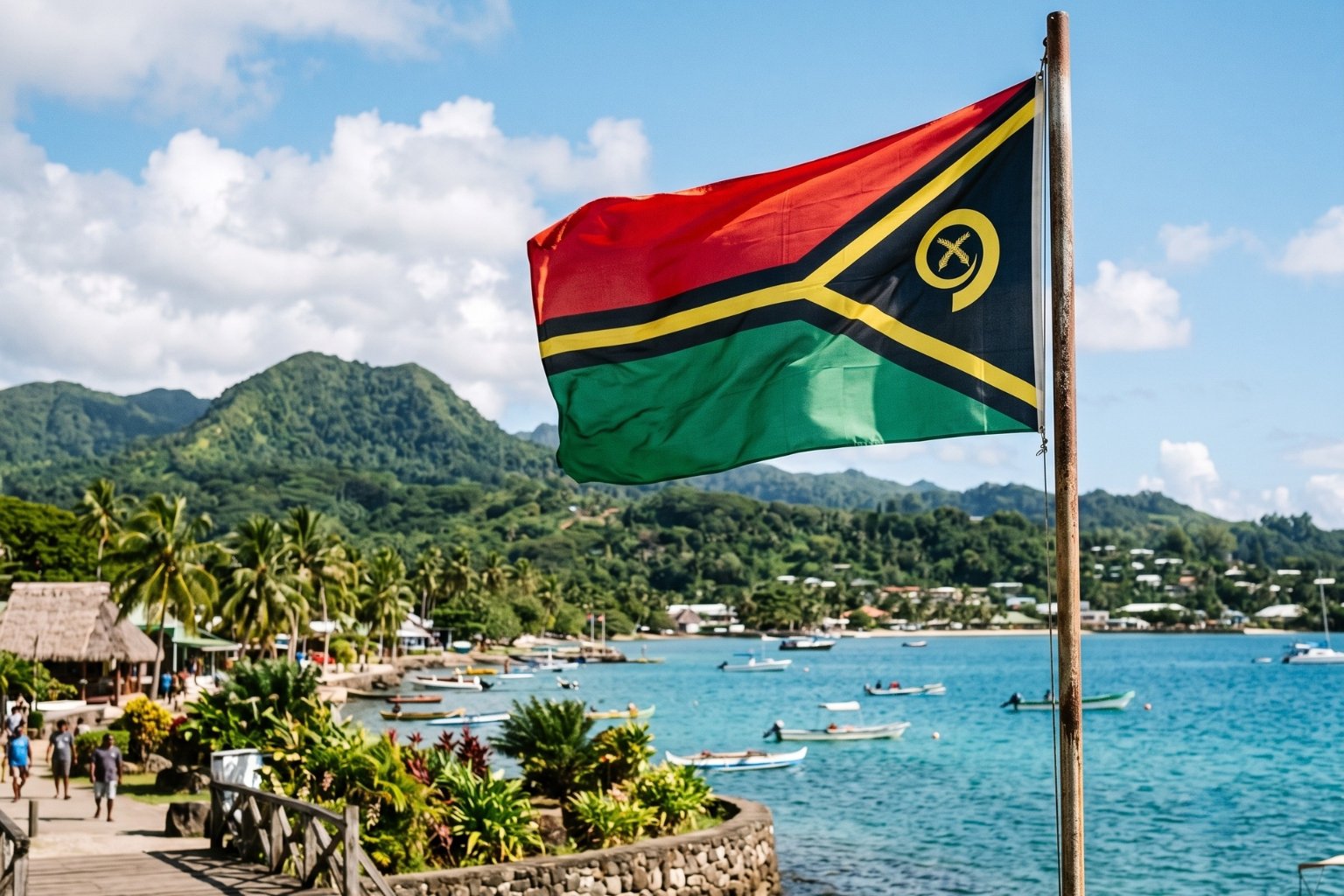

Fly into Port Vila on July 30 and you will see the Vanuatu flag everywhere, tied across shopfronts, waved from truck windows, painted on faces during the Independence Day parade. Few national flags carry a story this specific, where every color and shape was chosen for a reason people can still name today. Behind the red, green, black and yellow is a design that took more than a decade of political history to settle on, and a meaning that reaches back to boar tusks and namele leaves long before anyone imagined an independent Vanuatu.
What the Vanuatu Flag Looks Like
The flag is built from two equal horizontal bands, red on top and green below. From the hoist side, a black triangle cuts into both bands, outlined by two narrow yellow stripes that widen into a Y shape as they stretch toward the flag’s outer edge. Sitting inside the black triangle is a small gold emblem, a boar’s tusk curled almost into a full circle, wrapped around two crossed namele fern fronds.
Nothing on this flag is decorative filler. Every element ties back to a specific piece of ni Vanuatu identity, which is exactly what makes it worth unpacking piece by piece.
What Each Color and Symbol Means
| Element | What it represents |
|---|---|
| Red | The blood of the ni Vanuatu people, linked to boar sacrifice rituals and to what was given up on the road to independence |
| Green | The islands’ vegetation and the richness of their volcanic soil |
| Black | The Melanesian ni Vanuatu people themselves |
| Yellow, the Y shape | The layout of the archipelago as it appears on a map, and the spread of Christianity through the islands |
| Boar’s tusk | Wealth, status and traditional power |
| Namele fern fronds | Peace |
The boar’s tusk deserves a closer look, since it is not a generic symbol borrowed for the occasion. In Vanuatu kastom, a curved tusk is grown over years by removing a boar’s upper canine so the lower tusk keeps spiraling instead of wearing down. Owning one has always marked wealth and rank, which is why it sits at the very center of the national emblem rather than off to the side.
The namele leaf carries a similar weight beyond the flag itself. In many islands it is still placed at an entrance or on the ground to signal a taboo, a truce, or a peace agreement, long before anyone connects it to national symbolism. Putting it at the heart of the flag was a way of anchoring the new country in something the population already understood.
The Story Behind the Design
A shared colony with no shared flag
Between 1906 and 1980, Vanuatu existed as the New Hebrides, jointly run by Britain and France under an arrangement so convoluted that locals nicknamed it the Pandemonium instead of the Condominium. Each power flew its own flag over its own institutions. There was no single banner that represented the territory as one place, which made the search for a national flag, once independence talks began, a search for identity itself.
Early attempts at one identity
At the first South Pacific Games in 1963, a team from the New Hebrides marched under a flag of blue, yellow and white vertical stripes with a central emblem, an early and largely forgotten attempt at a shared symbol. As independence politics took shape through the 1970s, several parties built their own flags, most of them reaching for red, black and green, the colors most associated with Melanesian identity across the wider region.
Kalontas Malon’s design
In 1977, local artist Kalontas Malon, from Emae Island, designed a flag for the Vanua’aku Pati, the political party leading the push for independence. It combined red, green, black and yellow, and it became the direct template for the national flag adopted three years later.
From party symbol to national flag
When the Vanua’aku Pati led the country into independence, a parliamentary committee reviewed submissions from local artists and settled on a refined version of Malon’s design. Prime Minister Walter Lini personally asked for the yellow and black outlining, known as fimbriation, to be added so the black triangle would stand out more clearly against the red and green.
From Adoption to Independence Day
Most sources online quote three different dates for the Vanuatu flag, which is where a lot of confusion comes from. Parliament formally adopted the design on February 18, 1980, months before the country existed as a sovereign state. It was then raised as a national flag for the first time on July 30, 1980, the day Vanuatu became independent, at Independence Park in Port Vila and across ninety one flag raising ceremonies on thirty inhabited islands.
That gap between the two dates is not a mistake to correct. It reflects the reality of building a country out of an archipelago of dozens of languages, where a symbol had to be legislated first and then genuinely embraced on the ground.
The Flag Versus the Coat of Arms
A lot of articles blur the flag and the national coat of arms into one thing, and it is worth separating them clearly. The coat of arms shows a Melanesian warrior holding a spear, standing in front of a mountain, with a boar’s tusk and crossed namele fronds behind him and a yellow banner beneath reading Long God Yumi Stanap, Bislama for “We stand with God.” It was designed by Australian graphic artist Rick Frazer at Walter Lini’s request and adopted the same year as the flag, but it is a separate national emblem, not part of the flag’s design.
Where You Will See the Flag Today
Independence Day, July 30, is when the flag is genuinely everywhere, from government buildings in Port Vila to homes on the smallest outer islands. Outside that one day, it still flies over official buildings, schools, and at kastom ceremonies where it sits alongside older customs like the namele leaf itself.
For anyone visiting, it is worth noticing the flag on taxis, market stalls and small businesses around Port Vila, since it tends to travel with the same pride ni Vanuatu people bring to kava culture, land diving on Pentecost Island and the dozens of local languages still spoken across the archipelago. The flag is less a formality here than a genuinely lived symbol.
Quick Facts About the Vanuatu Flag
- Adopted by Parliament on February 18, 1980
- First raised as a national flag on July 30, 1980, Independence Day
- Designed by Kalontas Malon, from Emae Island
- Colors: red, green, black and yellow
- Central emblem: a boar’s tusk encircling two crossed namele fronds
- Commonly produced in a 3:5 ratio
- Distinct from the national coat of arms, which carries the motto Long God Yumi Stanap
