

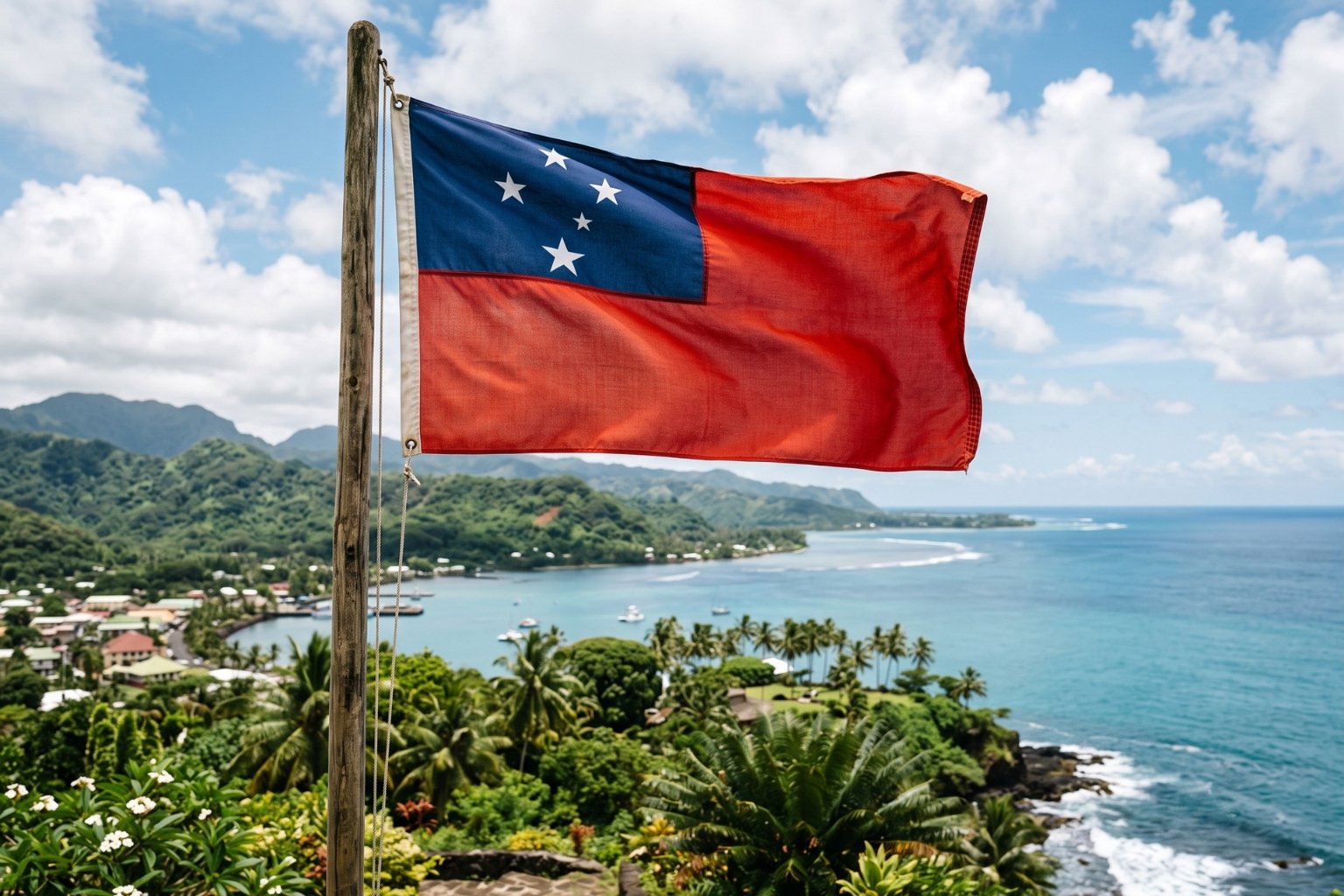

Most explanations of the Samoa flag stop at the postcard version: red for courage, blue for freedom, white for purity. That much is true, but it skips the part that actually makes the flag interesting. Behind the red field and the five stars of the Southern Cross sits a lineage of chiefly banners, a German imperial flag, a long stretch under the Union Jack, and one quiet correction in 1949 that most sources never mention. Here is the full picture, colors, symbols, and the story that shaped them.
What the Samoa Flag Looks Like
The flag is a red field with a blue canton in the upper hoist corner, close to the mast. Inside that blue rectangle sit five white five pointed stars, arranged to mirror the Southern Cross constellation exactly as it appears in the night sky over the South Pacific.
The official proportions are set at a ratio of 1:2, meaning the flag is twice as long as it is tall. The stars are scaled and positioned within the canton to keep the constellation recognizable without crowding the blue field around them. It is a simple design on paper, but every element was chosen with intent.
What the Colors and Stars Mean
The standard reading gives three colors and one constellation, but each carries more history than a single word suggests.
| Element | Core meaning | Deeper context |
|---|---|---|
| Red | Courage | Also read as a tribute to the bloodshed of Samoa’s long push toward independence |
| Blue | Freedom and unity | Doubles as a nod to the Pacific Ocean that surrounds and sustains the islands |
| White | Purity | Applied to both the stars and the ideals behind the independence movement |
| Southern Cross | Guidance and place | Marks Samoa’s position in the southern sky and its shared identity with other Pacific nations |
The Southern Cross is worth pausing on. It is not decoration borrowed at random. For centuries, Pacific navigators used this constellation to orient themselves at sea, so placing it on the flag ties the nation to a much older tradition of finding one’s way home. The same constellation shows up on the coat of arms and gets an indirect nod in the title of the national anthem, O Le Fu’a o Le Sa’olotoga o Samoa, “The Banner of Freedom.”
A Flag Six Generations in the Making
The flag flying today is not Samoa’s first, second, or even fourth flag. It is closer to the sixth, and each version reflects a different chapter of a long and often difficult political history.
The Chiefly Flags of the 1870s and 1880s
In 1875, Malietoa Laupepa, paramount chief of Tuamasaga, flew a red flag bearing a white cross and star, a design meant to signal both Christian faith and a claim to national unity. It did not last unchallenged. In 1887, German forces pressured rival chiefs into backing Tupua Tamasese Titimaea as king, and a new flag, a white field with a black cross over Laupepa’s cross and a red canton bearing a white star, was pushed into use instead.
Civil war followed in 1888. The dispute was only settled by the Berlin General Act of June 1889, signed by Germany, Britain, and the United States, which reinstated Laupepa as leading chief and brought his red and white cross flag back into use.
Under the German Empire
By 1900, after the western islands were formally divided off as a German possession, Samoa’s own flags gave way to Germany’s imperial standard, three horizontal stripes of black, white, and red with an eagle at the center. This flag flew over the territory until 1914, with no distinctly Samoan symbol on it at all.
The Union Jack Years Under New Zealand
New Zealand forces occupied the islands on 29 August 1914, at the start of the First World War. From 1920 onward, Western Samoa was administered first as a League of Nations mandate and later as a United Nations trust territory, and for most of this period the flag flown was simply the Union Jack or a New Zealand ensign, again with nothing to mark Samoan identity.
The 1948 Flag and the Missing Fifth Star
Pressure for self governance grew steadily after the Second World War. On 26 May 1948, Samoa adopted its own flag for the first time in decades, designed under the guidance of traditional leaders Malietoa Tanumafili II and Tupua Tamasese Mea’ole. That first version carried only four stars.
A fifth star was added the following year, and the finished design was formally gazetted on 24 February 1949. This is the flag that has flown, unchanged in its layout, ever since.
Independence Day, 1 January 1962
Samoa became the first Pacific island nation to reclaim full independence in the twentieth century on 1 January 1962. The 1949 flag was carried forward as the new national flag without alteration, a rare case where a colonial era design was kept whole simply because it had already come to represent Samoan aspiration rather than foreign rule. A separate coat of arms followed shortly after, adopted the same year.
Samoa’s Flag Is Not American Samoa’s Flag
This mix up shows up constantly online, so it is worth clearing up directly. American Samoa, an unincorporated United States territory made up of Tutuila and the Manu’a Islands, flies a completely different flag. It shows a blue field with a white triangle edged in red, and inside that triangle stands an American bald eagle grasping a Samoan war club, the uatogi, and a fue, the ceremonial fly whisk carried by orators.
The two flags share a color palette and a Samoan cultural reference point, but they represent two separate governments with two separate histories. If a flag has an eagle on it, it belongs to American Samoa, not to the independent nation of Samoa.
The Coat of Arms and the Words Beneath the Flag
Samoa’s coat of arms, adopted in 1962, draws visibly from the design language of the United Nations, a fitting nod given how long the country spent under UN trusteeship. A shield sits beneath a golden sun, topped with a Christian cross, and below it runs a scroll bearing the national motto, Fa’avae i le Atua Samoa, “God be the Foundation of Samoa.”
The coat of arms and the flag are related symbols with different jobs. The flag identifies the nation at a glance, while the coat of arms carries the fuller statement of national values, faith, and heritage in one image.
How Samoans Use the Flag Today
The flag is a constant, visible presence rather than a symbol reserved for special occasions. It flies over government buildings year round, appears at every national ceremony, and its display is protected under Samoan law to ensure it is used with proper respect.
It also travels well beyond the islands themselves. With large Samoan communities settled across New Zealand, Australia, and the United States, the flag shows up at rugby league and rugby union matches, cultural festivals, and community gatherings as a way for the diaspora to stay visibly connected to home.
Flags That Share the Southern Cross
Samoa is far from alone in placing the Southern Cross on its flag, and the resemblance is not a coincidence so much as a shared regional reference point.
| Country | Southern Cross treatment | What sets it apart from Samoa’s flag |
|---|---|---|
| Australia | Five stars, one smaller, on a blue field with the Union Jack | Retains a colonial emblem Samoa’s flag dropped entirely |
| New Zealand | Four red stars outlined in white, also on blue | Uses red stars rather than white, and keeps the Union Jack |
| Papua New Guinea | Five white stars alongside a bird of paradise | Pairs the constellation with a distinct national emblem instead of a solid color field |
Any claim that Samoa’s flag closely resembles flags like Costa Rica’s is really only a comment on a shared red, white, and blue palette, since Costa Rica’s flag has no constellation and no connection to the Pacific at all. The genuine family resemblance runs through the Southern Cross itself, shared by nations that look up at the same night sky.
Seeing the Flag in Samoa
Travelers visiting Samoa will see the flag everywhere, but it takes on real weight around Independence Day on 1 June, when it is raised in ceremonies across the country and especially in Apia, the capital. Government buildings, schools, and churches display it prominently, and it is common courtesy to treat the flag with the same respect Samoans do, avoiding letting it touch the ground and standing during any official raising or lowering ceremony you happen to witness.
Frequently Asked Questions
What do the colors of the Samoa flag mean?
Red stands for courage and the bloodshed of the independence struggle, blue for freedom, unity, and the surrounding ocean, and white for purity, applied to both the stars and the national ideals behind them.
When was the Samoa flag officially adopted?
The current design was gazetted on 24 February 1949 under United Nations trusteeship, then carried forward unchanged as the national flag at independence on 1 January 1962.
Is the Samoa flag the same as the American Samoa flag?
No. Samoa’s flag has no eagle and no triangle, while American Samoa’s flag centers on a bald eagle holding a Samoan war club and fly whisk inside a white triangle on a blue field.
Why does the Samoa flag look similar to Australia’s or New Zealand’s flag?
All three feature the Southern Cross constellation, since all three nations sit under that part of the night sky, though Samoa’s flag is the only one of the three with no Union Jack in its design.
