

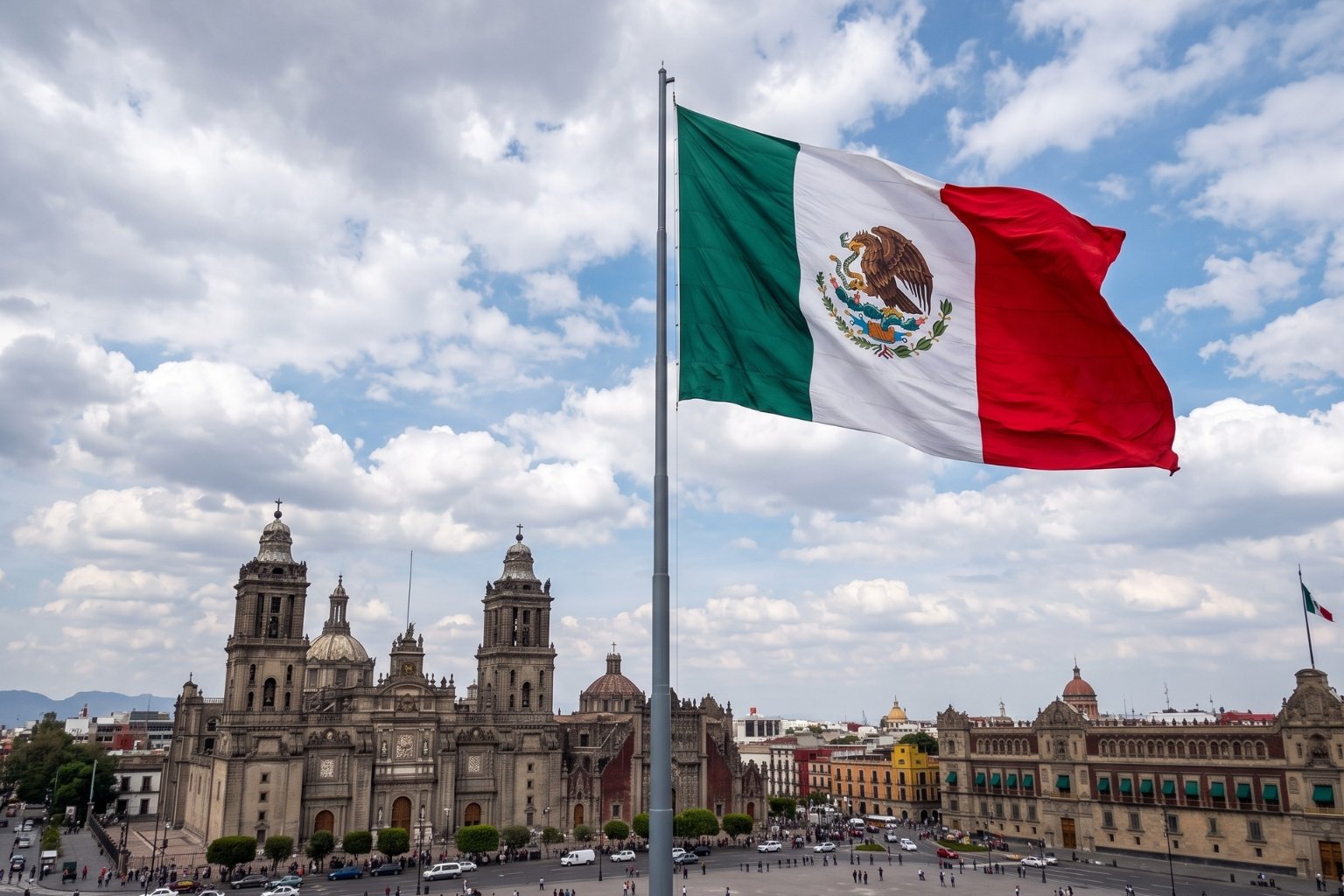

Stand in Mexico City’s Zócalo at sunrise and you will see a piece of fabric the size of a small house rising over the plaza, green white and red catching the first light. That flag carries an Aztec prophecy, a war of independence, and two centuries of political change folded into three stripes and one eagle. Here is what it actually means, where it came from, and how it still shapes daily life across the country.
What Green White and Red Actually Mean
The Mexican flag’s colors were never chosen for beauty alone. Each one carried a precise political promise at the moment of independence, and that promise has quietly evolved ever since.
The Original Meaning of 1821
When the tricolor was adopted in 1821, it represented the Three Guarantees of Iguala, the political deal that ended Spanish rule. Green stood for independence, white for the Roman Catholic religion, and red for the union between Spanish born Mexicans and those of mixed and Indigenous heritage.
That compromise was as much about who would hold power as it was about freedom. It let Mexico separate from Spain while keeping the existing social order largely intact.
How the Meaning Evolved
As Mexico moved through empire, republic, and reform, the religious reference faded from official use, replaced by broader civic ideals. Today most Mexicans learn a simpler version in school.
| Color | 1821 meaning | Modern meaning |
|---|---|---|
| Green | Independence | Hope |
| White | Catholic religion | Unity |
| Red | Union of the people | Blood of national heroes |
Both readings are historically accurate. They simply belong to different eras of the same flag.
The Aztec Legend at the Heart of the Coat of Arms
The stripes tell a political story. The emblem in the center tells a much older one.
The Prophecy That Founded Tenochtitlán
According to Mexica tradition, the god Huitzilopochtli told his people they would recognize their promised homeland by a single sign: an eagle perched on a cactus, devouring a serpent. After generations of wandering from a mythical homeland called Aztlán, they saw exactly that scene on a small island in Lake Texcoco.
They built their capital there in 1325. That city became Tenochtitlán, and centuries later, Mexico City.
Why an Eagle a Cactus and a Serpent
Every element on the flag’s coat of arms traces back to that vision. The eagle represents strength and the sun. The nopal cactus growing from a rock in water marks the exact founding site. The serpent has been read by different scholars as a symbol of the earth, of wisdom, or of a defeated adversary, and historians still debate which interpretation the Mexica themselves intended.
What is certain is that after independence, this pre Hispanic emblem was placed deliberately at the center of a European style tricolor. It ties Mexico’s ancient identity to its modern one in a single image, which is part of why the flag reads as more layered than most national banners.
From Battle Banner to National Symbol
The green white and red flag flying today is the result of at least thirteen redesigns. Four moments matter most.
The Virgin of Guadalupe Standard, 1810
Many historians consider the true first Mexican flag to be a banner carried by the priest Miguel Hidalgo after his call to arms on September 16, 1810, the Grito de Dolores. It showed the Virgin of Guadalupe rather than any tricolor, and it was never officially adopted, but it is the symbol that opened the war for independence.
The Army of the Three Guarantees, 1821
Eleven years later, under the Plan de Iguala, the first official tricolor appeared. It carried a crowned eagle, since Mexico briefly existed as an empire under Agustín de Iturbide.
Empire Republic Empire Again
Between 1823 and 1864, the crown disappeared as Mexico became a republic, and a serpent was added to the eagle’s talon along with oak and laurel branches. The crown returned briefly during the Second Mexican Empire under Maximilian I, then vanished for good once the republic was restored.
The Modern Design of 1968
The version Mexicans salute today was standardized by presidential decree in 1968, ahead of the Mexico City Olympics, fixing the eagle’s pose, the branches, and the proportions into law.
| Version | Year | What changed |
|---|---|---|
| Virgin of Guadalupe banner | 1810 | Religious symbol, not yet a tricolor |
| Army of the Three Guarantees | 1821 | First official tricolor, crowned eagle |
| First Republic flag | 1823 | Crown removed, serpent and branches added |
| Second Empire flag | 1864 | Crown briefly restored |
| Modern flag | 1968 | Design and proportions fixed by law |
Reading the Coat of Arms Like a Mexican
Look closely and the central emblem has more detail than most people ever register on a passing glance.
Oak Laurel and the Ribbon
Below the eagle, branches of oak and laurel are tied together with a ribbon in the national colors. Oak signals strength, laurel signals honor and victory, and together they frame the founding scene like a wreath around a portrait.
The Orientation Rule Almost No One Mentions
Mexican law is unusually specific about how the emblem may be displayed. The eagle must always face the green stripe and stand upright. A sideways or inverted emblem is read as a sign of distress or defeat, so official reproductions never take that liberty, even on merchandise.
Mexico’s Flag and Italy’s Flag: The Confusion Explained
Seen from a distance, the two flags look interchangeable, and that resemblance has caused real confusion in maritime signaling. Look closer and the differences hold up.
- Shade: Mexico’s green and red are darker than Italy’s.
- Proportions: Mexico uses a 4 to 7 ratio, longer than Italy’s 2 to 3.
- Emblem: Only the Mexican flag carries a central coat of arms.
There is no historical evidence either flag directly inspired the other. Both simply drew, separately, on the French tricolor tradition of the late 18th century.
Where the Flag Comes Alive in Mexico
For travelers, the flag stops being an abstract symbol the moment you see it raised in public.
Día de la Bandera, February 24
Every February 24, Mexican schools hold ceremonies where students recite an oath to the flag. It is a federal holiday, smaller in scale than Independence Day, but genuinely felt in classrooms and public squares across the country.
Independence Day and the Zócalo Ceremony
On the night of September 15, the president rings a bell and repeats a version of Hidalgo’s 1810 cry from the National Palace balcony overlooking the Zócalo, with the giant flag lit above the crowd. If you are in Mexico City that week, arrive early, the plaza fills fast, and the flag raising the next morning draws its own crowd of early risers.
Green White and Red on the Table
Mexican cuisine echoes the flag more than most visitors realize. The clearest example is chiles en nogada, a poblano chile stuffed with a spiced fruit and meat filling, covered in a pale walnut cream sauce, and finished with red pomegranate seeds.
Food historians trace the dish to independence era Puebla, where it was reportedly served to celebrate Agustín de Iturbide, with the colors composed deliberately to match the new flag. Whether or not every detail of that origin story is exact, the dish remains a seasonal favorite around Independence Day, and ordering it in September is as close as a traveler gets to tasting the flag itself.
Flying or Photographing the Flag as a Visitor
Mexico protects its flag by law, more strictly than many visitors expect.
- Photographing the flag in public spaces is entirely normal and welcomed.
- Casual or distorted reproductions on products require care, since the Ley sobre el Escudo, la Bandera y el Himno Nacionales regulates how the emblem can be used commercially.
- Buying a small souvenir flag is fine, but treat it as you would any national symbol, not as a disposable prop.
- During official ceremonies, follow the lead of those around you, removing hats and standing quietly as the flag passes.
None of this is meant to intimidate a curious traveler. It simply reflects how seriously the symbol is held by the people who grew up reciting an oath to it every February.
Quick Facts
| Detail | Information |
|---|---|
| Colors | Green, white, red |
| Central emblem | Eagle, cactus, serpent |
| Current design adopted | September 16, 1968 |
| Official ratio | 4 to 7 |
| Governing law | Ley sobre el Escudo, la Bandera y el Himno Nacionales |
| Flag Day | February 24 |
| Independence Day | September 16 |
