

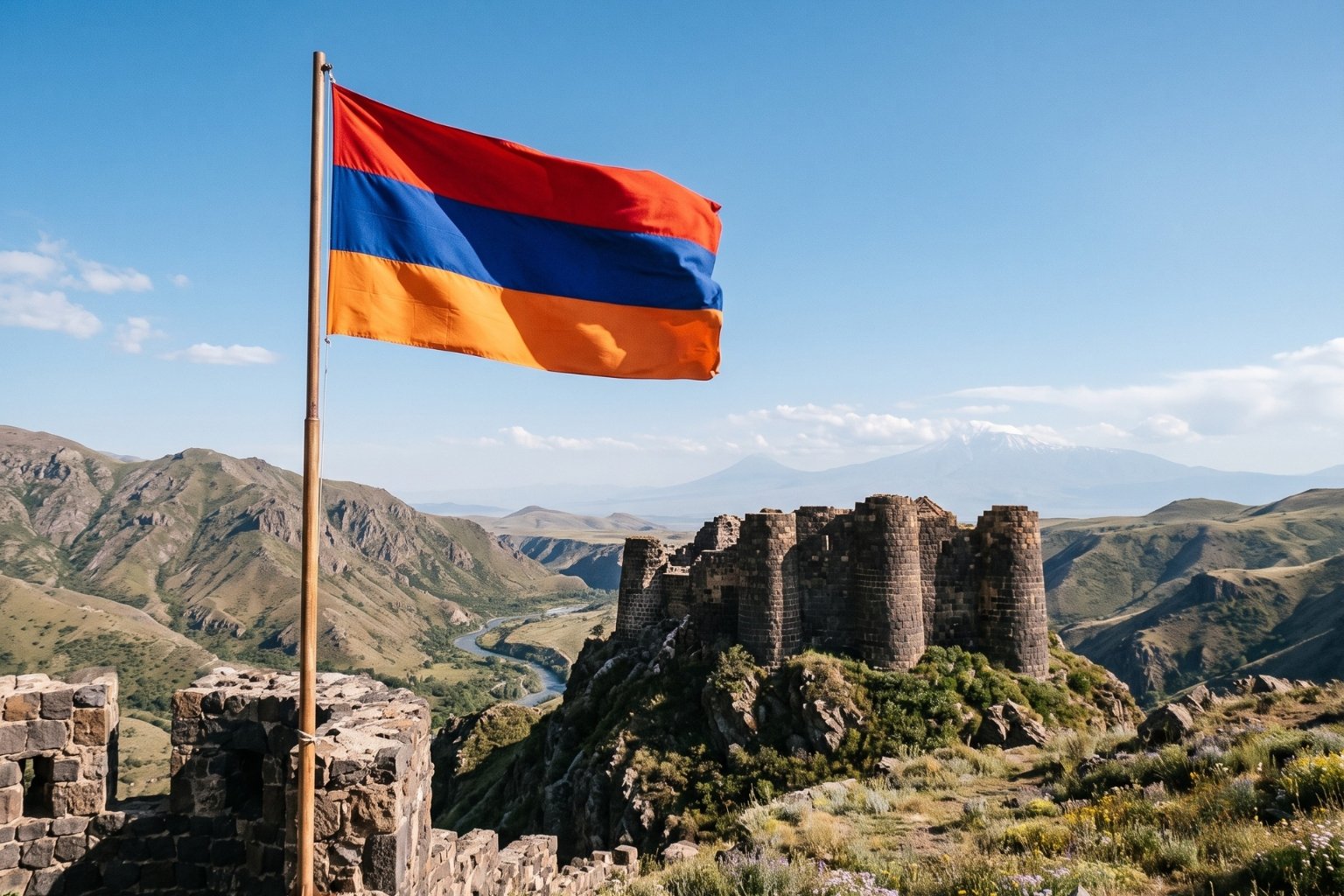

Three horizontal stripes, one for the land, one for the sky, one for the people who never stopped working the soil between them. That is the short version of the Armenia flag, and it barely scratches the surface. Behind the red, blue and orange lies a story that runs through a forgotten Cilician kingdom, a group of homesick students in Paris, and a law passed by the Armenian parliament less than twenty years ago.
What the Armenian Flag Looks Like Today
The flag of Armenia is a tricolor made of three equal horizontal bands. Red sits on top, blue in the middle, and orange along the bottom. The official proportion between height and length is 1 to 2, a ratio shared by many national flags across the region.
There is no emblem, no star, no added symbol on the cloth itself. The simplicity is deliberate. Every meaning the flag carries lives entirely inside its three colors.
What Each Color Actually Means
Armenia’s constitution and a dedicated law passed in 2006 spell out the official symbolism of each color. Alongside that legal definition, an older, more popular reading has survived among Armenians for generations.
| Color | Official meaning | Popular meaning |
|---|---|---|
| Red | The Armenian Highland, the people’s struggle for survival, the Christian faith, independence and freedom | Blood shed defending the homeland |
| Blue | The will to live under a peaceful sky | The clear sky and mountains of Armenia |
| Orange | Creative talent and hard work | Courage and industriousness |
Red
Red carries the heaviest weight of the three colors. It reaches back to the Armenian Highland itself, to centuries of resistance, and to a Christian identity that Armenia adopted earlier than any other nation on earth, in the year 301.
Blue
Blue is the gentlest of the three. It stands for the wish to finally live under a calm sky after a history marked by invasion and displacement.
Orange
Orange closes the flag on a note of optimism. It celebrates talent, craft, and the plain hard work that rebuilt the country more than once.
Why Orange Carries the Name of an Apricot
In Armenian, the word commonly used for the flag’s orange is ծիրանագույն, which translates literally as apricot colored. The apricot is not a random fruit here. Armenia is widely believed to be one of the earliest homes of the apricot tree, and the fruit still fills market stalls from Yerevan to the Ararat valley every summer.
That small linguistic detail says something the official law never quite captures. Armenia’s national colors are tied not just to abstract virtues, but to something you can taste.
Where the Colors Come From: The Cilician Kingdom
The red, blue and orange palette did not appear out of nowhere in the twentieth century. It borrows from the banner used at the end of the Rubenid dynasty, which ruled the Kingdom of Cilicia in the later Middle Ages.
That original banner combined red, blue and yellow. Yellow would later be swapped for orange, mostly because the two colors sat better together on cloth than red and yellow did.
The Origin Story
A Flag Born in Paris in 1885
The modern Armenian flag has an unexpected birthplace: Paris. In 1885, a group of Armenian students living in the city asked the clergyman and poet Ghevond Alishan to design a flag they could carry at Victor Hugo’s funeral.
Alishan proposed a tricolor of red, green and white, inspired by the biblical image of the rainbow Noah saw after the flood. It never became the national flag, but it planted the idea that Armenians abroad needed a shared banner of their own.
The First Republic Adopts Red, Blue and Orange
The real turning point came in 1918, when the First Republic of Armenia declared independence. The National Assembly debated several designs before settling on a horizontal tricolor of red, blue and orange, drawing directly on the old Cilician colors rather than Alishan’s version.
Sourcing orange fabric proved surprisingly difficult at the time, and early versions of the flag sometimes used yellow instead. The flag flew for a little over two years before the Sovietization of Armenia in 1920.
Stepan Malkhasyants, the Man Behind the Design
Historical records credit the linguist and academician Stepan Malkhasyants with presenting the tricolor concept to the National Assembly. He was better known for his work translating Armenian classical historians than for flag design, which makes his contribution to this particular piece of cloth all the more unusual.
The Soviet Interruption
Once Armenia became part of the Soviet Union, the tricolor disappeared from official use. It was replaced first by a plain red banner bearing Armenian lettering, then by the standard Soviet flag with a blue stripe added through the center starting in 1952.
The red, blue and orange flag did not vanish from memory, though. Armenian communities abroad, and eventually protesters inside Soviet Armenia itself, kept it alive through the decades.
1990: The Flag Returns
As the Soviet Union began to crumble, the Armenian Supreme Soviet officially readopted the tricolor on August 24, 1990, just over a year before full independence in 1991. Sixteen years later, on June 15, 2006, the National Assembly passed the law that finally locked in the flag’s legal meaning and proportions.
That same date, June 15, is now celebrated every year as Armenia’s National Flag Day.
Where You’ll Actually See the Flag in Armenia
Travelers notice the tricolor almost immediately in Yerevan. It flies over Republic Square, the Presidential Residence, Parliament, and the base of the Mother Armenia monument overlooking the city.
There is also a quieter custom worth knowing. During periods of national mourning, a black ribbon is added to the top edge of flags flown on public buildings, a small visual cue that carries real weight for anyone paying attention.
Armenia’s Flag versus the Artsakh Flag
The flag used in Nagorno Karabakh, also called Artsakh, looks almost identical to Armenia’s at first glance. The difference sits on the right edge of the cloth, where a white, stepped carpet pattern is added, echoing traditional Armenian rug design.
The pattern was meant to mark Artsakh as its own entity while visually affirming its bond with Armenia, a distinction easy to miss unless you know exactly where to look.
Quick Facts
| Detail | Information |
|---|---|
| Adopted | August 24, 1990 |
| Legal framework | Law on the State Flag, June 15, 2006 |
| Colors | Red, blue, orange |
| Proportions | 1 to 2 |
| Credited designer | Stepan Malkhasyants |
| Historical source | Cilician Kingdom banner, Rubenid dynasty |
| National Flag Day | June 15 |
Frequently Asked Questions
What do the colors of the Armenian flag mean?
Officially, red represents the Armenian Highland, the struggle for survival, the Christian faith and independence. Blue represents the wish to live under a peaceful sky, and orange represents creative talent and hard work.
Who designed the Armenian flag?
The tricolor is generally credited to Stepan Malkhasyants, who presented the design to the National Assembly of the First Republic of Armenia in 1918.
Is the third color orange or yellow?
It is orange today, though early versions of the flag in 1918 sometimes used yellow due to fabric shortages. Orange was chosen deliberately for how well it paired visually with red and blue.
What is the difference between Armenia’s flag and the Artsakh flag?
The Artsakh flag adds a white, stepped carpet pattern along the right edge of an otherwise identical red, blue and orange tricolor.
When is Armenia’s National Flag Day?
Armenia celebrates National Flag Day every year on June 15, marking the date the 2006 law on the state flag was adopted.
