

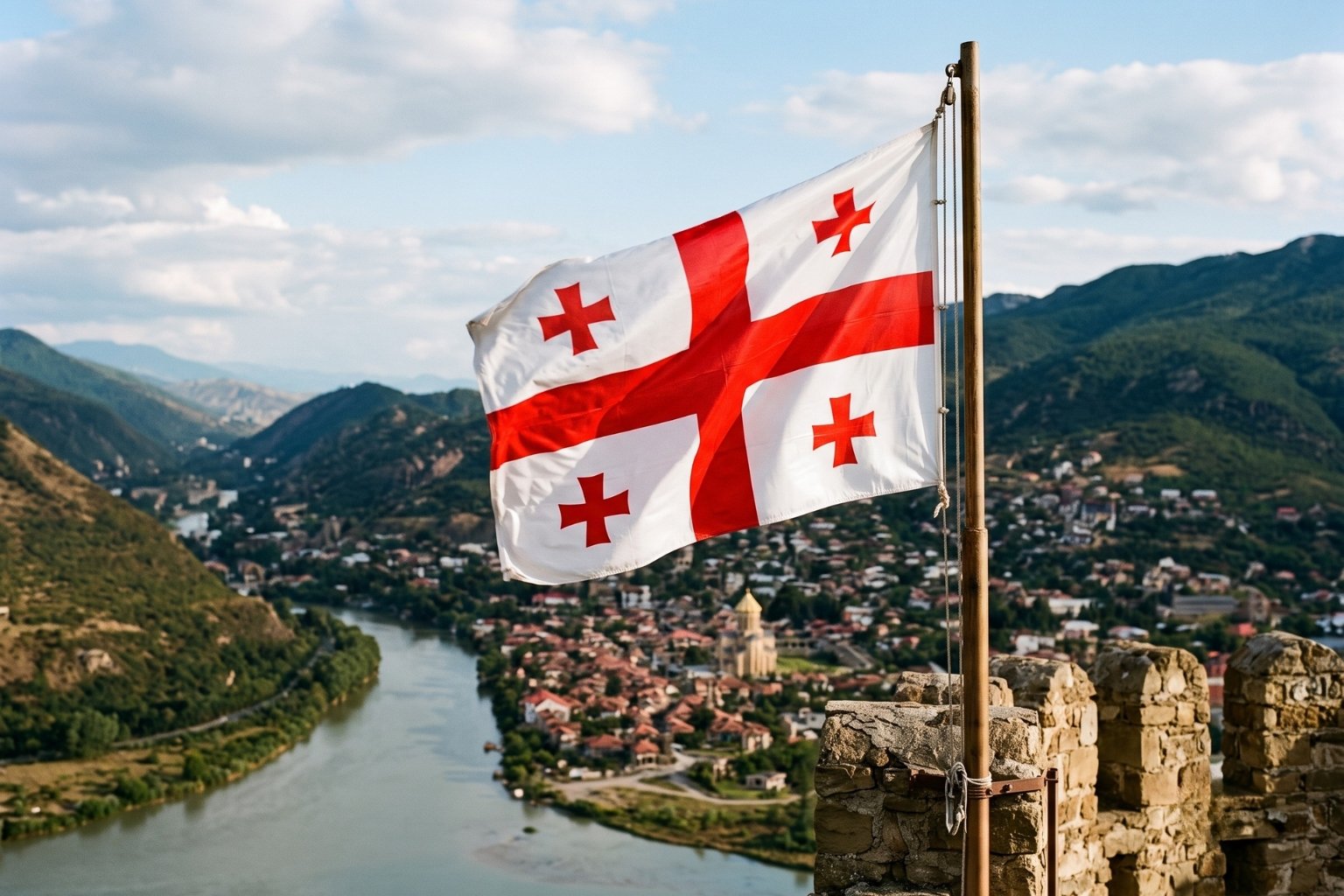

Fly into Tbilisi and one Georgian symbol grabs your eye before the food or the wine ever does: a white banner cut by five red crosses, rippling over the old town rooftops. Locals call it the Five Cross Flag. The Georgia flag carries a story that runs through Crusader Jerusalem, a medieval queen, seventy years of Soviet erasure, and a bloodless revolution that brought it home. To understand it is to understand how this small Caucasus nation holds onto who it is.
What the Georgia Flag Looks Like
The design is simple enough to sketch from memory, which is exactly the point. A white field carries one large red cross that stretches edge to edge, splitting the flag into four equal quarters. In each quarter sits a smaller Bolnisi cross, a distinctive equal armed cross with flared, arrow shaped tips.
The proportions and colors are fixed by Georgian law, down to the shade of red.
- Field: white
- Central cross: red, touching all four sides
- Four corner crosses: red, Bolnisi style
- Official ratio: 2:3
- Adopted: January 14, 2004
The Meaning Behind the Five Crosses
Each element on the flag carries centuries of layered symbolism, and Georgians read it as both a national and a religious statement.
The Central Cross of Saint George
The large cross is associated with Saint George, the country’s namesake and patron saint in Georgian tradition. Its placement, touching all four borders of the flag, is meant to show the saint’s protection extending over the whole territory.
The Four Bolnisi Crosses
The smaller crosses take their name from Bolnisi Sioni, a fifth century church in southern Georgia where this cross shape first appears carved in stone. Historians and theologians most often read the five crosses together as a reference to Christ and the four Evangelists, though some interpretations connect them to the Five Holy Wounds.
Why the Field Is White
White stands for purity, peace, and wisdom in Georgian heraldic tradition. It also functions as a visual echo of the Georgian Orthodox Church, whose architecture and iconography lean heavily on the same palette.
| Element | Meaning |
|---|---|
| White field | Purity, peace, spiritual identity |
| Central red cross | Saint George, national protection |
| Four Bolnisi crosses | Christ and the four Evangelists |
| Red color | Faith, courage, sacrifice |
Where the Design Actually Comes From
A Symbol Older Than the Country’s Modern Borders
This is the part most flag explainers skip past too fast. The five cross design is not a 21st century invention. It is a direct revival of a medieval Georgian banner, and that distinction matters for anyone trying to understand the country’s relationship with its own past.
The Jerusalem Cross and the Crusades
The cross pattern belongs to a family of designs known as the Jerusalem cross, first recorded around 1099 on the arms of Godfrey of Bouillon, leader of the First Crusade and self declared Defender of the Holy Sepulchre. Georgian kingdoms, deeply Christian and geopolitically tied to the wider Crusader world, adopted variations of this symbol as their own.
Queen Tamar, King George V, and the Written Record
Georgian chronicles connect flags bearing red crosses on white to the reigns of Queen Tamar in the late 12th and early 13th centuries and King George V in the 14th century, a period often called Georgia’s golden age. A coin minted under an earlier king, David IV, and rediscovered in 2021, shows a folded five cross composition that Georgia’s State Council of Heraldry ties directly to this same visual lineage.
Proof on a 700 Year Old Map
The clearest outside evidence comes from cartography rather than Georgian sources themselves. A 1339 map by the Italian cartographers Domenico and Francesco Pizzigano marks the cities of Tbilisi and Sukhumi with a five cross flag, confirming that European mapmakers already recognized this exact symbol as Georgian territory nearly seven centuries ago.
How Georgia Lost Its Flag Twice
Absorbed by the Russian Empire, 1801
When the Russian Empire annexed Georgia in 1801, national symbols including the historic flag were suppressed. For more than a century, Georgia had no official banner of its own to fly.
The Short Lived Tricolor of the First Republic
Independence arrived briefly in 1918. The Democratic Republic of Georgia adopted a new flag instead of the medieval crosses: a wine red field with black and white bands in the canton, chosen through a design contest. That tricolor lasted only until 1921, when Soviet forces absorbed Georgia into the USSR.
Soviet Georgia’s Hammer and Sickle Years
Under Soviet rule, the flag of the Georgian SSR cycled through variants built around the hammer, the sickle, and a red star on a blue sun, always subordinate to Moscow’s visual language. The medieval crosses had no place in this era at all.
The Rose Revolution and the Flag’s Return
1990, a Flag Comes Back Before Independence Does
As Soviet control weakened, the 1918 tricolor was briefly readopted in 1990, ahead of Georgia’s formal independence in 1991. It served as the national flag through a turbulent post Soviet decade, though it never fully shook its association with the instability of that period.
2004, Officially Georgian Again
Everything changed after the Rose Revolution of late 2003. Incoming president Mikheil Saakashvili had already used the medieval five cross banner as the symbol of his political movement, and once in office he pushed for its formal adoption. Parliament made it official on January 14, 2004, closing an 83 year gap since the design had last flown as Georgia’s own.
Where You’ll Actually See the Flag in Georgia
Tbilisi’s Old Town and Its Churches
Walk through Tbilisi’s Old Town and the flag appears constantly, draped over balconies, mounted beside Orthodox churches, painted onto souvenir stalls near Narikala Fortress. Its Christian symbolism sits comfortably alongside the city’s working churches, since the two visual languages come from the same source.
Flag Day, January 14
Georgia marks its State Flag Day every January 14, the anniversary of the 2004 adoption. Government buildings and public institutions are required by law to display the flag prominently on that date.
On Wine Labels and Everyday Life
Because Georgia leans so heavily on its identity as the birthplace of wine, the five cross motif shows up far beyond government buildings: on wine labels, church souvenir stands, and local branding across the country. For a traveler, it becomes a quiet visual thread connecting a Kakheti vineyard to a Tbilisi cathedral.
Georgia Flag Quick Facts
A fast reference for anyone who just wants the essentials of the Georgia flag without the full history.
| Fact | Detail |
|---|---|
| Official name | Five Cross Flag (khutjvriani drosha) |
| Adopted | January 14, 2004 |
| Colors | White field, red crosses |
| Proportion | 2:3 |
| Historical origin | Medieval Kingdom of Georgia, 12th to 14th century |
| National holiday tied to flag | State Flag Day, January 14 |
Frequently Asked Questions
Why does the Georgian flag resemble England’s Saint George cross?
Both flags draw from the same broader Christian heraldic tradition tied to Saint George and the Crusader era. The resemblance is a shared visual root rather than one country copying the other.
What did the older cherry red and black flag mean?
The 1918 tricolor used by the First Republic paired wine red with black and white. Interpretations vary, but the black is generally read as a nod to a difficult past, with the surrounding white read as hope for peace.
Is the flag connected to Jerusalem?
Indirectly, yes. The Jerusalem cross pattern that inspired Georgia’s central cross traces back to Crusader era Jerusalem, though the specific five cross composition became distinctly Georgian through centuries of independent use.
