

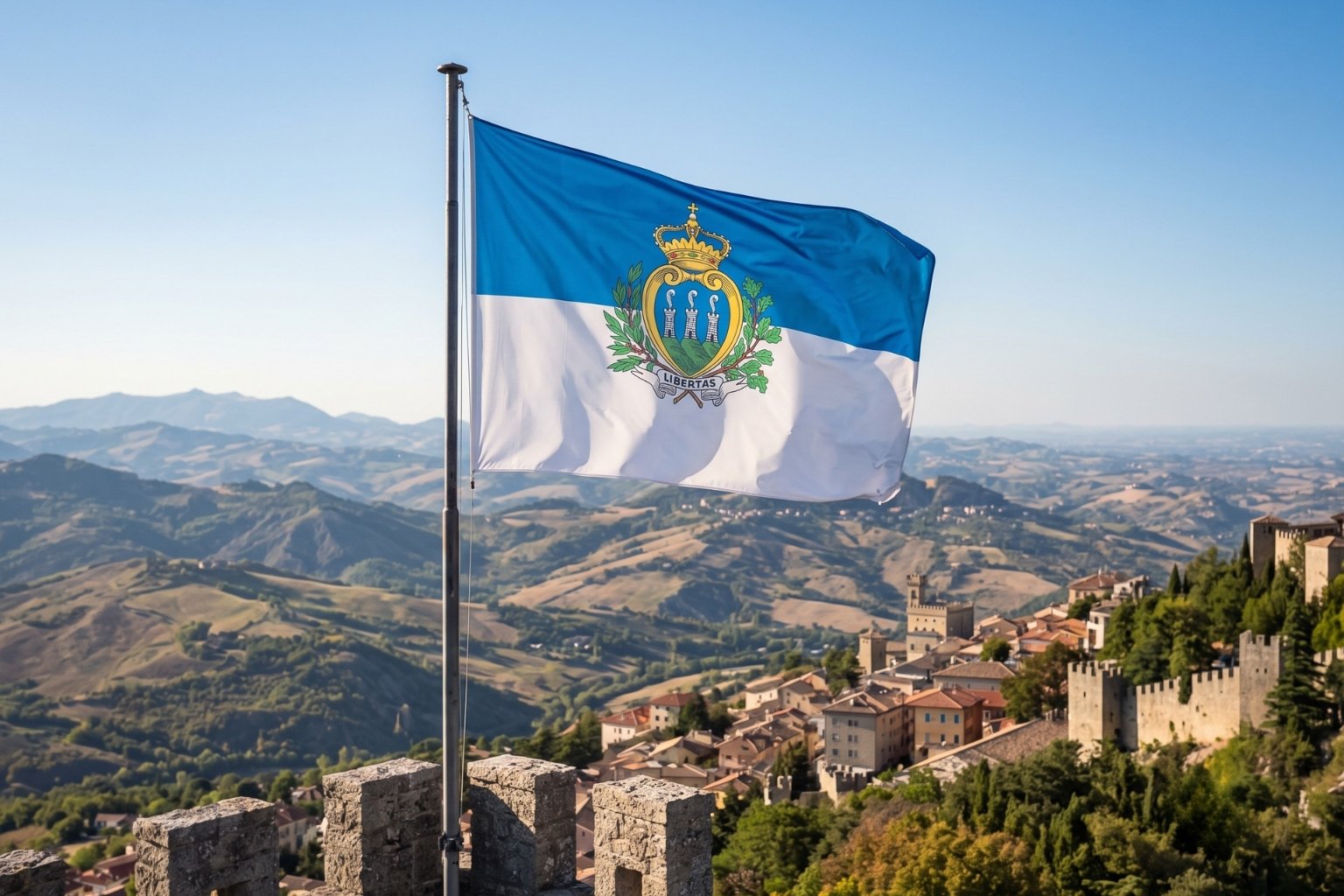

Fly into Monte Titano on a clear morning and the first thing you notice, before the towers even come into focus, is a strip of white and blue snapping in the wind above the rock. That is the San Marino flag, and it belongs to a republic that has been guarding its own colors, and its own independence, since long before most of Europe agreed on borders. Behind its simple two band design sits a coat of arms, three fortified towers, and a motto that explains why this tiny state has never stopped calling itself free.
What the Flag Looks Like Today
The official flag of San Marino is made of two equal horizontal bands, white on top and light blue below. At its center sits the national coat of arms, small enough not to overwhelm the bicolor but detailed enough to reward a closer look. The flag’s official proportions run at a ratio of 3 to 4, slightly squarer than most national flags you will recognize from a distance.
A simplified civil version, without the coat of arms, also circulates in everyday use, though the state itself always flies the full emblem.
The Colors and What They Actually Mean
The palette is deliberately restrained, and every shade carries weight.
| Color | Visual reference | Meaning |
|---|---|---|
| White | Snow on Monte Titano | Peace |
| Light blue | The open sky above the republic | Liberty |
White sits above blue on purpose. Sanmarinesi place peace symbolically over the sky itself, a quiet way of saying that calm comes first, even in a country whose whole history is a story of resisting outside pressure. Light blue stands for freedom and for the clouds that wrap around the mountain for much of the year, giving the republic its slightly detached, almost floating character when you look up at it from the plains below.
Reading the Coat of Arms, Piece by Piece
The bicolor gets the attention, but the coat of arms is where the real story lives.
The Three Towers: Guaita, Cesta and Montale
Three silver towers, each on its own green peak, form the heart of the shield. They represent Guaita, Cesta and Montale, the fortresses still standing along Monte Titano’s ridge. Each tower is topped with a slim ostrich feather vane, a detail so old its exact origin is debated, though one theory ties it to a pun on the Italian word for feathers, penne, echoing the name of the surrounding peaks.
The Crown: A Small Nation’s Claim to Sovereignty
A closed crown rests above the shield. For a republic with a population smaller than many single neighborhoods elsewhere in Europe, the crown is less about royalty and more about a firm, formal claim to full sovereignty, the right to answer to no one else.
Oak and Laurel: The Wreath Most People Miss
Two branches frame the shield, oak on one side and laurel on the other. Laurel has crowned winners since antiquity, while oak has long stood for endurance. Together they quietly sum up San Marino’s own account of itself, a state that has outlasted empires simply by holding its ground.
Libertas: The Word That Explains Everything Else
Below the shield, a scroll carries a single word, Libertas. Liberty is not decoration here. San Marino has served as a refuge for people fleeing persecution since its founding, and that scroll is the closest thing the flag has to a mission statement.
Where the Story Starts: The Forgotten 1465 Flag
Long before the current bicolor existed, San Marino flew something entirely different. The earliest documented standard dates back to 1465, commissioned from a manufacturer in Florence. It combined gold, white and a shade historians call alessandrino, likely a form of blue or purple whose exact tone is still argued over by specialists. Three towers already appeared on the white band, a detail that would outlive every other element of that early design.
1797: A Cockade Born Out of Defiance
The colors we recognize today trace back to a single decree. On 12 February 1797, San Marino’s Sovereign Council ordered that the national cockade be made of white and turquoise. The timing was not accidental. Revolutionary movements were reshaping Italy, and the neighboring Cispadane Republic had just adopted its own tricolor. Choosing distinct colors was San Marino’s way of drawing a line around its own identity at a moment when smaller states across the peninsula were being absorbed or redrawn.
From Cockade to National Flag: The Road to 1862
A cockade is not a flag, and it took decades for the white and blue to make that leap. Through the early 19th century, the colors gained ground informally, flown first from Guaita tower and later from the Public Palace. By 1862, the coat of arms had been formally standardized, and the white and blue bicolor was recognized as San Marino’s national flag in practice as much as in law, a symbol solid enough that neighboring castelli reportedly asked to borrow official copies when their own wore out.
2011: The Law That Finally Locked Everything Down
For all its age, the flag went centuries without a single unified legal text describing it precisely. That changed with Constitutional Law No. 1 of 22 July 2011, which fixed the exact colors, proportions and coat of arms design still in use today. The same law secured international protection for the emblem through the World Intellectual Property Organization, closing a loop that had technically been open since 1465.
Where You Will Actually See the Flag
This is the part most flag guides skip, and it is the part that matters if you are actually planning a trip. The San Marino flag flies year round above Guaita tower, the oldest and most visited of the three fortresses, reachable on foot from the historic center in under twenty minutes. Public ceremonies at the Palazzo Pubblico, San Marino’s seat of government, regularly bring out the full flag alongside the Captains Regent, the country’s co heads of state. If your timing allows it, aim for 3 September, San Marino’s national holiday marking the republic’s traditional founding in 301 AD, when the flag appears in far greater numbers than on an ordinary afternoon.
How It Compares to Other Blue and White Flags
White and blue is a popular combination worldwide, and San Marino’s flag gets mistaken for a few others at a glance. Argentina’s flag shares the same two colors but arranges them differently and adds a sun. Greece relies on blue and white too, though in stripes and a canton cross rather than a simple bicolor. What sets San Marino apart at any distance is the coat of arms itself. No other national flag carries three fortress towers on green peaks, which makes it one of the easier bicolors to identify correctly once you know what to look for.
Quick Answers
What do the colors of the San Marino flag mean? White stands for peace and for the snow on Monte Titano. Light blue stands for liberty and the sky above the republic.
Why does the flag show three towers? They represent Guaita, Cesta and Montale, the three fortresses that have historically defended San Marino along its mountain ridge.
When was the San Marino flag officially adopted? The bicolor became the recognized national flag in 1862, though its exact legal specifications were not fixed until the constitutional law of 2011.
What does Libertas mean on the flag? It is Latin for liberty, and it reflects San Marino’s long standing role as a refuge for people fleeing persecution, tied to its claim as the world’s oldest surviving republic.
