

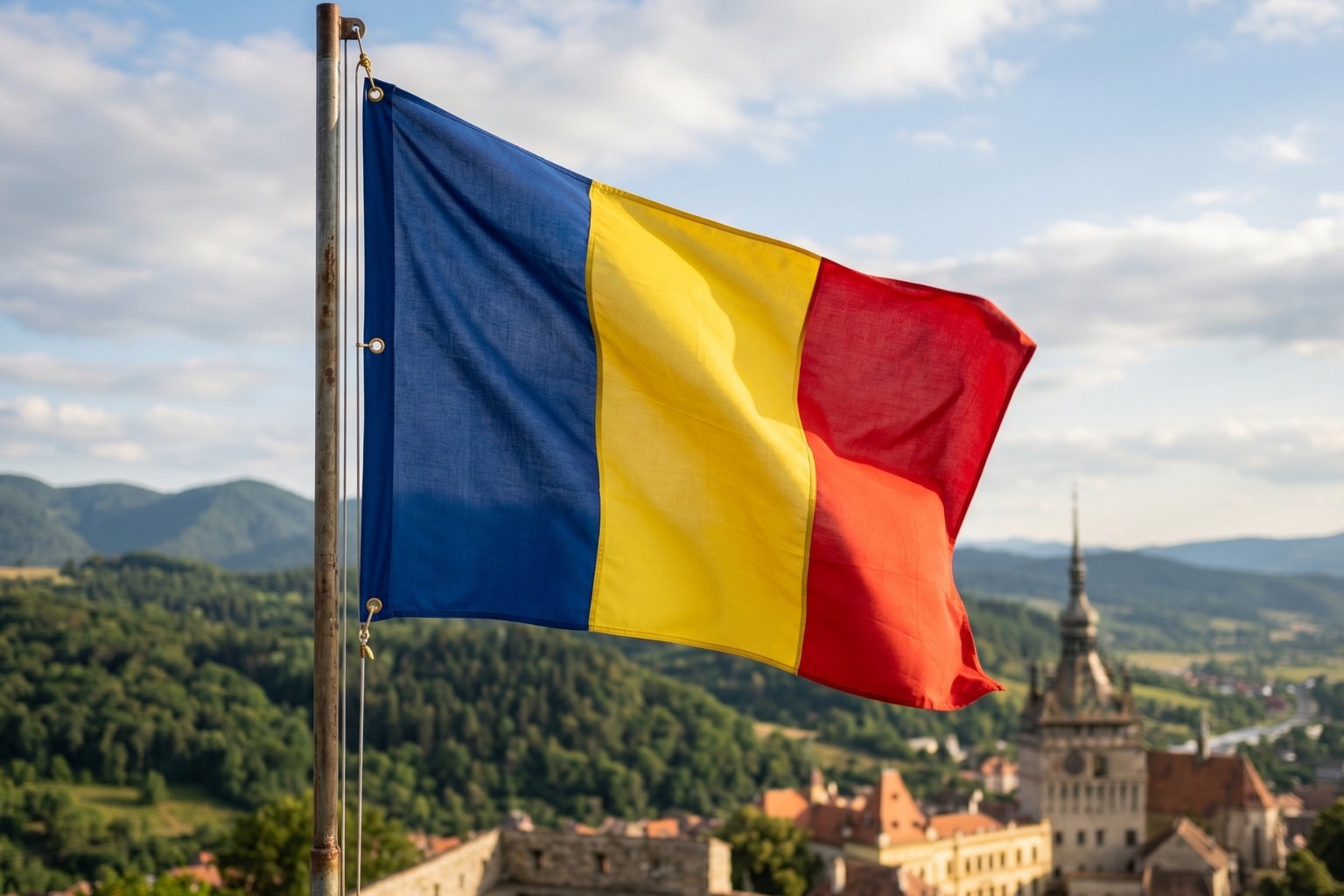

In December 1989, as Ceaușescu’s regime collapsed in real time on national television, Romanian revolutionaries did something that needed no commentary. They took the national flag and cut a hole in its center. What they removed was the communist emblem. What they left was a plain vertical tricolor of blue, yellow, and red. That gesture, broadcast live and repeated across the country, tells you more about the Romania flag than any official definition ever could.
What the Three Colors of the Romania Flag Actually Mean
The meaning of the three colors has never been fixed by a single authority and has shifted slightly depending on the era and the political regime in power. The version that has endured longest, and that most Romanians recognize today, comes from the revolutionary movement of 1848.
Blue: Liberty
Blue occupies the hoist side of the flag, the stripe closest to the pole. It has historically been associated with liberty, and more broadly with the aspirations of a people seeking independence from foreign rule. In some interpretations, particularly in the 19th century, it also carried connotations of the sky and of a future not yet written.
Yellow: Justice and the Richness of the Land
Yellow sits at the center and has carried two distinct meanings across Romanian history. The revolutionary reading links it to justice. The more earthly reading connects it to the fertile plains and golden grain fields that define much of Romanian geography, making it a symbol of the country’s natural wealth and agricultural identity.
Red: Fraternity
Red closes the flag on the fly side and represents fraternity, the bond between the Romanian people across the three historical provinces of Wallachia, Moldavia, and Transylvania. In some historical interpretations it also evokes the blood shed in the long struggle for independence and national unity.
The official legal shades are defined precisely by Romanian law: cobalt blue, chrome yellow, and vermilion red. The specificity matters. The law had to be explicit because the proximity of the Romanian and Chadian flags, nearly identical to the naked eye, has caused repeated diplomatic confusion at international events.
Medieval Roots: Where the Colors Come From
The tricolor did not appear out of thin air in 1848. Blue, yellow, and red were already present in the heraldic traditions of the three Romanian principalities long before the modern Romanian state existed.
The ruling princes of Wallachia used blue and yellow in their banners and seals. Moldavia incorporated red and blue in its own heraldic symbols. Transylvania, though long under Hungarian and later Habsburg control, carried similar color associations in the arms of its Romanian communities.
When the revolutionaries of 1848 chose their colors, they were not inventing a new identity. They were consolidating a shared visual heritage that already existed across the principalities, giving it a single, unified form for the first time.
1848 and the Birth of the Modern Tricolor
The modern Romania flag was born in revolution. The Wallachian Revolution of 1848 produced the first official tricolor decree, issued on June 14 of that year by the provisional government. The decree stated clearly that the national flag would have three colors: blue, yellow, and red, in that order, and carried the inscription “Dreptate, Frăție” meaning Justice and Fraternity in Romanian.
What makes this moment remarkable is that it was happening simultaneously across borders. Romanian students in Paris, watching the revolutionary wave sweep through Europe, were already waving a blue, gold, and red flag as early as April 26, 1848, according to reports published in the Gazeta de Transilvania. They described it explicitly as a symbol of union between Moldavians and Muntenians.
The influence of the French tricolor is not incidental. Romanian intellectuals of the period were deeply connected to Parisian political thought, and the vertical three-color format carried the unmistakable logic of the French model: a new political order expressed through color, proportion, and simplicity.
From Revolution to Nation: How the Flag Evolved
The decades between 1848 and the end of World War I were marked by slow, contested progress toward a unified Romanian state, and the flag reflected every step of that process.
In 1859, Moldavia and Wallachia united under Alexandru Ioan Cuza, who became the first ruler of a united Romania. The tricolor was confirmed as the symbol of the new principality. Cuza himself described the flag as “the family, the territory of every Romanian, the home where your parents were born and where your children will be born.”
Between 1862 and 1867, the flag moved between horizontal and vertical arrangements as the political situation evolved and diplomatic pressures from the Ottoman Empire shaped what was and was not permitted. The vertical tricolor, which is the format used today, was reestablished on April 23, 1867.
The Romanian Constitution of 1866 made it official in law: Article 124 defined the colors of the united principalities as blue, yellow, and red. The Assembly of Deputies confirmed the exact order and orientation in March 1867 and placed the Romanian coat of arms at the center of the state flag.
Romania declared independence from the Ottoman Empire in 1877, and the coat of arms on the state flag was updated to reflect the new status. Further modifications followed in 1897 and 1922, after Transylvania joined Romania and the Kingdom of Romania was formally established following World War I.
The Communist Emblem and the Flag That Was Torn
When the communist regime took power in 1948, it did what authoritarian regimes tend to do with national symbols: it altered them to erase what came before.
The plain tricolor was replaced with a flag bearing a communist emblem at its center, a design featuring mountains, forests, a rising sun, and eventually an oil derrick representing industrial ambition. The emblem was updated in 1952 and again in 1965 as the political line shifted, each version expressing a slightly different ideological posture.
For over four decades, Romanians lived with a flag that carried a symbol many did not choose and some actively resented. The emblem made the flag feel occupied, marked by a regime that had imposed itself on the colors rather than emerging from them.
Then came December 1989. As the revolution unfolded and Ceaușescu fled, Romanians across the country took their flags and cut out the center. The holes were not vandalism. They were a statement. On December 27, 1989, Decree-Law No. 2 made it official and removed the emblem permanently. The plain blue, yellow, and red tricolor was restored, and it has not changed since.
The Chad Problem: Two Countries, Nearly One Flag
Anyone who has sat through an international summit or a United Nations session has likely noticed the problem. The flag of Chad and the flag of Romania are, to most eyes, identical. Both are vertical tricolors. Both use blue on the hoist side, yellow in the center, and red on the fly side.
The technical distinction is minimal. Chad’s blue is marginally darker, described officially as indigo, while Romania’s is cobalt. In practice, the difference is difficult to perceive without direct comparison, and at a distance or on a screen, the two flags are functionally indistinguishable.
Chad adopted its tricolor in 1960 upon independence from France, drawing on the colors of the French tricolor and dropping the green used during the colonial period. Romania had been using its version for nearly a century by that point. The resemblance was not coordinated. It was the product of two separate countries drawing from overlapping European heraldic and revolutionary traditions.
The issue has come up formally. Chad raised the question of confusion at the United Nations in 2004. No resolution was reached. Both countries have retained their flags unchanged, and the near-identical designs remain a recurring footnote in vexillological discussions.
The Romania Flag Today
The flag’s current legal framework was established by a 1994 law and extended in 2001. The law specifies the exact color shades, the proportions of the stripes, and the protocol governing how the flag is to be displayed, reproduced, and respected.
Romania celebrates National Flag Day on June 26, a holiday established by Law No. 96 on May 20, 1998. The date commemorates the June 26, 1848 revolutionary decree that first officially named the three colors as the national standard. It is a relatively recent observance, introduced a decade after the end of communism, as part of a broader effort to reconnect Romanian civic identity with its pre-communist roots.
For the Romanian diaspora, spread across Western Europe, North America, and beyond, the plain tricolor carries particular weight. It is a flag without an emblem, without a superimposed ideology, and without ambiguity. After forty years of a modified version, the simplicity of the restored flag is itself a kind of meaning.
