

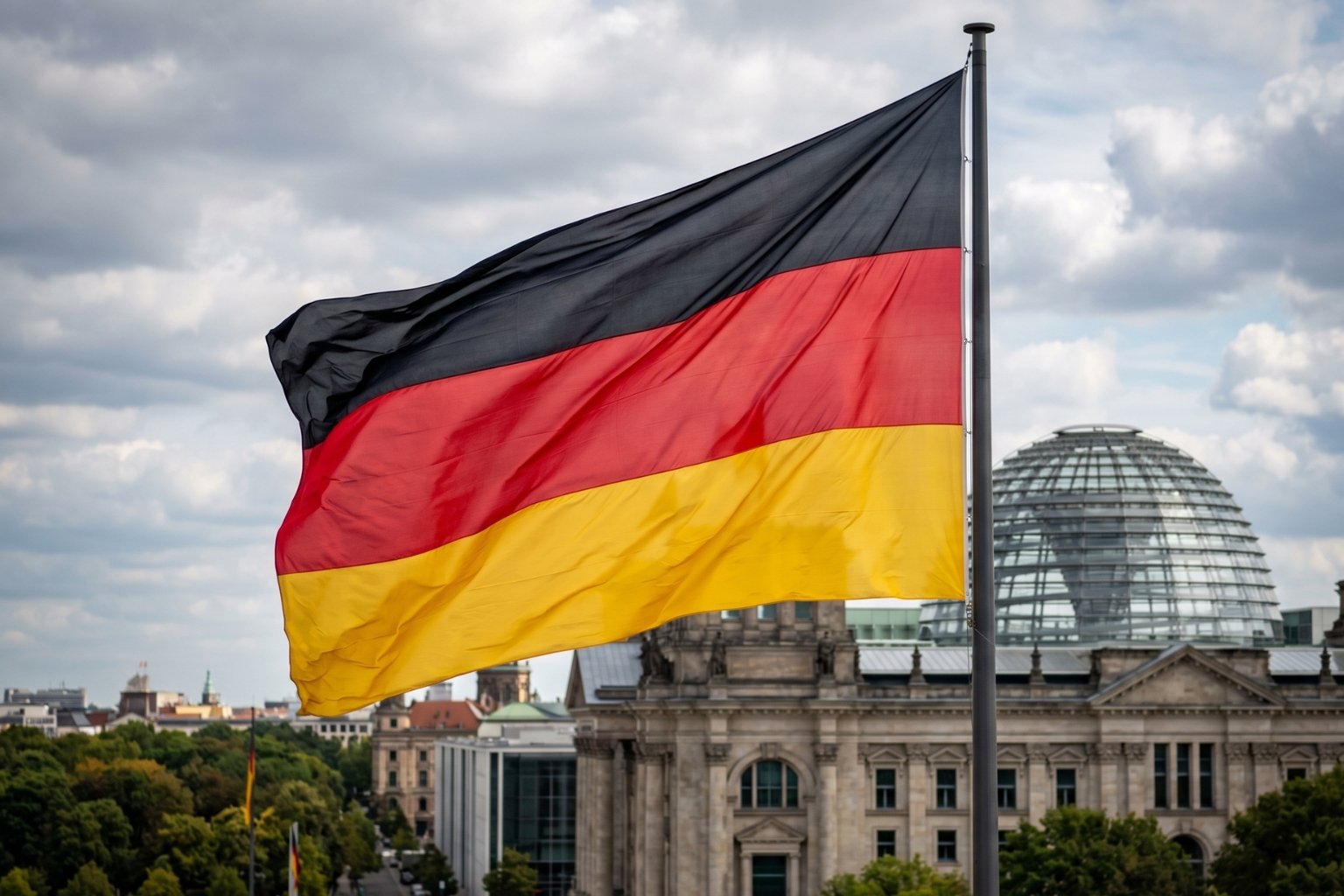

Few flags in the world carry as much contested, buried, and finally reclaimed history as the German tricolor. Black, red, and gold: three stripes that were banned under the Kaiser, suppressed by the Nazis, split between two countries for forty years, and finally reunited on the same day as Germany itself. Understanding this flag means understanding how a nation repeatedly fought to define what it wanted to be.
Three Stripes, Centuries of History
The German flag is a horizontal tricolor: black on top, red in the middle, gold at the bottom. The three bands are equal in width, and the flag follows a 3:5 ratio, established in 1950. Visually, it is one of the simplest national flags in Europe. Historically, it is one of the most layered.
The government flag and the civil flag
Most people see the plain tricolor and assume it tells the whole story. In practice, Germany uses two versions. The civil flag, flown by citizens and businesses, is the pure black-red-gold rectangle. The government flag, used by federal institutions, adds the Bundesadler (the Federal Eagle) centered on the red stripe. A coat of arms centuries older than the republic it now represents, the eagle connects contemporary Germany to a much longer chain of power and identity. The military uses its own distinct variant. These distinctions matter: the flag is not one thing but a family of symbols, each calibrated for a specific expression of statehood.
Where Do the Colors Actually Come From?
This is where the story gets genuinely interesting, and genuinely disputed. Most sources reach for a clean explanation. The reality is messier, and more compelling for it.
The Lützow Free Corps and the uniform theory
The most cited origin takes us to 1813, during the Wars of Liberation against Napoleonic occupation. Student volunteers joined the Lützow Free Corps, a unit formed to fight the French. They had no money for proper uniforms. The solution: dye their civilian clothes black, sew on red buttons, and trim the sleeves in gold or brass. These were not aesthetic choices. They were pragmatic ones. But the colors stuck, because the men who wore them became symbols of resistance and national aspiration. When those same students founded the Burschenschaft (student fraternity movement) after the wars, they carried the colors with them into politics, wearing them at the Hambach Festival of 1832, one of the earliest mass demonstrations for German unity and civil liberties.
The Holy Roman Empire connection
The other theory reaches back further, to medieval heraldry. The Holy Roman Empire, a sprawling political entity that dominated central Europe for nearly a thousand years and covered much of what is now Germany, used a black eagle on a gold background as its central emblem. When 19th-century reformers and revolutionaries went looking for symbols of a pan-German identity, this imperial imagery was already deeply embedded in the collective imagination. Black and gold were there. Red entered through the Lützow uniforms and, later, through the revolutionary associations of blood and sacrifice. The two theories are not mutually exclusive: one provided the palette, the other provided the political charge.
The verse that cemented everything
At some point during the revolutionary period of the 1840s, a phrase began to circulate that gave the colors a mythology they had never quite had before: “Out of the blackness of servitude, through bloody battles, to the golden light of freedom.” It is political poetry, not historical fact. Historians are clear that this reading was applied retroactively. But its power was real. It transformed three accidental colors into a narrative of struggle and liberation, one that would be invoked, suppressed, and reclaimed for the next two centuries.
A Flag That Was Fought Over
The history of black-red-gold is a history of political warfare by other means. The colors were adopted and abandoned at almost every turning point in German history.
1848 and the Frankfurt Parliament
The Revolution of 1848 brought the tricolor its first moment of official recognition. The Frankfurt Parliament, the first freely elected German national assembly, adopted black, red, and gold as the colors of a unified, liberal Germany. The revolution failed. The old monarchical powers crushed it, the parliament was dissolved, and the flag was suppressed along with the ideals it represented.
The German Empire (1871 to 1918)
When Otto von Bismarck unified Germany under Prussian leadership in 1871, he had no interest in the liberal symbolism of 1848. The new German Empire flew a tricolor of black, white, and red: the colors of Prussia combined with those of the Hanseatic League. Black-red-gold was politically toxic to the imperial establishment. It belonged to democrats and revolutionaries, which in Bismarck’s Germany amounted to the same thing.
The Weimar Republic restores the tricolor
After the fall of the empire in 1918, the Weimar Republic made the democratic choice explicit. In 1919, for the first time in German history, black, red, and gold became the official national flag. The choice was deliberate: a rejection of imperial Germany and an embrace of the liberal tradition of 1848. The republic was fragile from the start, and the flag became a target. Right-wing nationalists despised it, calling it the “flag of shame.” They preferred black, white, and red, the colors of the empire they wanted to restore.
The Nazi interlude
When the National Socialist movement came to power in 1933, one of its first symbolic acts was to relegate the Weimar tricolor. By 1935, the swastika flag was the sole official flag of Germany. Black-red-gold did not disappear: it went underground, becoming a quiet symbol of resistance for those who opposed the regime and remembered what the colors had once stood for.
Two Germanys, one palette
After World War II, the tricolor made its return, but in a form that reflected the new fracture in German life. West Germany (the Federal Republic of Germany) adopted the plain black-red-gold tricolor in 1949. East Germany (the German Democratic Republic) used the exact same colors but added the GDR state emblem: a hammer and compass encircled by a wreath of grain. For forty years, the same three colors flew over two very different ideas of what Germany was and should be.
Reunification and the final flag
On October 3, 1990, German reunification became official. The GDR’s flag disappeared. The plain black-red-gold tricolor became the flag of a single, reunified Germany. Carlo Schmid, one of the architects of the West German Basic Law, had put it plainly years earlier: the tricolor was the symbol of Germany’s long and tragic path toward democracy, and abandoning it would mean being faithless to that history. The reunified Germany kept it. That choice was not cosmetic.
What the Colors Mean Today
Germans have a complicated relationship with their flag. For most of the postwar period, displaying it outside of sporting events was considered, at best, unusual, and at worst, a signal of the kind of nationalism the country had spent decades trying to dismantle. The 2006 FIFA World Cup, hosted in Germany, changed something. Flags appeared on cars, balconies, and faces in a way that felt new: relaxed, unashamed, genuinely joyful. It was a form of patriotism that had detached itself from its darker chapters.
That shift is still ongoing. The flag today is less a statement of nationalist pride than a marker of civic identity, and for many Germans, a reminder of how hard unity and democracy were to achieve and how recently they nearly failed for the last time.
The German Flag Up Close
| Stripe | Color | German name | Symbolic resonance |
|---|---|---|---|
| Top | Black | Schwarz | Determination, historical struggle |
| Middle | Red | Rot | Courage, sacrifice, revolutionary spirit |
| Bottom | Gold | Gold | Freedom, hope, the light after the darkness |
Proportions: 3:5 width-to-length ratio, established in 1950. Variants: Civil flag (plain tricolor), government flag (with Bundesadler), military flag (distinct design). Official name: Bundesflagge (Federal Flag) or colloquially Deutschlandfahne.
The colors have meant different things to different people at different moments in German history. What makes them remarkable is that they survived all of those moments and still carry the weight of each one.
