

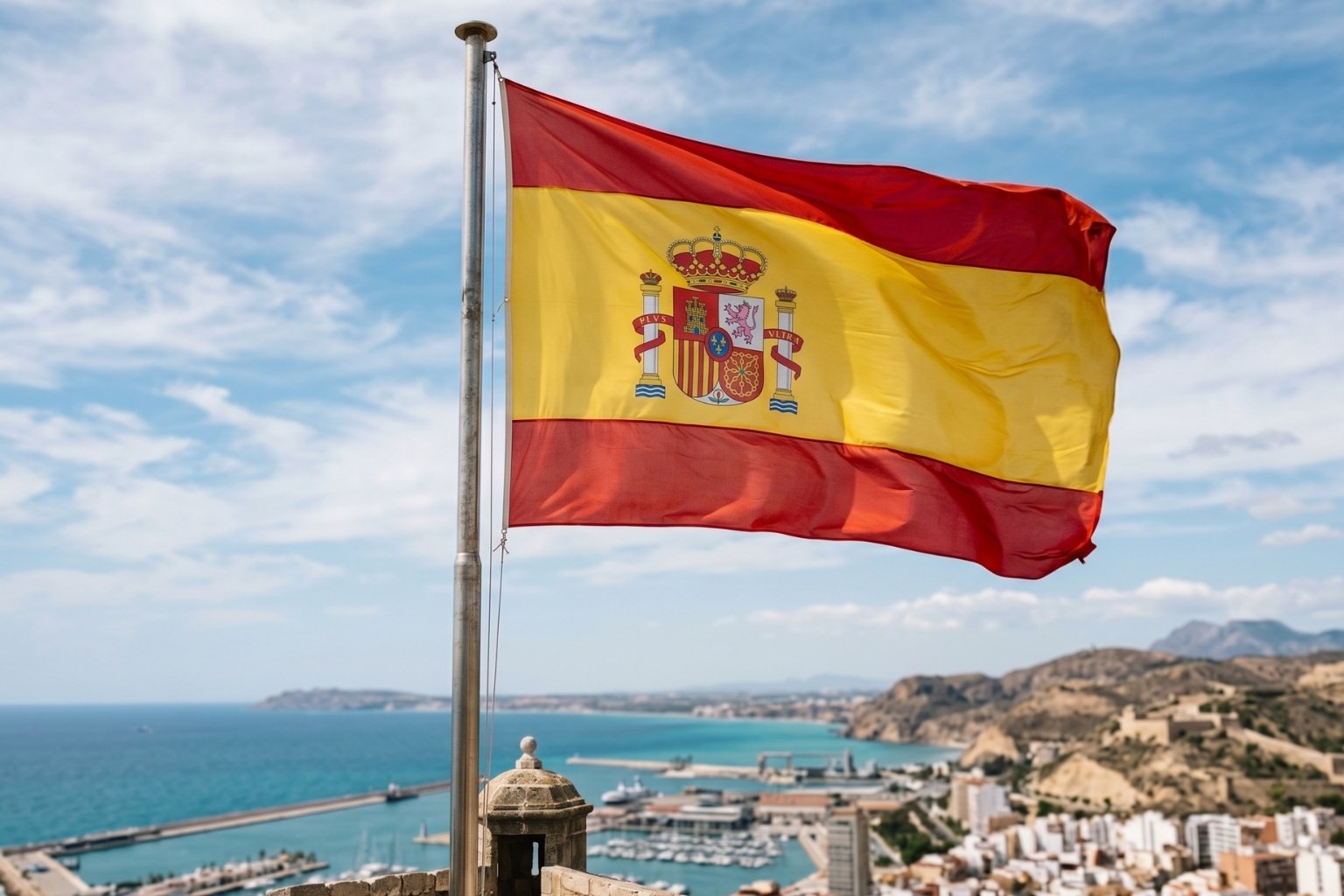

The Spanish flag is one of those objects that seems simple until you start pulling at its threads. Three horizontal bands, red above and below, a wide golden yellow in the center, and a coat of arms sitting slightly left of center: that is all there is, visually. But Spaniards call it la Rojigualda, a name that carries centuries of naval history, dynastic politics, and national reinvention. And the colors? They almost certainly do not mean what you have been told they mean.
What the Spain Flag Looks Like
The Bandera de España follows a strict 2:3 ratio. The flag is divided into three horizontal bands: two red stripes of equal width at the top and bottom, and a yellow (historically called gualda) central stripe that is exactly twice as wide as each red stripe. The proportion is 1:2:1.
The coat of arms appears on the yellow stripe, positioned toward the hoist side, roughly one quarter of the way in from the left edge. It is not centered on the flag, a deliberate choice that makes it visible when the flag hangs still.
| Element | Detail |
|---|---|
| Colors | Red (rojo) and yellow (gualda) |
| Proportions | 1:2:1 (red/yellow/red), ratio 2:3 |
| Coat of arms | Yes, on the state flag; absent on the civil flag |
| Official name | Bandera de España |
| Nickname | La Rojigualda |
There are two versions of the flag in use. The state flag bears the full coat of arms and is used by government institutions, the military, and official bodies. The civil flag omits the coat of arms entirely and is used by private citizens. Both are legally recognized.
The Real Story Behind the Red and Yellow
Here is where most accounts get things wrong. For decades, writers have explained the red as symbolizing the blood shed by Spanish soldiers in defense of the homeland, and the yellow as representing the gold of the empire, the wealth of the Americas, generosity, or prosperity. These are compelling narratives. They are also largely invented after the fact.
The honest origin of the colors is more practical and, in its own way, more interesting.
In 1785, King Charles III faced a genuine logistical problem. Spanish ships at sea were nearly impossible to distinguish from those of other European nations. Most Bourbon fleets, including Spain’s own, flew white flags bearing royal arms, and at any distance they were essentially identical. Confusion in naval engagements was a real risk.
Charles III commissioned his Minister of the Navy, Antonio Valdés y Fernández Bazán, to solve the problem. Valdés organized a design competition and selected twelve candidate sketches, all of which are preserved today in the Naval Museum of Madrid. The king reviewed them personally and chose two designs: one for the war navy, one for the merchant fleet. Both used red and yellow because these two colors together were the most visible combination at sea, sharp against grey water and pale sky.
The Pabellón de la Marina de Guerra was born on 28 May 1785. It was a naval ensign, not a national flag. For the next fifty years it flew over coastal fortresses, marine barracks, and warships, but not over the country at large.
That changed in 1843, when Queen Isabel II proclaimed the red and yellow design as the official national flag of Spain by royal decree. By then, the colors had already proven their staying power through the Peninsular War (1808 to 1814), when the rojigualda gained enormous popular recognition as Spanish forces fought Napoleon’s armies.
The red and yellow had also appeared in Spanish military culture long before 1785. King Philip II, in 1556, ordered the famous Spanish Tercios to carry flags with a yellow background and the Cross of Burgundy in red, colors that had already been present in earlier imperial banners. The 1785 decree did not invent a new palette; it formalized one that had accumulated meaning over generations of military history.
So the colors do not mean blood and gold. They mean visibility, tradition, and a king’s eye for a good design.
The Coat of Arms, Decoded
The coat of arms of Spain is a compressed history lesson. Every element points somewhere specific, and none of them are decorative.
The Five Kingdoms
The central shield is divided into quarters, each representing one of the medieval kingdoms whose union created modern Spain.
- Castile: A golden castle on a red field. The castle is a visual pun on the name: castillo means castle in Spanish.
- León: A crowned purple lion on a silver field. León derives from Legio, the Roman legion that garrisoned the region, though the lion became its heraldic symbol by the 12th century.
- Aragon: Vertical red and yellow stripes on a gold field, the same colors as the famous Senyera, still used today in the flags of Catalonia and Aragon.
- Navarre: Golden chains on a red field, a symbol said to originate from the Battle of Las Navas de Tolosa in 1212.
- Granada: A pomegranate flower at the base of the shield. The kingdom was the last to fall during the Reconquista, taken by the Catholic Monarchs in 1492. Granada literally means pomegranate in Spanish.
The Fleur-de-lis
At the very center of the shield, overlaid on the others, sits a small blue shield bearing three golden fleurs-de-lis. This is the emblem of the House of Bourbon, the French royal dynasty that has ruled Spain, with interruptions, since 1700. Its presence on the coat of arms is a reminder that modern Spain’s monarchy is, in dynastic terms, a branch of the French royal family.
The Pillars of Hercules and Plus Ultra
Flanking the shield on both sides stand two columns wrapped in red banners. These are the Pillars of Hercules, representing the two rocky promontories on either side of the Strait of Gibraltar: Gibraltar to the north, Ceuta to the south.
In classical mythology, Hercules placed these columns at what was believed to be the end of the known world, inscribed with the warning Non Plus Ultra: nothing beyond. For centuries this was accepted as literal truth. The Mediterranean ended at Gibraltar, and beyond it lay only open, unknowable ocean.
Then in 1492, Christopher Columbus crossed it.
When Spain laid claim to the Americas, the Non was quietly dropped. The motto became simply Plus Ultra: further beyond. It is the oldest recorded instance of a nation rewriting its own mythology in real time, and it still appears on the banners wrapped around the Pillars of Hercules on every Spanish flag in the world.
The current coat of arms was formally adopted on 5 October 1981.
A Flag That Has Changed With Every Regime
Few European flags have been redrawn as many times as Spain’s, and each revision tracks a political rupture.
Before the rojigualda existed, the dominant symbol of Spain was the Cross of Burgundy, a red diagonal cross on a white field. It arrived with Philip the Handsome after his marriage to Juana of Castile in 1496 and became the primary emblem of the Spanish Tercios, the most feared infantry force of the 16th century. It flew at the Battle of Pavia in 1525, it appears in Velázquez’s The Surrender of Breda, and it remained in military use long after Charles III introduced the red and yellow naval ensign.
After Isabel II proclaimed the rojigualda as the national flag in 1843, the design remained broadly stable through the 19th century and the early 20th. Then Spanish politics fractured.
The First Spanish Republic (1873 to 1874) modified the coat of arms. The Second Spanish Republic, proclaimed in 1931, made a more visible change: the bottom red stripe was replaced with a murrey stripe, a dark purple-red. The purple came from the old banner of Castile and was intended to signal a break from monarchical tradition. The republic also updated the coat of arms, adding the Pillars of Hercules and giving it more heraldic detail.
In 1936, the Civil War split Spain in two. General Francisco Franco‘s nationalist forces used a version of the flag that incorporated a black eagle, derived from the emblem of the Catholic Monarchs, along with the yoke and arrows of the Falangist movement. This version flew over Spain for nearly four decades.
When Franco died in 1975 and Spain transitioned to democracy, the flag was reconsidered again. The Constitution of 1978 re-established the red and yellow triband. The coat of arms was redesigned, removing the eagle and the Falangist symbols, and the current version was officially adopted in 1981 under King Juan Carlos I. It is the flag that flies today.
What the Flag Represents in Spain Today
The rojigualda is not a neutral object everywhere in Spain. In regions with strong independence movements, particularly Catalonia and the Basque Country, the national flag can carry complicated associations, and regional flags often take precedence in daily public life. The Catalan Senyera, with its red and yellow vertical stripes, shares the same medieval Aragonese heraldry as the coat of arms of the national flag, which makes the visual relationship between regional and national identity genuinely ambiguous and genuinely contested.
At the national level, the flag’s highest moment of visibility is October 12, Spain’s Día de la Hispanidad, National Day. The date marks Columbus’s arrival in the Americas in 1492. In Madrid’s Plaza de Colón, the king presides over a military parade, a formal flag-raising ceremony, and an air display by the Patrulla Águila, whose aircraft trace red and yellow trails across the sky. The symbolism is precise and intentional.
The flag you see above a government building in Seville, on the jersey of the Spanish national football team, or snapping in the wind at the border crossing into Gibraltar is carrying all of this at once: five medieval kingdoms, a naval decree, a dropped syllable from a Latin motto, and a democratic transition hard-won in the last quarter of the 20th century. That is what flags do. They compress history into cloth.
